Robotics Market Growth Expected Through 2030
Key Highlights
- The robotics market is projected to grow over the next 5 years as more industries and applications adopt automation.
- Cobots will see the largest growth in the years ahead as the barrier to entry improves as well as safety and ease of use for these robots.
- Growth in the robotics market will also drive growth for robotic grippers, presenting opportunities for fluid power and other technology suppliers.
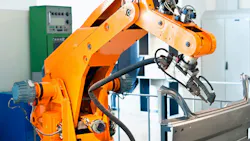
At Automate 2026, robots could be seen just about everywhere you looked. From small mobile robots used for transporting boxes and other objects to large industrial robots capable of moving a car door.
Automate 2026 took place June 22-25, and is considered North America’s largest event for robotics and automation technologies. This annual event offers the opportunity to see the latest automation systems and robot designs, as well as the componentry aiding their operation including fluid power and electromechanical products.
Prior to the event, I spoke with fluid power companies exhibiting at the show to learn what trends they’re seeing within the industrial automation space. Read the interviews below to learn where the see the market going in the years, technology development areas of focus and more.
Bosch Rexroth: Industrial Automation Requires Faster and Easier to Use Solutions
Delta Motion: Hydraulic Motion Control Still Critical to Industrial Automation
SMC Corp.: Automation Uptake Benefits from Integrated and Modular Solutions
Emerson: Automation Systems are Becoming Smarter, More Efficient, and More Adaptable
There were even a few humanoid robots walking around, though not that well from what I saw, so they’re still clearly a work in progress.
And the show floor was packed during my 2 days at the event with many people looking at all those robots, as well as the other automation solutions on display.
Since fluid power, particularly pneumatics, is used in various robotics applications along with many of the electromechanical technologies we cover here at Power & Motion, I thought it might be a good time to dive into current market conditions for the robotics industry.
Keeping tabs on how customer markets are performing, or expected to perform, can help inform where both business and technology development efforts should be focused. It also offers a snapshot of where current and potential future customer opportunities may exist.
For instance, the Association for Automation’s (A3) first quarter 2026 North American robot orders data shows there was a slight dip at the start of the year, but uptake of robots in various sectors besides automotive continues to grow — and is expected to in the years ahead to address labor challenges. This should bode well for technology suppliers to the robotics market.
Through this and other recent market data highlighted in this article, we can see where the robotics market is at today and expectations for the sector in the years ahead.
Logistics and Semiconductor Production to Aid Future Growth for Industrial Robots
Industrial robots cover a large segment of the robotics market as they are the most commonly used in various applications. Lifting heavy loads such as vehicle parts in an automotive factory is probably one of the most commonly thought of examples of an industrial robot. But their use in other sectors is increasing, driving demand for these robots in the years ahead.
The International Federation of Robotics (IFR) defines industrial robots as a multipurpose manipulator which can be automatically controlled and reprogrammed. It is programmable in three or more axes, and can be fixed in place or affixed to a mobile platform.
A3 describes industrial robots as the heavy hitters of the automation world because they can handle high-efficiency tasks repeatedly and with a high level of precision.
Interact Analysis is projecting the industrial robot market will see steady growth at an annual rate of 6.7% through 2030. Improving market sentiment, reshoring efforts in the U.S. as well as strong demand from the semiconductor and electronics sectors will be among the primary growth drivers.
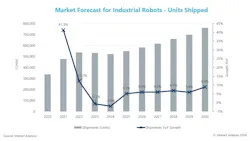
The market intelligence firm is predicting that material handling and assembly will be the applications in which industrial robots will be used most in the years ahead to aid with increasing demand for efficient logistics and precise assembly of manufactured goods.
Interact Analysis’ expected robot shipment average annual growth rates by global market from 2025-2030 are:
- Asia-Pacific (APAC) – 7.1%
- North and South America – 6.2%
- EMEA (Europe, the Middle East and Africa) – 4.7%.
Logistics, new energy and semiconductors are the sectors that will drive global shipment growth.
Although the automotive sector has been a strong driver for the robotics industry over the years, Interact Analysis and A3 both note reduced demand from this sector in North America and EMEA due to the weaker market conditions it has experienced in recent years.
Despite this, Interact Analysis is anticipating automotive to remain the largest sector for global shipments of industrial robots through 2030.
Interact Analysis also anticipates rising use of artificial intelligence (AI) to aid industrial robot growth. Integration of AI into robotics systems will continue to improve their capabilities and use cases. In addition, they are playing an important part in the production of the semiconductors and data center equipment necessary for AI’s operation.
Cobots Will be Fastest Growing Segment for Global Robotics Market
Both A3 and Interact Analysis note cobots as the strongest segment of the robotics market. Collaborative robots (cobots) are a type of industrial robot but are designed to work alongside human labor. The larger articulated versions many see in manufacturing facilities are usually behind cages or other safety structures.
Cobots can be placed along a production or assembly line to help with packaging, material handling, quality inspection, sorting and other tasks, making them a versatile and relatively easy-to-adopt option for many operations.
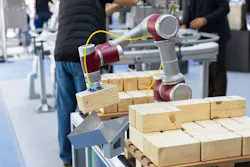
In its first-quarter 2026 robot order report, A3 noted that collaborative robots were the strongest performing category. This was the case for much of 2025 as well, with the association reporting that full-year cobot orders accounted for 19.6% of total robot orders during the year.
While Interact Analysis foresees articulated robots remaining the largest robotics segment through 2030, cobots will experience the fastest growth.
The firm reports that in 2025 cobot shipments were 14.5% above those from the previous year. And it is projecting further growth in the years ahead.
An annual shipment growth rate of 17.3% is expected for these smaller robots, while articulated robots will be 5%. Falling barriers to entry, improved safety, ease of use and cost reductions all contributed to increased cobot shipments in 2025, factors that are likely to aid future growth for this segment as well.
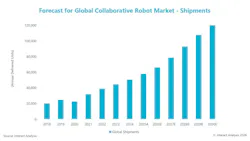
China is predicted to be the dominant market for cobot shipments through 2030, followed by the Americas and EMEA.
According to Interact Analysis, the industry is also starting to shift toward the creation and use of medium and heavy payload cobots. Cobots are typically used for lighter payloads of 10 kg (22 lbs.) or less, but newer models are reading payloads of 16-20 kg (35-44 lbs.) and higher, increasing their use cases and thus market growth potential.
Robotic Grippers Market to Rise in Tandem with Continued Robot Uptake
An important component of many cobots and other industrial robots is the gripper which is used to pick up and move objects. This is where pneumatics is often used within the robotics industry, as well as electric technologies and even hydraulics.
With uptake of robots continuing to rise, so too will the need for robotic grippers. As such, research firm Valuates Reports is projecting the global robot grippers market will achieve a compound annual growth rate (CAGR) of 18.4% through 2031.
Pneumatic grippers are expected to account for the largest segment of the market at 60%, including vacuum grippers.
While use of electric technologies is increasing, many of the pneumatics companies I spoke with at Automate said they are still seeing opportunities for this fluid power technology in the robotics sector. Increasing integration of electronics to create so-called smart gripping technologies is helping to improve the capabilities of pneumatic grippers which will aid their continued use in the market.
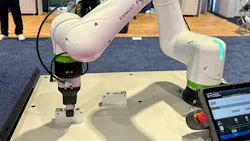
Per Valuates Reports, the need for flexible handling systems in various automated operations — such as production, warehousing, packaging, inspection, assembly and material transfer — is a key driver for the expected growth of the grippers market.
Read more of our robotics-related coverage.
Robots and Cobots Present Opportunity for Pneumatics
Soft Electrohydraulics Improve Actuation Technology for Robotics
Motion Control Components Benefit Robot Performance
Electric Actuators Improve Robotic Assembly of MRI Machines
Robotic Sealing: Understanding its Importance and the Selection Process
Next-Generation Robots will Rely on Integrating AI and Motion Control
Wider deployment of collaborative robots is also aiding market growth according to the research firm.
Demand for robotic grippers is coming from a number of sectors, including:
- automotive
- semiconductor and electronics
- food and beverage
- pharmaceuticals
- industrial machinery
- logistics.
These are all sectors employing more automation to help overcome labor challenges while also improving productivity. A high level of cleanliness and quality is required in several of these industries as well, making them well suited for use of automation. Human labor has to potential to introduce contaminants into the operation, which automation can help minimize — leaving humans available for other work for which their skills may be better suited.
Similar to industrial robots and cobots, APAC is forecast to be the largest global market for robotic grippers due to its strong manufacturing base for a wide range of industries. It will account for 43% of global demand through 2031, followed by Europe at 28% and North America at 26%.
However, Valuates Reports notes the North American market is experiencing robust growth. It states that expanding warehouse automation, investments in advanced manufacturing, growth in food and pharmaceutical production, and ongoing reshoring efforts are driving demand for robotic handling technologies, and thus aiding growth within the region for the grippers market.
Overall, the robotics market appears to be on a positive trajectory in the years ahead. It will be driven in large part by the need to address labor challenges through automation as many industries face a lack of skilled labor entering them — a factor that is not likely to change any time soon.
As such, there will be opportunities over the next several years as well for those working in the robotics market.
What About Humanoid Robots?
One segment of the robotics market that may only be tangentially applicable to Power & Motion’s audience, but still worth monitoring, is humanoid robots.
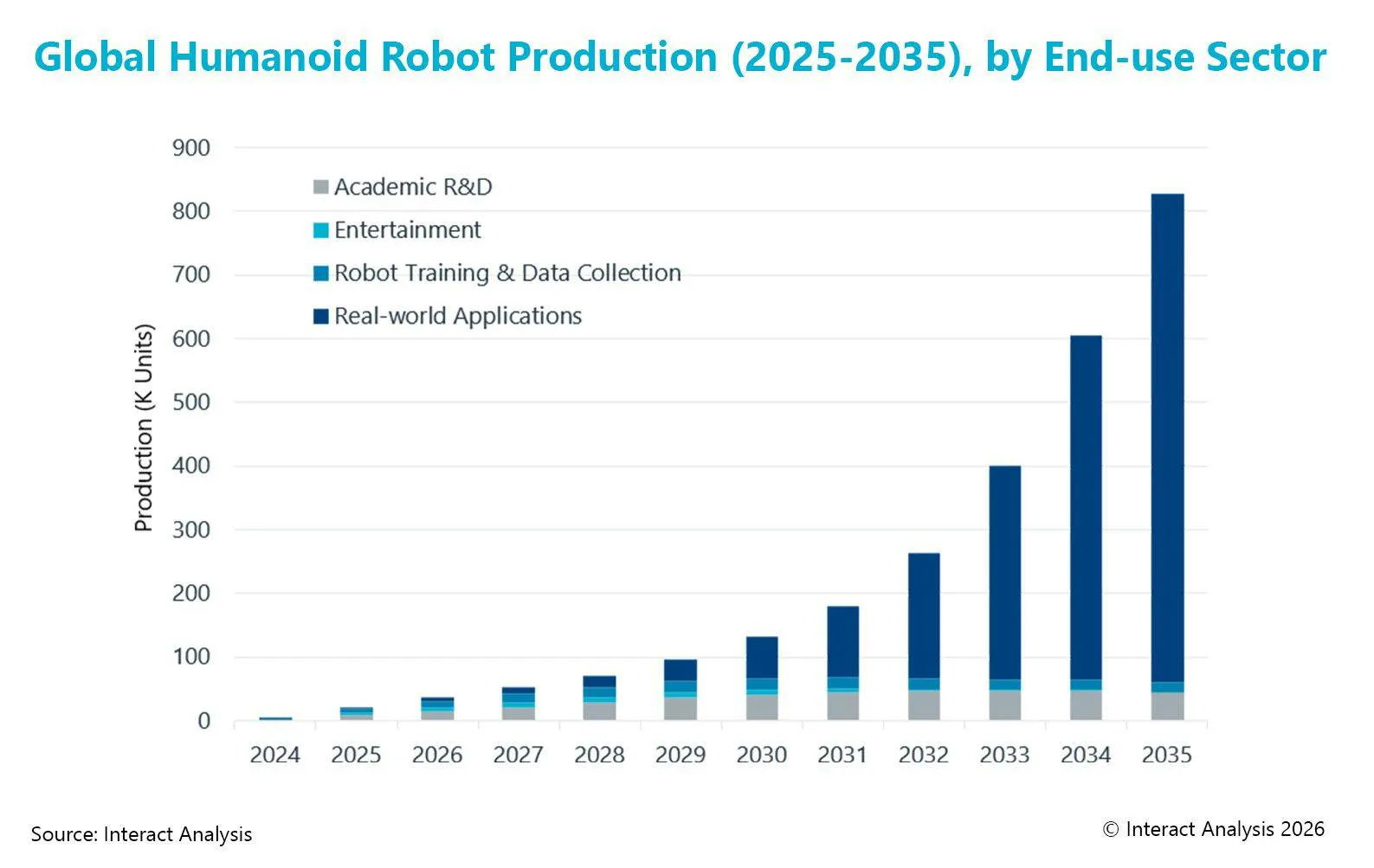
Interact Analysis reports that humanoid robot production grew significantly in 2025. However, real-world applications remain limited. Future growth for these robots is expected to be slow as there are still many technical challenges to be addressed.
Needless to say, the opportunities in this market remain to be seen.
Richard Vaughn, Head of Product Management – Linear Technologies at Bosch Rexroth noted during my pre-Automate interview with him that linear actuation is used in humanoid robots, and so he was looking forward to seeing what progress has been made in this sector during the event’s Humanoid Robot Forum, a new addition for 2026.
Given their design and performance requirements, humanoid robots will require actuation technologies that are compact and lightweight. Though traditional hydraulics and pneumatics are not going to be a good fit in this application, it could present opportunities for new technology developments and other types of linear actuation technologies to be used.
About the Author
 Sara Jensen
Sara Jensen
Executive Editor, Power & Motion
Sara Jensen is executive editor of Power & Motion, directing expanded coverage into the modern fluid power space, as well as mechatronic and smart technologies. She has over 15 years of publishing experience. Prior to Power & Motion she spent 11 years with a trade publication for engineers of heavy-duty equipment, the last 3 of which were as the editor and brand lead. Over the course of her time in the B2B industry, Sara has gained an extensive knowledge of various heavy-duty equipment industries — including construction, agriculture, mining and on-road trucks —along with the systems and market trends which impact them such as fluid power and electronic motion control technologies.
You can follow Sara and Power & Motion via the following social media handles:
X (formerly Twitter): @TechnlgyEditor and @PowerMotionTech
LinkedIn: @SaraJensen and @Power&Motion
Facebook: @PowerMotionTech