Automation Uptake Benefits from Integrated and Modular Solutions
Key Highlights
- SMC’s Jesse DeSanto offers his insights on the trends shaping the industrial automation space, including the need for easier to use and deploy solutions.
- He also touches on how pneumatics continue to be used in automation applications, and the importance of choosing the right technology option for a given application.
- AI-driven vision systems, humanoid robots and the continued expansion of automation are themes he looks forward to seeing at Automate 2026.
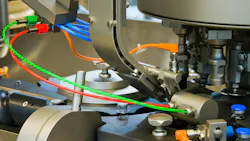
Investments in automation continue to gain momentum as various industries aim to improve efficiency and productivity. As use of these systems grows, so too does the need to ease their uptake.
As Jesse DeSanto, National Product Manager, End Effectors & Low Vacuum at SMC Corp. of America explains in this Q&A with Power & Motion, today’s industrial automation customers are increasingly looking for solutions which are intelligent, integrated, and modular as well as easy to configure and deploy.
He explained that while engineers are capable of creating complex automation systems, they are short on time, which is necessitating these features as they can help make it faster and easier to implement a system. And the faster an automation system can be built, the sooner an operation can reap its benefits.
Our discussion with DeSanto also touches on the continued importance of pneumatics in many industrial automation applications, industries in which he is seeing automation growth as well what themes he expects to see at Automate 2026.
*Editor’s note: Questions and responses have been edited for clarity.
Power & Motion: What is the current state of the industrial automation market? Are companies still investing in automation technologies?
Jesse DeSanto: The industrial automation market remains strong, with companies continuing to increase investments in technologies that improve efficiency, productivity, and operational reliability. The primary goal is to control or reduce operating costs while maintaining profitability and competitiveness.
This trend is expected to continue — and likely accelerate — as manufacturers and end users look for new ways to optimize operations, address labor challenges, and improve overall process performance.
Power & Motion: Are there specific industries or applications where increased interest in automation solutions is currently being seen? If so, which industries or applications are investing the most, and why?
Jesse DeSanto: Warehouse automation, construction, and food service/restaurant automation are all seeing significant growth in automation adoption. One of the primary drivers is ongoing labor shortages, particularly for physically demanding or repetitive tasks that are difficult to staff consistently.
These industries are investing in automation to improve productivity, reduce manual labor requirements, increase consistency, and maintain operational efficiency in challenging labor environments.
Power & Motion: Are pneumatics still widely used in industrial automation systems, or are electric actuation technologies becoming more dominant? Or are both technologies used fairly equally?
Jesse DeSanto: Pneumatic systems remain widely used across industrial automation, although electric automation technologies continue to gain market share. Ultimately, the best solution depends on the application requirements.
For customers seeking a simple, rugged, and cost-effective solution, pneumatics are often an excellent choice. While pneumatic systems require compressed air and higher energy consumption can be a concern, several design strategies are available to improve efficiency.
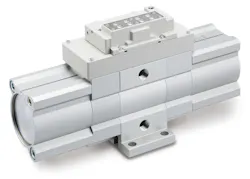
Examples include designing systems to operate at lower pressures, such as 4 bar (58 psi), and incorporating air boosters such as SMC’s VBAE Series, Booster Regulator or storage tanks to reduce unnecessary air consumption and optimize overall system performance.
For applications requiring higher precision, variable force and speed control, programmable motion profiles, or greater flexibility, electric systems are often preferred. Electric actuators eliminate the need for air compressors and much of the associated pneumatic maintenance; however, troubleshooting and repairs can become more complex if a system experiences downtime.
Power & Motion: What features or capabilities are customers currently looking for in automation solutions?
Jesse DeSanto: Customers are increasingly looking for intelligent, integrated, and modular solutions that are easy to configure and deploy. Engineers are highly capable of building complex systems, but one of the biggest constraints they face is time. Solutions that are user-friendly, configurable, and readily available help simplify integration and accelerate implementation.
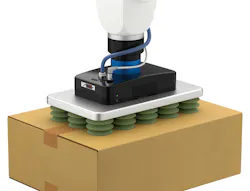
One example is the ZGS/ZGP vacuum gripper system. It is an integrated vacuum solution designed for flexibility across a wide range of applications. The system can be configured with either foam pads or suction cups and is available in multiple sizes, including:
- 400 x 240 mm,
- 300 m x 180 mm, and
- 200 x 120 mm.
The platform supports both industrial and collaborative robot applications and offers multiple control options, including IO-Link communication. Flow characteristics can also be adjusted using a venturi cartridge system, and the largest array configuration includes the option to integrate with a vacuum pump when additional performance is required.
Its modular and configurable architecture makes it a strong solution for customers looking to simplify vacuum system integration while maintaining flexibility across different applications.
Power & Motion: What challenges still exist when developing automation solutions or increasing adoption of automation technologies? What can help overcome those challenges?
Jesse DeSanto: One of the biggest challenges is developing a deep understanding of customer needs within each market segment. Industries such as automotive, electronics, food and packaging, and others all have unique operational requirements and challenges.
Automation systems are ultimately built from individual component technologies — pneumatic, electric, sensing, vacuum, and control solutions — so understanding how each application operates is critical to delivering meaningful value.
Overcoming these challenges requires maintaining close relationships with end users, asking relevant technical and operational questions, and carefully listening to customer needs and pain points.
Power & Motion: What trends or technologies are most anticipated at Automate 2026? Are there any emerging trends expected to be showcased?
Jesse DeSanto: Humanoid robotics and the continued integration of artificial intelligence (AI)-driven vision systems within automation platforms are expected to be major areas of interest. These technologies have the potential to significantly improve productivity, flexibility, and decision-making within automated environments.
One of the biggest challenges moving forward will likely be data management and how companies effectively process, organize, and utilize the large volumes of information generated by these intelligent systems.
Power & Motion: What are expected to be some of the biggest themes or key takeaways from this year’s show?
Jesse DeSanto: One of the biggest themes will likely be the continued expansion of what is considered automatable. Automation technologies are advancing rapidly across nearly every industry and application space.
Events like Automate showcase how broad and capable the automation industry has become, demonstrating that virtually any process or task may eventually be automated when the right technologies and integration strategies are applied.
About the Author
 Sara Jensen
Sara Jensen
Executive Editor, Power & Motion
Sara Jensen is executive editor of Power & Motion, directing expanded coverage into the modern fluid power space, as well as mechatronic and smart technologies. She has over 15 years of publishing experience. Prior to Power & Motion she spent 11 years with a trade publication for engineers of heavy-duty equipment, the last 3 of which were as the editor and brand lead. Over the course of her time in the B2B industry, Sara has gained an extensive knowledge of various heavy-duty equipment industries — including construction, agriculture, mining and on-road trucks —along with the systems and market trends which impact them such as fluid power and electronic motion control technologies.
You can follow Sara and Power & Motion via the following social media handles:
X (formerly Twitter): @TechnlgyEditor and @PowerMotionTech
LinkedIn: @SaraJensen and @Power&Motion
Facebook: @PowerMotionTech