Robot Orders Grow 6.6% in 2025
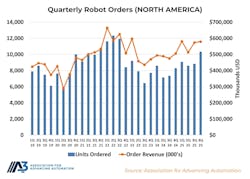
The latest data from the Association for Advancing Automation (A3) shows North American robot orders increased 6.6% in 2025. This growth was driven by several market areas which are increasing their adoption of automation solutions.
A total of 36,766 robots were ordered in 2025, up from the 31,311 robots ordered in 2024. Robot orders in the fourth quarter (Q4) of 2025 were also above those from the same period in 2024 -10,325 robots ordered in Q4 2025 compared to the 8,277 ordered in Q4 2024.
According to A3, the rise in robot orders in Q4 2025 marked the sixth consecutive quarter of year-over-year growth and lifted annual totals to their highest level since 2022, demonstrating the continued investment companies are making in robotics as part of their automation efforts.
Collaborative Robot Orders Rose in 2025
Orders for collaborative robots, commonly referred to as cobots, also increased in 2025. Full-year orders totaled 7,212 units while Q4 2025 orders came in at 2,953 units which A3 said is the highest quarterly volume recorded since it began reporting collaborative robots as a distinct category in Q1 2025.
Get More Market Data
Visit our Market Trends page for more content related to economic and technological trends influencing the fluid power and motion control industries. You can also sign up for our biweekly Market Trends in Power & Motion newsletter to have this information delivered directly to your inbox.
Per A3’s data, cobots accounted for a large share of both Q4 and full-year orders - 28.6% of all robots ordered in Q4 2025 and 19.6% of total robots ordered in 2025 - which the association said underscores the growing importance of collaborative systems as part of modern automation strategies.
A3 began reporting cobots as a distinct category within its quarterly North American robot orders reports because it is one of the fastest growing segments of the robotics industry.
Cobots are designed to work within a shared space with humans while traditional robots are typically isolated from human workers. The lower cost, smaller footprint and ease of programming associated with cobots have helped increase their uptake in a wide range of industries. These factors are expected to contribute to their continued growth as manufacturers and other businesses look to implement more automation.

Robot Use Increasing in Range of Markets
A3’s Q4 2025 robot orders report also indicates that orders from non-automotive customers outpaced those from the automotive industry. The association said general industries captured the majority share of units ordered throughout 2025.
Use of robots in automotive manufacturing has been a common practice for many years, but A3’s data shows other sectors are now realizing the benefits of robotics as well.
Food and consumer goods, semiconductors and electronics, and life sciences are among the non-automotive industries which contributed to the growth of robot orders in 2025. These are all growing sectors, and like many others are automating more processes to help overcome labor challenges as well as increase the accuracy and productivity of their operations.
A3 noted in its report that activity from automotive OEMs showed meaningful improvement in the second half of 2025 which could be a signal of stabilization in core automotive markets heading into 2026.
“Automotive OEMs came back strong in the second half of the year, which often serves as a leading indicator for growth in supplier and component markets,” said Alex Shikany, Executive Vice President at A3. “Combined with steady demand across food, electronics, and other non-automotive industries, this points to a positive outlook for 2026.”
The association anticipates continued momentum for robot orders in 2026 as investments in automation solutions increase further.
“The rebound in robot orders over the course of 2025 reflects renewed confidence in automation as a long-term solution to competitive pressures,” said Shikany. “We’re seeing increasing adoption across sectors, especially in general industry applications and at automotive OEMs, as manufacturers look to automation to address workforce shortages, manage reshoring initiatives, and boost productivity.”
Robotics an Important Customer Market
Hydraulic, pneumatic and electromechanical technologies are commonly used to aid the functionality of robots of various types, making the robotics market an important customer sector for the fluid power and motion control industries. And as adoption of automation continues to rise, so too will use of robots and its market potential for those serving this sector.
Read more about the use of fluid power and motion control technologies in robotics.
Robots and Cobots Present Opportunity for Pneumatics
Electric Actuators Improve Robotic Assembly of MRI Machines
Soft Electrohydraulics Improve Actuation Technology for Robotics
About the Author
 Sara Jensen
Sara Jensen
Executive Editor, Power & Motion
Sara Jensen is executive editor of Power & Motion, directing expanded coverage into the modern fluid power space, as well as mechatronic and smart technologies. She has over 15 years of publishing experience. Prior to Power & Motion she spent 11 years with a trade publication for engineers of heavy-duty equipment, the last 3 of which were as the editor and brand lead. Over the course of her time in the B2B industry, Sara has gained an extensive knowledge of various heavy-duty equipment industries — including construction, agriculture, mining and on-road trucks —along with the systems and market trends which impact them such as fluid power and electronic motion control technologies.
You can follow Sara and Power & Motion via the following social media handles:
X (formerly Twitter): @TechnlgyEditor and @PowerMotionTech
LinkedIn: @SaraJensen and @Power&Motion
Facebook: @PowerMotionTech