First Quarter 2026 Robot Orders Flat, but Uptake Continues to Grow
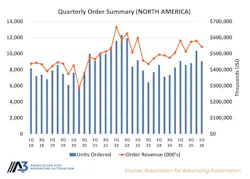
Robot orders in the first quarter of 2026 were essentially flat according to the latest data from the Association for Advancing Automation (A3). The association’s data shows robot orders in North America reached 9,055 units, a 0.1% decline from the same period in 2025.
This is also a slight decline from robot orders posted in the fourth quarter of 2025 which came in at 10,325 units.
Order revenue, however, declined on a year-over-year basis which A3 attributes to cyclical decline in robot orders from automotive OEMs. Unit orders for this segment were down 35.1% and 48.2% in revenue during the first quarter (Q1).
Despite declines from the automotive industry, robot orders from other sectors grew in Q1, demonstrating the continued uptake of robotics, and automation in general, in various sectors.
Why Follow the Robotics Market?
Robots of various types commonly use hydraulic, pneumatic and electromechanical motion control technologies. Pneumatics, for instance, are often used for the grippers and other end-of-arm tools on a robot due to the speed and force this fluid power technology can provide.
As adoption of robots continues to grow, so too will the market opportunities within this sector, making it an important one to continue monitoring. Visit our Market Trends page for more content examining technological and economic trends of importance to the fluid power industry.
A3 reports that the following non-automotive industries posted strong year-over-year gains in robot orders:
- Life Sciences/Pharma/Biomed: +54.1% units, +70.2% revenue
- Semi & Electronics/Photonics: +31.7% units, +79.2% revenue
- Plastics & Rubber: +25.2% units, +32.6% revenue
- Food & Consumer Goods: +16.0% units, +16.3% revenue
- All Other Industries: +24.5% units, +29.2% revenue.
Collaborative Robots Remain Strong Market Segment
According to A3’s Q1 robot order data, collaborative robots remained one of the strongest-performing categories during the quarter. A total of 1,637 collaborative robots, also referred to as cobots, were ordered in Q1 2026 which the association said is a 55.6% increase in units compared to Q1 2025.
Collaborative robots accounted for 18.1% of all robot units ordered and 12.9% of total order revenue during the quarter, further demonstrating the importance of this segment to the overall robotics market.
First quarter data shows the life sciences/pharma/biomed sector accounted for the strongest level of demand, representing 60.7% of total collaborative robot orders during the quarter. A rising global population and longer lifespans is driving the need for more products from this sector which is in turn prompting it to adopt more automation solutions.
Strong demand was also seen from the semiconductors/electronics/photonics industry segment in Q1; it accounted for 45.9% of collaborative robot orders during the quarter. This segment requires a high level of precision and cleanliness which cobots and other robotics technologies are able to provide.
“Collaborative robots are one example of how the robotics market continues to evolve,” said Alex Shikany, Executive Vice President at A3, in the association’s press release announcing its Q1 2026 robot order data.
“The broader takeaway from the first quarter is that automation demand is becoming more diverse in terms of industries, applications and deployment models. That is an important signal for the long-term health of the market, especially as companies continue to invest in productivity, flexibility, quality and competitiveness.”
About the Author
 Sara Jensen
Sara Jensen
Executive Editor, Power & Motion
Sara Jensen is executive editor of Power & Motion, directing expanded coverage into the modern fluid power space, as well as mechatronic and smart technologies. She has over 15 years of publishing experience. Prior to Power & Motion she spent 11 years with a trade publication for engineers of heavy-duty equipment, the last 3 of which were as the editor and brand lead. Over the course of her time in the B2B industry, Sara has gained an extensive knowledge of various heavy-duty equipment industries — including construction, agriculture, mining and on-road trucks —along with the systems and market trends which impact them such as fluid power and electronic motion control technologies.
You can follow Sara and Power & Motion via the following social media handles:
X (formerly Twitter): @TechnlgyEditor and @PowerMotionTech
LinkedIn: @SaraJensen and @Power&Motion
Facebook: @PowerMotionTech