Fluid Power Industry Pulse: Second Quarter 2026 Presents Challenges and Opportunities
We are now halfway through 2026. So how is the fluid power industry faring? Thus far, it seems like ‘okay’ would be the best way to describe market conditions for the hydraulics and pneumatics sector.
As of yet there have been no major upswings or downswings in business activity.
Lauren Saidel-Baker, ITR Economist & Senior Consulting Speaker, probably put it best during the National Fluid Power Association’s (NFPA) spring economic webinar when she said that overall, the business cycle is improving but at a very sluggish pace.
She said that a snap back to great growth is not expected but instead a gradual momentum build is the most likely scenario as the year progresses and even as we head into 2027.
Recent NFPA fluid power shipment and order data is also in line with Saidel-Baker’s assessment. May data showed slight shipment declines again, but were slightly improved compared to April and order activity is positive — all of which are indicating relatively stable conditions for the hydraulics and pneumatics industry.
In general, most Power & Motion readers also feel market conditions for the industry are positive, with 66% indicating as such in a survey we ran from April-June 2026.
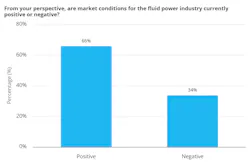
However, this is down slightly from a survey we conducted at the beginning of the year when we asked readers about their expectations for 2026. Eighty percent (80%) of respondents to that survey were expecting market conditions to be more positive for the fluid power industry in 2026.
Not surprisingly, as the year has progressed market conditions have altered slightly. Saidel-Baker noted aspects such as tariffs still being a factor for many as well as continued uncertainty about interest rates. As of June 17, the U.S. Federal Reserve is holding interest rates steady at 3.50-3.75%.
And of course, there was the war with Iran which continues to impact supply chains and in particular the transport of oil due to the closure of the Strait of Hormuz during the war.
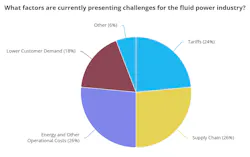
These impacts were evident when we asked readers in our survey what factors were currently presenting challenges for the industry with most indicating supply chain and energy and other operational costs as the factors challenging the market.
Negotiations are still under way to end the war and at the moment the Strait of Hormuz is open, but supply chain challenges are expect to linger for some time yet because it was closed for so long.
Defense, Construction Equipment and Automation Among Top Opportunity Areas for Fluid Power Industry
Although there remain some uncertainties in the marketplace, opportunities exist as well for the fluid power sector.
Saidel-Baker noted during her presentation that business to business spending is picking up and many sectors, such as construction machinery, are moving into a growth trend which should bode well for the fluid power industry.
When asked what market segments Power & Motion readers see the most opportunities in this year, those that topped the list for respondents were defense, construction equipment and manufacturing equipment.
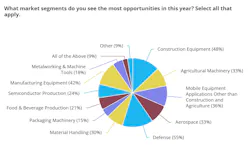
These results were similar to those from our survey at the beginning of the year; at that time, respondents indicated construction equipment as well as other mobile equipment applications, defense and food & beverage production were market segments in which they saw the most opportunities.
Many of these markets were also noted as opportunity areas during the NFPA’s 2025 Industry & Economic Outlook Conference (IEOC).
Defense, for instance, is expected to be a growth market as countries around the world upgrade their military vehicles and equipment. Reshoring and the buildup of data centers are also contributing to growth opportunities for these market segments as well as the fluid power companies which serve them.
Other sectors Saidel-Baker noted as opportunity areas included semiconductors which she said is “off to the races” and providing a huge domestic manufacturing opportunity that will not be going away anytime soon. Semiconductors can be found just about everywhere these days, including data centers, prompting strong production demand for them.
When it comes to technology trends and key development areas of focus, automation topped the list for readers in both of our surveys.
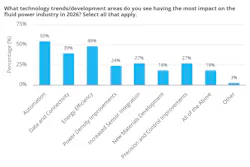
This is not surprising given automation continues to grow in both mobile and industrial applications as a means of helping overcome labor challenges and improve productivity, prompting various technological developments from the fluid power industry.
If the crowded show floor at Automate 2026 — a large robotics and industrial automation event — was any indication, interest in automation solutions is not waning. Both days I attended the show the exhibit floor was packed with people.
And the fluid power companies exhibiting at the Automate I spoke to prior to the show noted the continued interest they are seeing from customers in automation technologies. While some noted a slowdown in recent years because of tariffs, geopolitical tensions and other factors impacting the economy, in general they view it as a long-term growth area.
As Jesse DeSanto, National Product Manager, End Effectors & Low Vacuum at SMC Corp. of America, stated, the automation market remains strong as companies continue investing in technologies to “improve efficiency, productivity, and operational reliability. competitiveness.
“This trend is expected to continue — and likely accelerate — as manufacturers and end users look for new ways to optimize operations, address labor challenges, and improve overall process performance,” he said.
Read my full interview with SMC’s DeSanto as well as my other pre-Automate interviews with Bosch Rexroth, Emerson and Delta Motion for their insights on the industrial automation market.
SMC – Automation Uptake Benefits from Integrated and Modular Solutions
Bosch Rexroth - Automation Remains an Investment Priority for Industrial Applications
Emerson - Automation Systems are Becoming Smarter, More Efficient, and More Adaptable
Delta Motion - Hydraulic Motion Control Still Critical to Industrial Automation
From our second quarter survey and industry discussions, it appears that in general the fluid power industry is doing okay so far in 2026, and despite the challenges that remain, there also continue to be a number of opportunities.
What are your thoughts? How has 2026 been so far for your company? What challenges and opportunities are you seeing? How do you expect the rest of the year to go? Take our next survey or send an email to [email protected] to offer your thoughts.
About the Author
 Sara Jensen
Sara Jensen
Executive Editor, Power & Motion
Sara Jensen is executive editor of Power & Motion, directing expanded coverage into the modern fluid power space, as well as mechatronic and smart technologies. She has over 15 years of publishing experience. Prior to Power & Motion she spent 11 years with a trade publication for engineers of heavy-duty equipment, the last 3 of which were as the editor and brand lead. Over the course of her time in the B2B industry, Sara has gained an extensive knowledge of various heavy-duty equipment industries — including construction, agriculture, mining and on-road trucks —along with the systems and market trends which impact them such as fluid power and electronic motion control technologies.
You can follow Sara and Power & Motion via the following social media handles:
X (formerly Twitter): @TechnlgyEditor and @PowerMotionTech
LinkedIn: @SaraJensen and @Power&Motion
Facebook: @PowerMotionTech