Fluid Power Industry Pulse: Do First Quarter 2026 Predictions Still Hold True?

Understanding current and future market conditions as well as predicted areas of opportunity can benefit not only business planning but also design initiatives.
So, at the beginning of the year we polled Power & Motion’s audience to gain insight into expectations for the hydraulics and pneumatics industry in 2026. By sharing the results of that survey here, we hope to provide a snapshot of how the sector was feeling coming into the year and set the stage for what may yet lie ahead.
Of those who responded to our survey, the majority indicated they expected market conditions to be more positive in 2026.
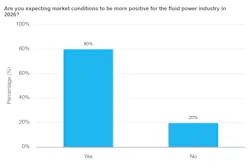
Although there remained a lot of uncertainty coming into the year, there were indicators signaling potential upward momentum for the industry such as additional interest rate cuts, recovery in some customer markets and stabilizing fluid power shipments and orders.
Three interest rate cuts were made in late 2025, providing some monetary relief for those interested in making large purchases. As of the U.S. Federal Reserve’s March meeting, it is keeping rates in the 3.50-3.75% range. Inflation, weak labor demand and the economic uncertainty brought on by the war with Iran all contributed to the Fed’s decision reports IndustryWeek, another publication part of Power & Motion’s parent company EndeavorB2B.
The Fed indicated at its March meeting that additional rate cuts are possible yet this year, but it will have to wait and see how economic conditions continue to pan out.
In terms of the market segments our audience expected to see opportunities in 2026, defense, construction equipment and other mobile equipment applications were top choices followed by aerospace, material handling and food and beverage production.
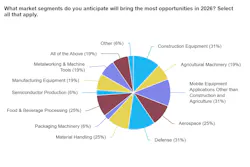
These align with many of the opportunity markets noted by presenters at the National Fluid Power Association’s (NFPA) 2025 Industry & Economic Outlook Conference (IEOC). Defense spending, for instance, is expected to increase globally. NATO (North Atlantic Treaty Organization) and several European countries have announced planned increases in defense spending noted Nico Palesch from Oxford Economics during his IEOC presentation. And the Trump Administration is proposing increased defense spending in its 2027 budget.
The construction equipment market has the potential to benefit from the buildup of data centers currently taking place in the U.S. Large machinery in particular, such as excavators, will be needed to help build these facilities as well as their supporting infrastructure which could aid machine demand.
Speaking of data centers, we also asked readers if they see data centers as an opportunity area; respondents were evenly split on this.
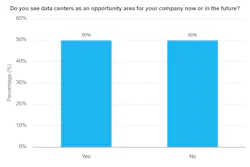
Fluid power technologies are not only used in the machinery building data centers but also in the facilities themselves. For instance, hoses and fittings are some of the components utilized in the cooling systems critical to the operation of data centers.
And Frank Langro, Director – Product Market Management, Pneumatic Automation, North America, at Festo Corp., noted in an interview with Power & Motion that Festo is seeing a need for automation for the ancillary systems surrounding data centers.
More opportunities are likely to be found as data center buildup continues to grow.
Adoption of automation systems continues to grow in a range of industries – from construction equipment to packaging machinery. As such, it is becoming a dominant area of development for the hydraulics and pneumatics industry.
Sixty-three percent of respondents to our survey indicated it will be the most impactful technology trend and development area in 2026.
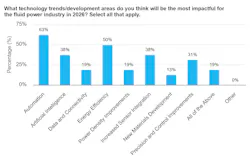
With many industries facing a shortage of skilled labor, adoption of various automation technologies is increasing, prompting developments from the fluid power industry as hydraulics and pneumatics will remain a key component of automated systems and machines.
This is the start of what I hope will become a quarterly check-in with the fluid power industry to get a sense of market conditions and how the sector is faring. Have thoughts on other questions to ask, or want to provide insights directly? Email me at [email protected].
Now that we are through the first 3 months of the year and starting the second quarter, do these market conditions and opportunity areas still ring true? Or have things changed? Are there new market opportunities and development areas of focus for the fluid power industry in 2026?
Take our brief survey below to let us know where things stand for the hydraulics and pneumatics industry, and we’ll share the results in the future so we can all stay more attuned to what is happening in this critical sector.
About the Author
 Sara Jensen
Sara Jensen
Executive Editor, Power & Motion
Sara Jensen is executive editor of Power & Motion, directing expanded coverage into the modern fluid power space, as well as mechatronic and smart technologies. She has over 15 years of publishing experience. Prior to Power & Motion she spent 11 years with a trade publication for engineers of heavy-duty equipment, the last 3 of which were as the editor and brand lead. Over the course of her time in the B2B industry, Sara has gained an extensive knowledge of various heavy-duty equipment industries — including construction, agriculture, mining and on-road trucks —along with the systems and market trends which impact them such as fluid power and electronic motion control technologies.
You can follow Sara and Power & Motion via the following social media handles:
X (formerly Twitter): @TechnlgyEditor and @PowerMotionTech
LinkedIn: @SaraJensen and @Power&Motion
Facebook: @PowerMotionTech