How Global Manufacturing will be Impacted by the U.S.-Iran Conflict

Over the last decade, manufacturers around the world — including those in the fluid power industry — have dealt with challenges presented by the Great Recession, COVID-19 and various geopolitical tensions. The current conflict between the U.S. and Iran is the latest event expected to impact the global manufacturing industry.
New industry analysis from Jack Loughney, Senior Data Analyst at Interact Analysis, indicates the conflict and its aftermath is likely to cause delayed shipping, energy fragility and supply chain disruptions for manufacturers of all types.
As of March 16, the Strait of Hormuz, through which more than 20% of the world’s oil supply passes through, remains closed because of the conflict. This has caused shipping disruptions for natural gas, oil, and other goods, leading to increased freight and fuel costs.
Some countries’ maritime officials are cautioning against operating in the region as well due to safety and other concerns brought about by the conflict, bringing about additional shipping and logistics disruptions.
Because of these factors, Loughney said there are three parts of the global manufacturing industry that will most be impacted by the conflict between the U.S. and Iran:
- energy-intensive sectors,
- export-oriented manufacturing hubs, and
- demand for machinery and industrial equipment.
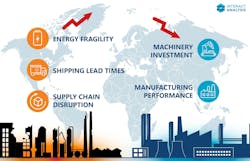
Energy-Intensive Sectors
Chemicals, metals and other energy-intensive sectors are expected to face further energy price increases due to the U.S.-Iran conflict according to Loughney’s analysis. These manufacturing sectors rely on liquified natural gas (LNG) and oil to power their operations.
But shipping delays caused by the conflict means higher costs for LNG and oil, leading to higher energy costs for manufacturers, many of whom — particularly in Europe — are already dealing with high energy prices because of the Russia-Ukraine war.
For fluid power companies serving these markets, this could lead to lower demand for their hydraulic and pneumatic technologies. Customers will have to allocate more towards energy costs, leaving less available for other operational expenses such as new machinery and components.
Export-Oriented Manufacturing Hubs
Asia’s manufacturing hubs such as Indonesia and Vietnam export billions of dollars’ worth of goods to other parts of the world. To do so, they typically utilize the Suez Canal.
However, Loughney said they are heavily reliant on the petrochemical output of the Gulf region and therefore likely to face the same rising input costs and potential freight disruptions as manufacturers in other parts of the world.
Learn more about how the U.S.-Iran conflict is impacting various industries by reading these articles from other publications part of Power & Motion's parent company EndeavorB2B.
Iran War Shakes Up Global Shipping Routes from IndustryWeek
Oil rises sharply as US-Iran conflict disrupts Strait of Hormuz flows from Oil & Gas Journal
Middle East Conflict Disrupts Global Air Cargo Networks as Capacity Drops and Rates Rise from AviationPros
Potential Supply Chain Implications of the Iran Conflict from Supply Chain Connect
How Iran Conflict Could Impact Carriers This Week and Beyond from FleetOwner
In a Volatile Resin Market, Be Prepared but Disciplined, Expert Says from Plastics Machinery & Manufacturing
Iran War Pressures Water Sector Supply Chains from WaterWorld
Shipping and Other Supply Chain Woes From War in Iran from Material Handling & Logistics
A large number of products are now produced in Asia, including electronics and metals. This means fluid power companies and others sourcing products from Asian manufacturers could also feel the impacts of the higher costs and shipping disruptions brought about by the U.S.-Iran conflict including price increases and longer lead times.
Weakened Demand for Machinery and Industrial Equipment
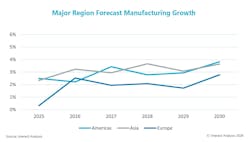
Loughney said the conflict could eventually lead to weakened demand for machinery and industrial equipment. This would occur if manufacturers delay or scale back investments because of sustained energy price increases and inflation.
As he explained in his analysis, higher energy prices increase costs for both manufacturers and consumers. This leaves less money available for discretionary expenses; as consumer spending on non-essential items declines, demand for certain manufactured goods declines as well.
Manufacturers facing higher operational costs and reduced demand for their goods look for ways to cut costs in other areas, which typically means less investment in new machinery unless absolutely necessary.
Weaker machinery demand leads to reduced demand for the componentry powering industrial machines as well like hydraulics and pneumatics.
Loughney concluded his analysis by saying that historical data shows the significant impacts disruptions to energy markets and global logistics can have on the manufacturing economy. And the current global manufacturing economy is no different.
It is therefore necessary for fluid power companies and others who are part of the manufacturing economy to understand the immediate and long-term implications sustained disruptions caused by the U.S.-Iran conflict could bring. Doing so can help determine what actions can be taken to minimize business impacts.
About the Author
 Sara Jensen
Sara Jensen
Executive Editor, Power & Motion
Sara Jensen is executive editor of Power & Motion, directing expanded coverage into the modern fluid power space, as well as mechatronic and smart technologies. She has over 15 years of publishing experience. Prior to Power & Motion she spent 11 years with a trade publication for engineers of heavy-duty equipment, the last 3 of which were as the editor and brand lead. Over the course of her time in the B2B industry, Sara has gained an extensive knowledge of various heavy-duty equipment industries — including construction, agriculture, mining and on-road trucks —along with the systems and market trends which impact them such as fluid power and electronic motion control technologies.
You can follow Sara and Power & Motion via the following social media handles:
X (formerly Twitter): @TechnlgyEditor and @PowerMotionTech
LinkedIn: @SaraJensen and @Power&Motion
Facebook: @PowerMotionTech