Q3 2026 Robot Orders Rise as Market Adoption Becomes More Diversified
Key Highlights
- The Association for Advancing Automation’s (A3) third quarter robot orders report shows continued growth for the North American robotics market.
- Automotive components, semiconductors & electronics, and life sciences were sectors with some of the largest robot orders during the quarter.
- Cobots once again accounted for a significant portion of total robot orders as more industries look to adopt these robots to automate certain tasks and processes.
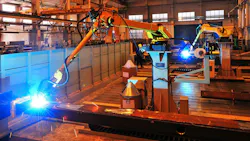
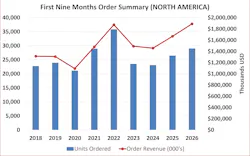
Robot orders in North America rose again in the third quarter of 2026. Data from the Association for Advancing Automation (A3) shows that a total of 10,989 robots were ordered during the quarter, an increase in units of 24.8% compared to the third quarter of 2025.
This was up from the 8,940 units recorded in the second quarter of 2026 as well.
Per A3, total North American robot orders for the first 9 months of 2026 reached 28,984 units which is a 9.6% increase over the same period last year.
The association attributes the quarterly growth to the continued adoption of robots in various industries. Increasing use of collaborative robots also helped drive growth during the quarter.
Use of Collaborative Robots Continues to Grow
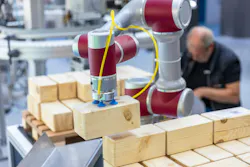
Orders for collaborative robots, or cobots, rose during the third quarter of 2026. A3 reports 1,831 cobot units were ordered in the third quarter, a 56% increase from the third quarter of 2025.
Cobot orders were up from the first and second quarters of 2026, as well, and continue to account for a large portion of total robot orders. In the third quarter, cobots accounted for 16.7% of all robot orders.
Total collaborative robot orders in North America through September 2026 were 4,605.
Collaborative robots are smaller, easier to install in existing operations and can be used alongside human workers, all of which contributes to their increasing uptake.
And as Alex Shikany, Executive Director, A3, told Power & Motion in a previous interview, for some companies they simply need to automate a certain task, not create a completely automated process, which cobots allow them to do.
Increasingly More Markets are Adopting Robotics
Aiding growth for North American robot orders during the third quarter of 2026 was the increased adoption of these machines in a wide range of industries. Historically, use of robots has been associated with the automotive industry.
Want More Market Data?
Visit our Market Trends page for more insights on how customer markets and technological developments of importance to the fluid power and motion control sectors are trending.
While that is still a strong market segment for robots, their use in other sectors has risen in recent years to help overcome labor challenges while also offering opportunities to improve productivity and efficiency.
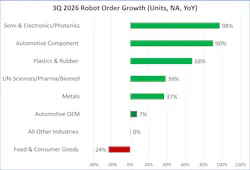
A3 reports that robot orders from automotive OEMs picked up again in the third quarter after recording declines in the first half of 2026. Robot orders in this customer segment increased 7.5% on a year-over-year basis while orders from suppliers to the automotive industry were up 90.4%.
Other industries which saw strong order increases during the third quarter included –
- Semiconductors & Electronics/Photonics: 97.6% units
- Plastics & Rubber: 67.7% units
- Life Sciences/Pharma/Biomed: 38.7% units
- Metals: 37.0% units
- Other Industries: 0.5% units
Food & Consumer Goods was the one industry which saw a drop in orders of 23.7% during the quarter.
Demand for semiconductors and electronics, due in part to the rising use of artificial intelligence (AI), continues to grow which is prompting the use of robots to aid production of these delicate electronics.
A3 notes in its third quarter 2026 North American robot orders report that investment in domestic pharmaceutical manufacturing is helping drive growth for robotics in the life sciences sector.
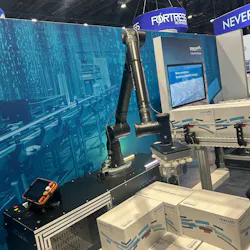
Packaging and processing applications are also adopting more robots to help increase throughput and productivity, reduce operational costs as well as improve quality and consistency according to the 2026 Robotics in U.S. Packaging & Processing Report recently released by PMMI, The Association for Packaging and Processing Technologies.
Robots could be seen throughout the show floor at PACK EXPO International 2026, demonstrating the rising adoption of robots in this sector. Jorge Izquierdo, vice president, market development, PMMI, noted during a presentation at the event that today robots can be found throughout production lines in the packaging and processing industry to aid the movement of goods.
PMMI expects robot uptake to continue in the packaging and processing industry, and projects it will achieve a 10.3% compound annual growth rate by 2031.
Shikany said in A3’s third quarter report that what stands out most about the quarterly data is not just how much orders grew, “but how broadly it was distributed across the market.
“That broader mix is important because it points to a robotics market that is becoming increasingly diversified across industries and applications,” he said.
This continued diversification is expected to help drive continued growth for the robotics industry as well as the many technology suppliers to it, including many fluid power and other motion control technology developers.
About the Author
 Sara Jensen
Executive Editor, Power & Motion
Sara Jensen is executive editor of Power & Motion, directing expanded coverage into the modern fluid power space, as well as mechatronic and smart technologies. She has over 15 years of publishing experience. Prior to Power & Motion she spent 11 years with a trade publication for engineers of heavy-duty equipment, the last 3 of which were as the editor and brand lead. Over the course of her time in the B2B industry, Sara has gained an extensive knowledge of various heavy-duty equipment industries — including construction, agriculture, mining and on-road trucks —along with the systems and market trends which impact them such as fluid power and electronic motion control technologies.
You can follow Sara and Power & Motion via the following social media handles:
X (formerly Twitter): @TechnlgyEditor and @PowerMotionTech
LinkedIn: @SaraJensen and @Power&Motion
Facebook: @PowerMotionTech
Related
 Two industrial robots working along a production line
 Blue and yellow robots working along a production line