Robot Orders Continue Growth Trend in Second Quarter 2026
Key Highlights
- North American robot orders rose 4.3% compared to second quarter 2025, and cobots once again accounted for a large share of total robot orders.
- Demand for robots in non-automotive industries continues to grow, helping drive total robot orders during the second quarter and first half of 2026.
- For fluid power and other motion control technology developers serving the robotics market, this continued growth is likely to provide further opportunities in this important customer sector.
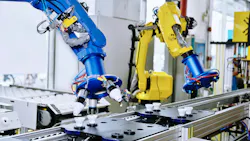
Second quarter 2026 robot order data shows investments in robotics continues to grow.
The Association for Advancing Automation (A3) reports North American robot orders reached 8,940 units in the second quarter. This is a 4.3% increase compared to the second quarter of 2025.
And it is just slightly below the 9,055 units recorded in the first quarter of 2026, indicating relatively stable demand for the robotics market.
Total robots ordered during the first half of 2026 reached 17,995 units valued at $1.166 billion which A3 said is a 2.0% growth in units and 6.6% growth in order value over the first half of 2025.
Robotics Uptake Becoming More Widespread Across Industries
Visit our Market Trends page for even more economic and technology trend information on important customer markets for the fluid power and motion control industries.
With each of A3’s quarterly robot order reports, the association has noted the rising use of robotics in industries outside of automotive. Although the automotive industry still accounts for a large share of robot orders and use, over the last several quarters A3 has reported rising order numbers in a range of other industries as well.
And the second quarter of 2026 was no different.
A3 said that double-digit year-over-year gains in robot orders were recorded in several industries during the second quarter:
- Semiconductors & Electronics/Photonics: 38%
- Automotive Component: 20%
- Food & Consumer Goods: 18%
- Metals: 18%
- Life Sciences/Pharma/Biomed: 9%.
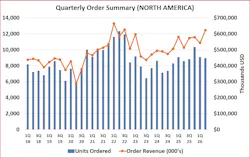
Per A3, non-automotive customers accounted for 56% of robot units ordered during the quarter.
For the first half of 2026, A3 reports robot orders from automotive OEMs declined 25% compared to the first half of 2025, but gains in other sectors helped offset the declines:
- Semiconductors & Electronics/Photonics: +35% units
- Life Sciences/Pharma/Biomed: +32% units
- Automotive Component: +24% units
- Food & Consumer Goods: +17% units
- Plastics & Rubber: +6% units
- All Other Industries: +6% units
- Metals: +3% units
When asked what was prompting industries outside of automotive to increase their uptake of robots, Alex Shikany, Executive Director, A3, told Power & Motion that a big part of it has to do with the technology now being able to do more than it could even a few years ago.
“New applications are opening up, systems are becoming more flexible, and companies that may not have been able to justify robotics in the past are finding that they can now make the business case work,” he said. “You also have robotics increasingly working together with vision, AI (artificial intelligence), sensing and software. That makes it possible to handle more variation, adapt to different products or tasks, and automate processes that historically may have been too difficult or inconsistent for a robot.
“And the business pressures are pretty straightforward,” he continued. “Companies are looking for productivity, better quality, more flexibility and ways to make the best use of the people they have. In many cases, automation can help with several of those things at once.
“That is what makes the growth outside automotive so interesting to me. We are not just seeing more robots. We are seeing more types of companies and customers finding practical ways to use them.”
Demand for Cobots Continues to Rise
A3’s order data shows collaborative robots (cobots) accounted for a large portion of orders once again in the second quarter of 2026.
A total of 1,137 cobots were ordered during the quarter, accounting for 12.7% of total robot units ordered in the second quarter. This was a slight dip from the 1,637 cobots ordered during the first quarter, but still demonstrates the strength of this segment of the robotics market.
In the first half of 2026, A3 said total collaborative robot orders totaled 2,774 and accounted for 15.4% of all robots ordered during the first 6 months of the year.
Demand for cobots in the first half of 2026 was strongest in the Life Sciences/Pharma/Biomed and Semiconductor & Electronics/Photonics sectors, accounting for 43.7% and 36.5% of first-half robot orders, respectively.
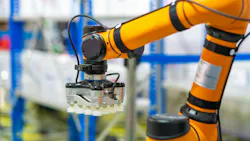
Shikany said the continued growth of cobots in various sectors is due in large part to the flexibility and ease of use they provide.
“For the right application, a cobot can be relatively easy to program, move to another task or add into an existing operation without having to redesign the entire process around it,” he said.
“They also fit well with the way a lot of companies are thinking about automation today. It is not always about replacing an entire process with a fully automated system. Sometimes it is about automating one repetitive or difficult part of a job and having the technology work alongside the people who are already there,” he continued.
The strong demand for cobots in the Life Sciences/Pharma/Biomed and Semiconductors & Electronics/Photonics industries demonstrate this he said as they are “areas where flexibility, precision and the ability to fit automation into an existing operation can matter quite a bit.
“There are still plenty of applications where a traditional industrial robot is the better answer, especially when you need speed, payload or very high throughput,” he noted. “But cobots have given companies another option, and I think that has helped bring robotics into a lot of applications and customers that might not have considered it before.”
These factors will help continue to drive growth for the overall robotics market in the years ahead.
Market intelligence firm Interact Analysis is projecting steady growth of 6.7% through 2030 for industrial robots, and a 17.3% growth rate is expected for just the cobots segment of the global robotics industry. Increasing technological capabilities, diversification of industries using robots and the need to automate where possible to address labor challenges are among the factors expected to drive growth for this sector.
About the Author
 Sara Jensen
Sara Jensen
Executive Editor, Power & Motion
Sara Jensen is executive editor of Power & Motion, directing expanded coverage into the modern fluid power space, as well as mechatronic and smart technologies. She has over 15 years of publishing experience. Prior to Power & Motion she spent 11 years with a trade publication for engineers of heavy-duty equipment, the last 3 of which were as the editor and brand lead. Over the course of her time in the B2B industry, Sara has gained an extensive knowledge of various heavy-duty equipment industries — including construction, agriculture, mining and on-road trucks —along with the systems and market trends which impact them such as fluid power and electronic motion control technologies.
You can follow Sara and Power & Motion via the following social media handles:
X (formerly Twitter): @TechnlgyEditor and @PowerMotionTech
LinkedIn: @SaraJensen and @Power&Motion
Facebook: @PowerMotionTech