Opportunity Markets for Fluid Power and Motion Control in 2027
Key Highlights
- Construction of data centers is driving demand for not only the components used in these facilities but also the machinery required to build them which is benefiting multiple market segments.
- Increased defense spending around the world is helping boost manufacturing for vehicles, ships, aircraft and componentry used in this sector.
- Manufacturing activity is up in several other industries as well, with semiconductor production among the strong growth areas as use of these components rises in various industries.
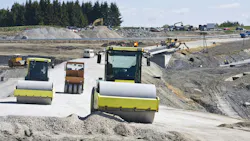
Heading into 2027, growth is showing in various markets of importance to the fluid power and motion control sectors.
Construction is benefitting from the current data center boom, global defense spending is on the rise, and manufacturing is in a growth phase. These sectors are all presenting growth opportunities for the hydraulic, pneumatic and electromechanical technology suppliers serving these markets.
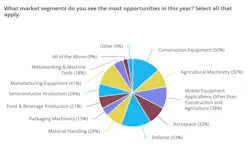
At the beginning of 2026, Power & Motion asked readers what market segments they saw the most opportunities in this year. Not surprisingly, construction equipment, defense and manufacturing equipment were the top three choices indicated, which can be seen in Figure 1 below.
Growth in these sectors is expected to continue into 2027. So, we’ve decided to dive into these markets to help you better understand what is driving their growth and what specific opportunities they may present in the year ahead.
Read the article "2027 Market Outlook: Prepare for Slow but Steady Growth" to gain more insights on how the economy and various customer markets are expected to perform in 2027.
Data Centers Giving Construction Industry a Boost
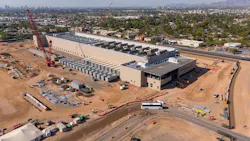
Improving conditions in the construction industry, driven primarily by the influx of investments in data centers, makes it a key sector to watch going forward.
Nico Palesch of Oxford Economics, who spoke during the National Fluid Power Association’s (NFPA) 2026 Industry & Economic Outlook Conference (IEOC), said the past couple of years were particularly bad for the construction sector across the board.
This was due to many factors, but in particular the rise in interest rates that occurred in the 2022-2023 timeframe.
However, that situation is turning around slowly and construction is the sector Oxford Economics is more optimistic about over the next couple of years, he said. “We've seen really clear signs of it in Europe. We've seen signs of bottoming out in North America, especially in residential,” he said. “And so we do expect there to be greater strength heading into next year.”
Aiding this, particularly in the U.S., is the data center boom which has prompted a lot of construction activity. Data centers are being built all over the world, but the U.S. is outpacing all of them “and it is reaping huge amounts of benefit from this,” said Palesch. “Not only in terms of direct construction output, but [this is] also spilling over into different industrial inputs and segments as well” such as the cooling and other componentry used in these facilities.
Daniel Winter, President of Danfoss Power Solutions, said in an interview with Power & Motion that the majority of the growth the company has seen so far in 2026 has come from its data center business which supplies hoses, fittings and other components used in these facilities' cooling systems.
Though there are some questions about how long the data center boom will last, Winter said he does see it as a long-term trend. Construction of these facilities is developing differently in different parts of the world, with demand potentially shifting to other regions such as Europe in the future.
While growth rates related to the data center market may not be what they are now, he still anticipates they could be in the range of 20%.
Construction Equipment Demand Increasing in Line with Improving Market Conditions
Increased construction of data centers means there is also more demand for the machinery that builds these facilities.
This is leading to improvements in unfilled orders and inventories for equipment manufacturers, a lot of which is driven by the growth in data centers said Alastair Hayfield from Interact Analysis during his presentation on the construction equipment market at the NFPA IEOC 2026.
Construction of these facilities and the surrounding infrastructure also typically rely on larger equipment, which is benefitting that segment of the market while compact machinery is still struggling noted Hayfield.
He said Interact Analysis is forecasting growth for the construction equipment market in 2026 and 2027. “This is largely driven by the data center boom — rental fleets and big contractors looking to procure equipment for those projects,” said Hayfield. “It's not being driven by big increases in residential, warehousing or factory starts.”
Taylor St. Germain from ITR Economics, on the other hand, said during his NFPA IEOC 2026 presentation that ITR expects commercial construction to come back in 2027, which should bode well for equipment demand as well.
“You’re starting to see building activity pick up, commercial property prices are starting to rise again. There’s a lot of reasons to be more excited about commercial [construction] in 2027,” he said.
He did agree with Hayfield though that residential construction will continue to struggle due primarily to ongoing affordability issues. Interest rates remain high, which is making it more expensive to purchase or build a home.
Ken Baker, CEO of Bailey International, told Power & Motion that the construction market, particularly related to data centers and infrastructure, appears to be steady. And he expects infrastructure-driven construction to stay reasonably strong into 2027 due to investments being made in this area — which will continue to prompt demand for construction equipment and the components used in it like hydraulics.
Gain More Industry Insights
Read all of our State of the Industry Q&As with members of the fluid power and motion control industries to learn what expectations they have for 2027.
Brian Dengel, General Manager, KHK USA Inc.: Industrial Automation to Remain a Growth Driver
Increased Global Defense Spending Will Benefit Range of Technology Suppliers
Defense is expected to be another positive market going forward for those who serve this sector. Many countries and regions around the world, like Europe, are increasing their defense spending due to the persistence of various geopolitical events.
Palesch said defense spending will be a key growth driver for the European market as it looks to build up its military fleets. “This will help European industry in a very big way because, as part of this, they are going to spend more money on their own domestic manufacturers because for them they see this as a sort of matter of survival and security,” he said.
The majority of this European defense spending will be focused on:
- Aerospace
- Precision & Optical Instruments
- Ships, Military Vehicles and Rail.
Winter said defense is an opportunity area Danfoss is exploring because of the growth potential the company sees in this market. He sees opportunities for the company’s electrification technologies in marine vessels as this sector has been pushing toward use of such technology in recent years. Land-based military vehicles have traditionally relied on hydraulics technologies and therefore he sees potential in the company being able to provide its hydraulics solutions for these applications.
Several members of the fluid power industry Power & Motion has spoken with throughout the year have also noted defense as a market they are either looking into or have already started to work in more.
Other technology suppliers are seeing opportunities in this market as well.
Anant Bhat, Director of Business Development – Bearings & Industrial Solutions Americas at Schaeffler, noted in an interview with Power & Motion defense is one of the industries in which the company has seen robust demand in 2026. He said there has been strong demand for the company’s high-precision bearings for engines and auxiliary power units from this sector, which is expected to continue into 2027.

Manufacturing Activity is on the Upswing
According to ITR’s St. Germain, manufacturing is in a growth phase which is expected to continue into 2027.
The Institute for Supply Management (ISM) Manufacturing PMI marked its 10th consecutive month of expansion in October 2026, further demonstrating the growth occurring in the manufacturing sector. Growth was recorded in 12 manufacturing industries during the month, with five of the six largest industries expanding in October:
- machinery
- computer & electronic products
- transportation equipment
- chemical products and
- food, beverage & tobacco products.
Growth is projected to continue in these and several other manufacturing sectors going into 2027 and beyond. Electronics, pharmaceuticals, aerospace, mining equipment as well as industrial and metalworking machinery are among those Scott Hazelton from S&P Global Market Intelligence pointed to during his presentation at the NFPA IEOC 2026.
Semiconductors to be a High-Growth Sector
Production of electronic components, particularly semiconductors, is expected to provide strong and steady growth for the manufacturing sector going forward.
Hazelton said semiconductors are a good place to be over the coming years with high growth rates expected through 2030. Data center construction is helping drive the need for these components as semiconductors are used for much of the data processing that occurs in these facilities.
The CHIPS Act helped drive a lot of investment in domestic production of semiconductors. Hazelton noted in his presentation that many of these facilities are now starting to come online, which will help meet future demand for semiconductors.
Buildup of these facilities has also driven the need for technologies capable of producing semiconductors, which Chelsea Krause, Vice President, Fluid & Motion Control at Emerson, expects will continue to provide opportunities in the years ahead.
She said the rapid growth of semiconductor manufacturing is creating demand for the equipment and automation technologies needed to produce semiconductors. As pneumatics and motion control play an important role in these production technologies, Krause said Emerson expects this sector will remain an attractive area for innovation and growth going forward.

Defense Spending to Benefit Aerospace and Other Manufacturing Industries
As noted above, increased defense spending around the world is expected to be an opportunity for many, including from the manufacturing side of things.
When Palesch discussed the growth defense investments are expected to bring, he showed a chart demonstrating how Germany’s manufacturing forecast improved over the next several years due to announced defense spending commitments.
A recent report from Interact Analysis corroborates this, indicating the country’s aerospace and defense sector is entering a new investment cycle to meet Europe’s increased defense spending. It notes several German manufacturers who are investing in manufacturing facilities to meet this demand.
Hazelton noted defense spending is a strong contributor to the projected growth for the U.S. shipbuilding sector in the years ahead.
Defense spending is also benefitting the aerospace sector, with Hazelton saying that defense orders were up 21% in the first half of 2026. Overall, U.S. aerospace production is expected to see steady growth in the years ahead as demand from the commercial side increases as well with companies like Boeing currently projecting strong demand for new aircraft through 2045.
Scott Curley – Senior Vice President, Sales and Marketing at Regal Rexnord, said in an interview with Power & Motion, the company is seeing significant momentum in the aerospace industry. This will drive the need for precise, reliable motion solutions required by various aircraft applications, and he expects this sector to be an opportunity area for Regal Rexnord in 2027.
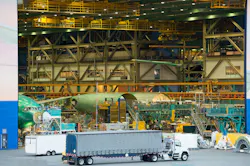
Fathom Digital Manufacturing, a provider of manufacturing and low- to mid-volume production services, recently made two acquisitions to expand its aerospace and defense production capabilities which will help it meet the growth opportunities it sees in these markets.
“We see several factors contributing to growing demand across aerospace and defense,” Rush LaSelle CEO of Fathom, told Power & Motion. “Continued investment in advanced technologies is driving greater complexity in the components and assemblies required to support them. At the same time, manufacturers are placing greater emphasis on domestic production capacity, supply chain resilience, and the ability to move efficiently from development into sustained production.
“As mechanical systems become more sophisticated and electronics increasingly integrated, manufacturers need suppliers with expertise across multiple disciplines,” he continued. “Precision machining, specialized finishing, electronics manufacturing and complex assembly all play a role, but equally important is the ability to consistently deliver the quality, documentation and reliability these applications demand.
“The challenge is translating technological innovation into dependable production capacity. Aerospace and defense manufacturers increasingly need partners with the engineering expertise, quality systems and manufacturing breadth to support technically demanding programs at scale. That's a central part of our strategy at Fathom and why the addition of TCS and PGM is so complementary to our existing capabilities.”
Based on these projections and industry insights, 2027 and beyond should provide good opportunities for those working in the construction, defense and manufacturing sectors.
About the Author
 Sara Jensen
Executive Editor, Power & Motion
Sara Jensen is executive editor of Power & Motion, directing expanded coverage into the modern fluid power space, as well as mechatronic and smart technologies. She has over 15 years of publishing experience. Prior to Power & Motion she spent 11 years with a trade publication for engineers of heavy-duty equipment, the last 3 of which were as the editor and brand lead. Over the course of her time in the B2B industry, Sara has gained an extensive knowledge of various heavy-duty equipment industries — including construction, agriculture, mining and on-road trucks —along with the systems and market trends which impact them such as fluid power and electronic motion control technologies.
You can follow Sara and Power & Motion via the following social media handles:
X (formerly Twitter): @TechnlgyEditor and @PowerMotionTech
LinkedIn: @SaraJensen and @Power&Motion
Facebook: @PowerMotionTech
Related
 Hydraulic hoses and other components on an industrial machine