Global Aerospace Actuator Market to Grow 3.2% Through 2034
Key Highlights
- Actuators are the hardware behind many commands and functions in aerospace applications, making them a critical component within these applications.
- The continued importance of actuators to airplanes, helicopters and other aerospace applications will be a key driver for the growth Stratview Research is projecting for the global aerospace actuator market.
- Hydraulic actuators will remain the primary technology used, but the industry will also continue to advance actuation technology options to meet evolving performance requirements.

Whether moving the flight-control surfaces of a commercial aircraft, deploying spoilers, adjusting helicopter rotor pitch, or controlling the flight path of a UAV, each action ultimately depends on actuators converting commands into precise mechanical movement.
Actuators are critical to the functionality of various types of vessels in the aerospace industry. Commercial aircraft, military fleets, helicopters and UAVs (unmanned aerial vehicle) all rely on actuators and each of these segments of the industry are expanding, although at different rates and for different operational requirements. This variation explains why aerospace actuators remain a sizeable business.
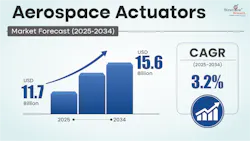
Stratview Research is projecting the global aerospace actuators market to generate more than U.S. $140 billion in cumulative sales through 2034 due to widespread use of actuation technologies in the aerospace industry and its continued growth.
As the aerospace actuator market grows in the years ahead, actuator technology is expected to evolve as well to bring new capabilities to the market.
Commercial Aircraft to Create the Broadest Actuator Demand
According to Stratview Research, commercial aircraft are expected to account for the largest portion of actuator demand during the forecasted period.
In a commercial aircraft, actuators are used to perform a number of functions, including:
- moving primary flight controls,
- deploying flaps and slats,
- operating spoilers, landing gear, and thrust reversers,
- opening and closing doors, and
- regulating engine functions.
On premium-configured aircraft, the requirement extends into the cabin, where multiple actuators may be installed in each business- or first-class seat to provide reclining and other seat adjustment capabilities.
Several safety-critical control surfaces use actuators connected to segregated hydraulic or electrical power sources, ensuring that a single failure does not result in loss of control.
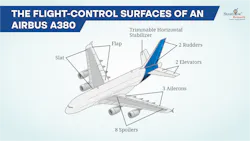
A modern commercial aircraft typically uses over 100 actuators to control almost everything, although aircraft size decides the requirement. The Airbus A380, for example, has three pairs of ailerons, two rudder panels, four elevator panels and 16 spoilers, in addition to its slats, flaps and trimmable horizontal stabiliser — all of which relies on actuation technology.
Commercial programmes are also where different actuation technologies increasingly coexist. Airbus introduced a 2H2E architecture on the A380, combining two hydraulic and two electrical power systems. The architecture, which uses conventional hydraulic servocontrols alongside electrohydrostatic actuators, was subsequently carried into the A350.
The high demand for actuators from commercial aircraft is directly linked to the delivery that generates an initial equipment requirement and decades of inspection, repair and replacement demand. Boeing projects demand for 43,625 new commercial aircraft between 2026 and 2045, including more than 33,500 single-aisle aircraft.
This combination of actuator content and fleet scale gives commercial aviation the broadest addressable demand across aircraft categories.
Most Actuators Enter the Fleet at Line Fit
Want more market data like this? Visit our Market Trends page for our content covering both economic and technology trends or sign up for our biweekly Market Trends in Power & Motion newsletter to have it delivered directly to your inbox every other Friday.
Actuator demand is heavily weighted towards line-fit installation, which accounts for >90% of aerospace actuator demand, according to Stratview Research. This is logical considering that a new aircraft enters service with its complete set of flight control, landing gear, engine, utility and other required actuators already installed.
Once in service, actuators are generally not replaced simply because an aircraft has reached a particular age. Maintenance requirements depend on the actuator, aircraft and approved maintenance program, and many removals are driven by condition or identified discrepancies.
Hydraulic leakage, seal deterioration, excessive wear, abnormal movement, degraded performance and internal component problems can trigger inspection, repair, overhaul or replacement. Federal Aviation Administration (FAA) guidance, for example, calls for hydraulic systems to be checked for leakage, wear, damage and abnormal operation.
A 2026 FAA proposal similarly treats certain actuator replacements as ‘on condition’, required only when inspection results warrant them.
Replacement can also become necessary when an actuator develops a known reliability or safety issue, or when an improved design is mandated. FAA directives provide examples where landing-gear actuators were replaced following operational discrepancies such as jamming, with improved units subsequently installed. This helps explain the comparatively small retrofit share of the market.
How Actuators for Aerospace Applications are Evolving
As the aerospace actuator market grows in the years ahead, it is expected there will be a number of technological advancements as well within the actuator market to meet evolving performance requirements.
The Shift from Mechanical to Powered Flight Controls
The most basic actuator system designs were direct mechanical control systems — the pilot’s force was transmitted through cables, rods, pulleys, and linkages, rather than through a powered actuator as we usually understand the term today.
As aircraft grew larger and control loads increased, powered actuation became necessary. Today, aerospace applications use hydraulic, electric, pneumatic, and other actuation technologies, depending on the force, speed, weight, redundancy, and control requirements of the system.
Despite the move towards more-electric aircraft (MEA), Stratview Research expects hydraulic systems will continue to account for more than half of the aircraft actuators market. Why?
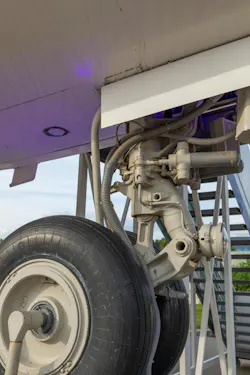
The main reason is force capability combined with an enormous installed base. Large aircraft control surfaces and systems such as landing gear impose substantial loads, and hydraulic systems can generate high forces in relatively compact packages.
They also have decades of certification and operational experience across commercial and military fleets. Importantly, hydraulics can hold substantial loads without continuously consuming significant energy.
Electric actuation technology, on the other hand, is gaining ground. Modern aircraft increasingly use electromechanical actuators (EMAs) as well as electrohydraulic (EH) and electrohydrostatic actuators (EHA), etc., where system-level weight, maintenance, power-on-demand, or removal of centralized hydraulic infrastructure makes them attractive.
Actuation Technology Will Need to Become Lighter, Smaller and More Reliable
Aircraft designers have always wanted actuators that are lighter, smaller and more reliable. More-electric architectures add another requirement — they increasingly need to be easier to integrate into the aircraft's electrical and digital architecture.
As such, OEMs are focusing on use of electromechanical actuation, higher power-to-weight ratios, integrated electronics and modular architectures.
Liebherr, for example, presented its latest modular EMAs at ILA Berlin and Farnborough 2026, targeting the electrification and digitalization of civil and military aircraft. Its LiVCAS architecture uses prequalified, scalable modules rather than developing every actuator as a fully bespoke system.
Decentralized hydraulics are developing alongside electrification. Instead of eliminating hydraulics entirely, electrically powered local hydraulic power packs can move hydraulic generation closer to the point of use, reducing dependence on centralized hydraulic infrastructure.
Looking ahead, actuators are also becoming more closely integrated with power electronics, sensing, software and monitoring functions. These integrated electronic control platforms can combine position control, signal conversion and system monitoring.
What Comes Next for Aircraft Actuation?
The next step in actuation is also about getting more capability from a smaller actuator and knowing more about its condition while it is operating. Rather than relying only on scheduled inspections, condition-based and predictive maintenance allow early indication of wear or abnormal functioning.
Higher power density and miniaturization are becoming important design targets, especially where installation space and weight are limited.
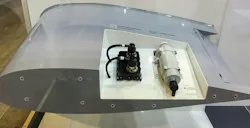
NASA (National Aeronautics and Space Administration), for example, has developed shape-memory-alloy (SMA) actuators that use thermally activated SMA tubes to produce rotary movement. NASA says the technology can provide similar power to larger conventional actuators within a smaller, lighter package.
NASA and Boeing have also demonstrated SMA actuation on an F/A-18 wing section, including a full-scale actuator capable of 20,000 in.-lb. of torque.
These technologies are not ready to displace conventional aerospace actuators across the aircraft, nor do they need to. Their significance lies in what they add to the design space.
After more than a century of change, the actuator's fundamental job remains the same — turning a command into controlled mechanical movement. What continues to change is how much aircraft designers expect that hardware to deliver for every kilogram, watt and cubic centimeter it occupies.
Regardless of where actuator technology goes in the future, these devices will remain a critical component in aerospace applications for years to come and thus bring continued growth opportunities for the aerospace actuator market.
This article was written and contributed by Chandana Patnaik, Senior Content Strategist at Stratview Research.
About the Author
 Chandana Patnaik
Chandana Patnaik
Senior Content Specialist, Stratview Research
Chandana Patnaik is an experienced technical writer, presently serving as a Senior Content Specialist at Stratview Research. She has carved her niche in specific areas including disruptive technologies, information, and specialty chemicals. etc.
She is a regular contributor to various magazines and blogs and writes insightful content that keeps readers stay up-to-date with the latest trends and developments in her areas of expertise.