2027 Market Outlook: Prepare for Slow but Steady Growth
Key Highlights
- Challenging market conditions have persisted for fluid power and motion control technology companies in 2026, but signs are showing for a return to more positive conditions heading into 2027.
- Slow growth is expected next year as some markets begin to improve, such as heavy-duty trucking, but factors such as the Iran war continue to present challenges.
- Rising data center construction and manufacturing activity will contribute to the growth potential projected in 2027 and beyond.

Is 2027 the year we’ll finally have a return to more positive market conditions for the fluid power and motion control technology sectors? The past few years have been filled with uncertainty due to rapidly changing trade policies and geopolitical tensions while supply chains, down customer markets and other factors have also posed challenges.
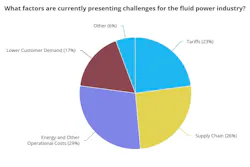
2026 has been much of the same, with many describing it as a bit of a mixed bag because of these challenges. Figure 1 below shows which of these challenges have been most impactful for Power & Motion readers this year.
But there have been some market opportunities. For instance, the boom in data center construction and the infrastructure needed for it is helping boost the construction equipment market as well as those supplying components used in these facilities which includes many from the fluid power industry.
There are some more positive signals starting to show as well, which has many thinking there may be better times ahead.
As Eric Lanke, President & CEO of the National Fluid Power Association (NFPA) noted during the association’s 2026 Industry & Economic Outlook Conference, the last 12 months have been marked by growing shipments and so far trends are showing this may continue in the months ahead.
NFPA’s August 2026 fluid power shipment data shows another month of gains for fluid power shipments and orders activity. With both the 3/12 and 12/12 rates of change returning to positive territory during the month, the association says the hydraulics and pneumatics industry is showing stable growth conditions.
Daniel Winter, President of Danfoss Power Solutions, also spoke of the improving market conditions the company is starting to see during its 2026 Distributor Meeting. Though not the case in every part of the world, those he said which are showing improvements include China, India, Brazil and North America.
This is essentially the sentiment going into 2027 — signs of growth are showing but it will not be consistent across all markets. Read on to learn more about how and in what markets growth is expected to occur in 2027 so you can better plan your business and design initiatives in the year ahead.
Economy to Enter a Period of Slow Growth
The general consensus among the many economic experts who spoke at the NFPA’s Industry & Economic Outlook Conference (IEOC) held in August 2026 is that we are headed into a period of growth.
It was noted that it will most likely be a period of slow growth going forward, but growth nonetheless. That is, barring any new shocks to the global economy, said Nico Palesch of Oxford Economics during his presentation at the event.
Currently, the war with Iran and the subsequent closure of the Strait of Hormuz remains the largest concern for the global economy he said. This is causing some supply chain disruptions, particularly for shipments of oil as more than 20% of the world’s oil supply is shipped through the strait.
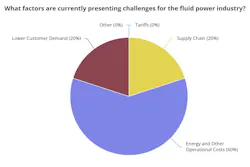
Fuel and energy costs are already rising because of it, and if the war persists these could be exacerbated further, along with the availability of oil (see Figure 2).
Despite this current challenge to the global economy, Palesch said it is still growing, though slowly. Increased manufacturing activity and construction growth due to the buildup of data centers are some of the factors he pointed to that are helping drive growth for the global economy.
He noted the boom in data centers has helped keep global trade afloat in 2026. The inputs needed for these facilities, including computer chips, electronics, cooling systems and building materials, is contributing to the large amount of global trade occurring around the world.
Taylor St. Germain from ITR Economics also spoke to the period of slow growth the economy is entering. He noted that ITR expects the U.S. economy will grow over the next 3 years; 2027 is expected to be a year of flat or little growth followed by more growth in 2028.
He said manufacturing and industrial production is growing, and commercial construction is expected to pick up in 2027.
With the growth projected in the years ahead, he suggested companies start preparing now. Capitalize now on interest rates before they go even higher and look internally at what improvements can be made to take advantage of longer-term growth opportunities.
Although prices are higher for many operational expenses like energy and there remains a lot of uncertainty in the global economy — and the world in general — St. Germain said both are becoming the new normal and not going away any time soon.
This continued uncertainty is why ITR is projecting a period of slow but steady growth in the years ahead he said.
Expectations for Key Customer Markets in 2027
Many customer markets of importance to the hydraulics and pneumatics sector, as well as other motion control technology suppliers, such as construction and manufacturing, are showing improvements which are expected to continue into 2027.
This is contributing to projections for growth in 2027 and beyond.
Palesch said Oxford Economics expects over the next couple of years that sectors which are already strong, like high-tech which is on a massive growth trend due in part to the AI (artificial intelligence) boom, will continue to be strong. Growth is expected to broaden out to other categories as well, he said, such as wood products aided by the improving construction market.
To help plan business activities for next year, below we’ve highlighted expectations for some of the key customer markets for the fluid power and motion control technology sectors.

Agricultural Equipment
It remains uncertain whether the agricultural equipment industry will see better days in 2027. Sales for agricultural machinery have been down for most of 2026.
The Association of Equipment Manufacturers’ (AEM) Ag Tractor and Combine report for September 2026 shows yet another month of declines for the sector, with U.S. tractor sales down 16.4% and U.S. combine sales down 10.9% during the month.
Georg Stieler of STM Stieler, who presented on the state of the agricultural equipment market at the NFPA IEOC 2026, pointed to fertilizer — much of which comes from the Middle East and is shipped through the Strait of Hormuz — fuel and crop prices as challenges facing this market.
However, he said the rate of decline for machine sales has begun to ease compared to the large dips seen in 2025. But this does not mean the market is out of the woods just yet as the aforementioned challenges are still a concern.
Ken Baker, CEO, Bailey International, feels somewhat more optimistic about the agricultural equipment market. He said in an interview with Power & Motion that there seems to be some slight improvements in the agriculture market due to replacement needs.
This is a market he will continue to watch in 2027 for a potential rebound. “The market has been down long enough that pent-up replacement demand is building,” he said.
Gain More Industry Insights
Read all of our State of the Industry Q&As with members of the fluid power and motion control industries to learn what expectations they have for 2027.
Brian Dengel, General Manager, KHK USA Inc.: Industrial Automation to Remain a Growth Driver
Construction Equipment
Construction appears to be the sector everyone is feeling more optimistic about going forward, aided in large part by the buildup of data centers.
After a couple of years of difficult market conditions, Palesch said it looks like things are turning around for the global construction market. Construction of data centers, especially in the U.S., is a key contributing factor.
Over the last 12 months alone, the U.S. has built 56 billion dollars’ worth of data centers, noted St. Germain.
And to build these facilities, construction equipment such as excavators and wheel loaders is required. This is helping increase demand for equipment, and leading to future growth expectations for the sector said Alastair Hayfield from Interact Analysis during his presentation on the construction equipment market at the NFPA IEOC 2026.
He anticipates data centers will be the primary driver for the construction equipment market in the year ahead. Affordability continues to be a challenge for residential construction, and he does not foresee large increases in other construction segments either such as warehousing.

Heavy-Duty Trucking
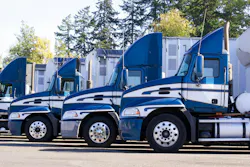
Jonathan Starks of FTR Transportation Intelligence noted at the start of his NFPA IEOC presentation that 2026 kicked off with a lot of risks for the trucking sector, including tariffs, the conflict with Iran, and questions about whether the USMCA (U.S., Mexico, Canada Agreement) would be reinstated.
But the 2026 order season was strong for the Class 8 truck market and he said demand is getting back to a normal cadence. OEM inventory is still elevated, but is coming down and expected to normalize going into 2027.
Starks said the heavy truck market is reaching a recovery stage and that shipment data is moving up at a pretty strong pace. “As of right now, barring some significant change on the demand side or the productivity side, we should be moving into a recovery phase that should last for several years.”
How far and fast that goes is up for debate, he noted, but FTR is expecting recovery to begin in 2027 and for the sector to hit a normal market peak in 2028 or 2029. Freight growth, solid utilization, replacement needs as well as fleet modernization and growth are all contributing factors to the growth FTR is projecting for the heavy truck market.
However, cost pressures, policy uncertainty and uneven fleet profitability are likely to be among the constraints the market continues to face.
Manufacturing
The manufacturing sector, like other major customer markets, has also been plagued by the challenges brought on by tariffs, interest rates, trade policies and more. But it continues to experience growth.
ITR’s St. Germain said industrial growth and manufacturing growth are both in accelerating growth phases; both are expected to continue growing into 2027 though likely at a slower pace as the year progresses.
The Association for Manufacturing Technology (AMT) is also seeing growth within the manufacturing sector. Both AMT and St. Germain note that growth opportunities are not consistent across sectors, but overall the industry is experiencing an upswing in activity.
AMT’s most recent U.S. Manufacturing Technology Orders Report helps demonstrate the growth it is seeing in the market. Manufacturing technology orders were up 21% in August 2026 from the previous month and 36.3% compared to August 2025. Per the report, manufacturing technology orders have exceeded half a billion dollars for 6 consecutive months.
Semiconductor production and other electronics, aerospace, and defense are some of the industries noted by AMT, St. Germain and other presenters at the NFPA IEOC 2026 which are helping drive demand for the manufacturing sector.
Based on the growth ITR is seeing in manufacturing and other sectors, St. Germain said new orders and shipments for both hydraulics and pneumatics are expected to trend upward in the months ahead.
These are of course not all of the markets in which fluid power and motion control technologies are used, but they do help provide a snapshot of what is happening in various customer markets and where to expect growth in 2027.
About the Author
 Sara Jensen
Executive Editor, Power & Motion
Sara Jensen is executive editor of Power & Motion, directing expanded coverage into the modern fluid power space, as well as mechatronic and smart technologies. She has over 15 years of publishing experience. Prior to Power & Motion she spent 11 years with a trade publication for engineers of heavy-duty equipment, the last 3 of which were as the editor and brand lead. Over the course of her time in the B2B industry, Sara has gained an extensive knowledge of various heavy-duty equipment industries — including construction, agriculture, mining and on-road trucks —along with the systems and market trends which impact them such as fluid power and electronic motion control technologies.
You can follow Sara and Power & Motion via the following social media handles:
X (formerly Twitter): @TechnlgyEditor and @PowerMotionTech
LinkedIn: @SaraJensen and @Power&Motion
Facebook: @PowerMotionTech
Related

 Close up view of hydraulic cylinders, hoses and other components on a machine