Demand for Automation Brings Opportunities for Fluid Power
Key Highlights
- Chelsea Krause, Vice President, Fluid & Motion Control at Emerson, offers her insights on how ongoing demand for automation is bringing a number of market and technology development opportunities.
- Demand for automation solutions can be found in both high-growth industries like data centers and semiconductor manufacturing as well as established customer markets such as packaging and food & beverage.
- Customers are increasingly looking for solutions versus individual components, many of which are now a mix of pneumatic and electric motion technologies.

Despite some persisting market challenges in 2026, the year has also presented several opportunities.
Chelsea Krause, Vice President, Fluid & Motion Control, Emerson, said the underlying demand for automation continues to be strong, and will remain so as the factors driving it — labor challenges and the need for greater flexibility and productivity — persist in the years ahead.
She noted the diversity of applications requiring automation are bringing opportunities as well for Emerson and the fluid power industry as a whole. These include high-growth markets such as data centers and semiconductor manufacturing in addition to established customer markets like food & beverage and packaging.
With the increasing demand for automation is also coming the need for solutions that are often a mix of pneumatic and electric technologies to ensure all performance requirements are achieved.
In this Q&A with Power & Motion, Krause offers her insight on how automation demand will bring continued market opportunities, the technological trends driving development efforts for Emerson, and expectations for the year ahead.
*Editor’s note: Questions and responses have been edited for clarity.
Power & Motion: From your perspective how have market conditions been in 2026 for your company and the fluid power industry as a whole?
Chelsea Krause: 2026 has been a positive but uneven year for the fluid power industry. North America has been a real bright spot for us, and we continue to see attractive growth opportunities across Asia. Europe has been more mixed and challenging.
What I find encouraging is that the underlying demand for automation remains strong. Customers still need to produce more, improve productivity, address labor challenges and become more flexible. If anything, those pressures are increasing. That creates a lot of opportunity for our industry, even if where that growth shows up looks different around the world.
Power & Motion: What factors have presented challenges this year for your company, or the industry as a whole?
Chelsea Krause: One of the biggest challenges is simply the pace of change. Trade conditions can shift, supply chains continue to evolve, technology is moving quickly, and the strongest growth markets can look very different from one region to another.
At the same time, customers aren't slowing down their expectations. They want more productivity, more flexibility, better energy efficiency and smarter solutions. The challenge for our industry is keeping pace with those expectations.
Power & Motion: How has your company attempted to address or overcome these challenges?
Chelsea Krause: Our focus has been on staying close to our customers and being intentional about where we invest. We are strengthening customer engagement across our organization and using those insights to guide where we innovate, where we focus new product development and how we evolve our portfolio.
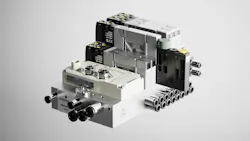
We are thinking more broadly about motion. The answer isn't always pneumatic or electric. Increasingly, it's about selecting and combining the right technologies for the application. That's one of the things that excites me about what we can do at Emerson. We have strong pneumatic and electric motion technologies within AVENTICS, precision handling and feeding capabilities within Afag, and the ability to connect those technologies to the broader Emerson automation portfolio and expertise.
We are also leveraging our global footprint and capabilities while continuing to strengthen how we respond to regional customer and market needs. That balance of global capabilities and local market understanding is increasingly important as conditions and opportunities vary around the world.
Power & Motion: Do you expect these challenges to persist in 2027?
Chelsea Krause: Absolutely, and I don't necessarily see that as a bad thing. Change creates opportunity.
The long-term drivers behind automation aren't going away: productivity, labor availability, flexibility, energy efficiency and digitalization. I expect those forces to continue shaping our industry well beyond 2027.
Our job is to keep up with the pace of our customers. That means innovating faster, making our technology easier to apply and ultimately helping customers get more out of their machines and operations.
Power & Motion: What opportunities — from a market or technology perspective, or both — have you seen this year, and do you expect these opportunities to continue in the year ahead?
Chelsea Krause: One of the exciting things about automation right now is the diversity of the opportunity.
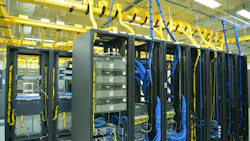
The rapid growth of data centers and semiconductor manufacturing is creating demand for the infrastructure, equipment and automation technologies that support them. Pneumatics and motion control play important roles across a wide range of applications in these industries, and we expect them to remain attractive areas for innovation and growth.
At the same time, there is still tremendous opportunity in established industries such as food and beverage, packaging, and life sciences. Customers in these markets are looking for ways to increase throughput, manage labor constraints, improve quality and make production more flexible.
For our industry, the opportunity isn't limited to one hot market. It's about applying fluid power and motion technology in new ways to solve increasingly complex automation challenges. That also creates a strong pipeline for new product development. When we stay close to customers and understand where their applications are headed, we can focus innovation on the problems they will need to solve next, not just the ones they are solving today.
Power & Motion: What are the most requested features or capabilities you’ve been getting from customers this year, and how, if at all, do they fit in with broader industry-wide trends?
Chelsea Krause: The conversation with customers is changing. It's less often, "I need this valve or actuator," and more often, "Here is the problem I'm trying to solve."
Machine builders are being asked to deliver equipment that is faster, more flexible, more energy efficient and easier to maintain, often while working with fewer engineering resources and tighter development timelines.
That's where our engineering and engineered-to-order capabilities become increasingly valuable. We can work alongside an OEM's engineering team to solve an application challenge rather than simply provide a component. That could mean optimizing a pneumatic architecture, developing an application-specific assembly, integrating handling or feeding into a machine design, or helping determine where pneumatic or electric motion makes the most sense.
That's an important shift for our industry. The value is increasingly in solving the application, not just supplying the component. And those customer challenges are valuable inputs into our new product development process as we determine where we can solve a problem once and then scale that innovation more broadly.
Power & Motion: Are there any technology trends or development areas that you’ve seen have a large impact on the fluid power industry in 2026?
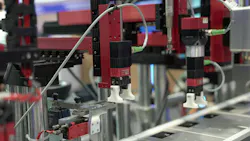
Chelsea Krause: Hybrid motion is one of the trends I'm most excited about. I don't believe the future is simply pneumatic versus electric. We're seeing machine builders use pneumatics, electric actuators, motors, drives, sensing and controls together, choosing the technology that makes the most sense for each motion.
That is also where the combination of AVENTICS and Afag within Emerson becomes really exciting. We can look at motion more holistically, from pneumatic and electric actuation to handling and feeding, and develop technologies that make those different forms of motion easier to apply together.
We're also seeing growing interest in more precise and dynamic pneumatic control. Proportional technologies allow pressure and flow to be adjusted in real time, which can help machine builders improve accuracy, adapt more quickly to product changeovers and optimize performance. It's an area where we continue to see opportunities for new product development and differentiation.
Energy efficiency is another major area of focus. Customers are paying more attention to compressed air consumption at the machine and component level. That is driving greater use of sensing and diagnostics to identify leaks, optimize pressure and better understand how pneumatic systems are performing.
Altogether, motion control is becoming more connected, more precise and more integrated with the rest of the automation architecture. That's opening up some really interesting areas for innovation.
Power & Motion: Are there any new trends you see influencing the fluid power industry in 2027 and beyond? If so, what are those trends and how do you anticipate them impacting fluid power designs and/or the industry?
Chelsea Krause: The lines between fluid power, electric motion and controls will continue to blur. We sometimes talk about electrification as though one technology will simply replace another. I believe the future is more interesting than that. The best machine designs will use the right technology for each motion and make those technologies work together seamlessly.
That also means fluid power components will increasingly be expected to do more than create motion or regulate pressure. Customers will expect greater intelligence, diagnostics, energy management and easier integration into the broader automation system.
For product development, that changes the question. It isn't only, "How do we make a better valve, cylinder or actuator?" It's also, "How do we make that technology easier to select, configure, connect and optimize as part of the complete machine?"
That's a significant opportunity for fluid power. If we make our technologies easier to apply and integrate, pneumatics will continue to be an important part of the next generation of automation.
Power & Motion: What opportunities do you see for the fluid power industry in 2027? Are there any markets you anticipate doing well or offering areas of opportunity in the coming year?
Chelsea Krause: We can't give away all of our trade secrets! But in all seriousness, I am optimistic about the opportunities ahead.
We continue to see attractive opportunities in high-growth areas such as semiconductor manufacturing, medical automation, and the infrastructure supporting data center growth, while established markets including food and beverage, packaging and life sciences continue to create new automation challenges to solve.
I'm equally excited about the technology opportunity. Customers are asking more of their machines: more productivity, more flexibility, better energy efficiency and greater intelligence. That gives us an opportunity to rethink what fluid power can do and how it works alongside electric motion, handling, feeding and controls.
That's what makes this an exciting time for AVENTICS and Afag within Emerson. We have the opportunity to bring together strong motion technologies with broader Emerson automation capabilities, while continuing to invest in new products and solutions driven by the problems our customers are trying to solve.
I don't believe 2027 will be about one technology or one market winning. There is plenty of opportunity for companies that stay close to their customers, move quickly and keep innovating.
About the Author
 Sara Jensen
Sara Jensen
Executive Editor, Power & Motion
Sara Jensen is executive editor of Power & Motion, directing expanded coverage into the modern fluid power space, as well as mechatronic and smart technologies. She has over 15 years of publishing experience. Prior to Power & Motion she spent 11 years with a trade publication for engineers of heavy-duty equipment, the last 3 of which were as the editor and brand lead. Over the course of her time in the B2B industry, Sara has gained an extensive knowledge of various heavy-duty equipment industries — including construction, agriculture, mining and on-road trucks —along with the systems and market trends which impact them such as fluid power and electronic motion control technologies.
You can follow Sara and Power & Motion via the following social media handles:
X (formerly Twitter): @TechnlgyEditor and @PowerMotionTech
LinkedIn: @SaraJensen and @Power&Motion
Facebook: @PowerMotionTech