How Proportional Control Can Improve Paint Operations for Automotive Manufacturers
Key Highlights
- When painting newly manufactured vehicles, there can be paint which doesn’t make it onto the vehicles, called overspray, which can add costs to an OEM’s operation.
- These costs can be reduced when highly responsive proportional control technology like direct-acting pressure regulators are integrated into the robot arms doing the painting.
- Paint robots equipped with these regulators are more efficient at changing spray patterns to deliver the precise flow and pressure required for the angle of spray, leading to less overspray, and thus costs, for automotive manufacturers.
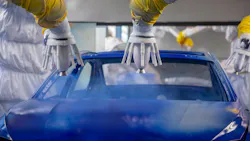
Automotive paint increases a vehicle’s aesthetic appeal and protects it over its lifetime. However, the media can be expensive. Average automotive paint prices have risen by 30% over the last four years, with global prices for leading companies set to increase even more by the end of 2026.
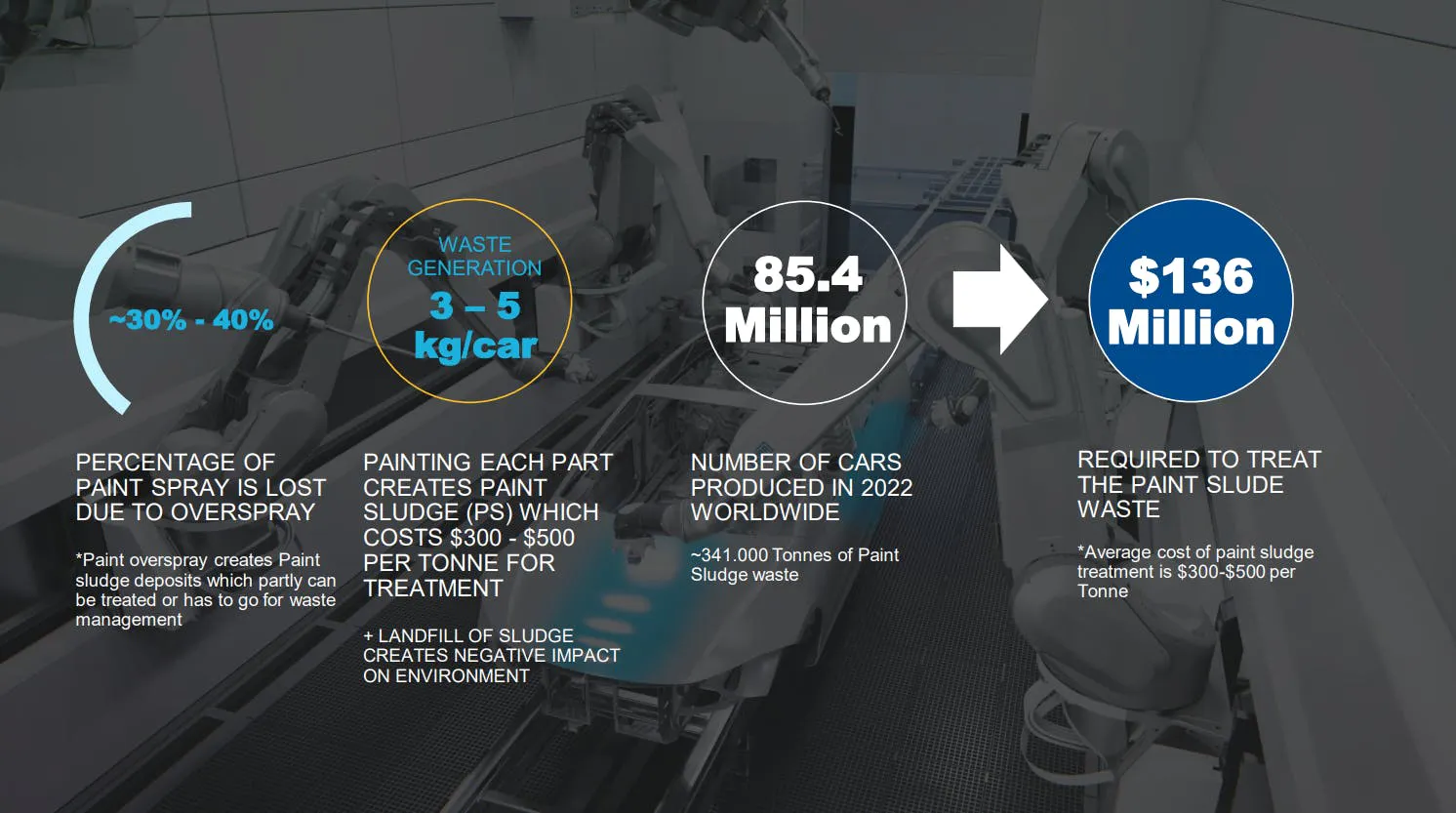
Adding to this trend, roughly 30-40% of paint becomes waste due to overspray. This paint sludge (PS) requires expensive treatment, further increasing costs, and can influence a manufacturer’s environmental impact.
Minimizing overspray and its related costs starts with engineering paint robots that achieve high transfer efficiency during the automotive paint process (see sidebar at the end of this article to learn more about the costs associated with overspray).
Integrating highly responsive proportional control within paint robot arm designs can maximize transfer efficiency, significantly reducing costs for automotive manufacturers while improving finish quality.
Getting to the Root Cause of Overspray is the First Step to Minimizing it
While the need to minimize overspray is evident, the best way to do it may not be. That’s why it’s important to understand what prevents paint droplets from being directed and adhering to the intended surface.
When painting automotive exteriors, automotive paint robot arms quickly move around the body to deliver paint. As the arm constantly changes position, the angle of delivery changes too.
The paint must be directed toward the surface according to each angle. Otherwise, the paint droplets will miss the vehicle body and instead drift through the air. To direct the most paint toward the vehicle exterior, the atomizers in the arm must spray in a specific pattern according to each angle the paint is delivered.
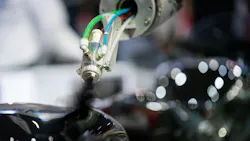
The spray itself is made up of compressed air, otherwise known as shape air, combined with paint media inside the robotic arm. The flow and pressure of this shape air determines the spray pattern of the media. To achieve the necessary spray pattern each angle requires, proportional technologies in the sprayer arm must quickly change compressed air pressure and flow rates.
Transfer efficiency is the way to measure how efficiently automated paint systems use paint media. It’s a ratio that describes how much paint adheres to an intended surface compared to how much paint was sprayed.
High transfer efficiency results in a low amount of overspray, while low transfer efficiency results in a high amount of overspray.
The faster proportional technologies can control compressed air pressure and flow rate changes to match the spray pattern to the angle, the higher the transfer efficiency of the robotic arm.
Direct-Acting Pressure Regulators Provide Paint Robots with Superior Media Control
In automotive applications, automated paint systems with high transfer efficiency ensure that the paint that is sprayed effectively coats the desired surface rather than becomes overspray. This minimizes media consumption and waste for automotive manufacturers and reduces their related costs.
To help automotive manufacturers maximize transfer efficiency and minimize overspray during automated paint processes, it’s critical that automated paint system original equipment manufacturers (OEMs) engineer robotic paint arms with highly responsive and consistent proportional technologies.
Most proportional technologies used in robotic paint arms have a reaction time of 130-150 milliseconds (ms).
However, there are now direct-acting pressure regulators with a response time of 80 ms. This higher level of sensitivity can respond to necessary compressed air pressure and flow rate changes significantly faster than conventional proportional valve technologies as robotic arms move around vehicle bodies.
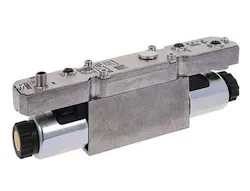
What makes this level of shape air control possible is the regulator’s innovative engineering. It has double solenoid coils on both sides and is programmed with software that features a self-adapting control algorithm.
The valve can directly connect to flow sensors that calculate the exact flow and pressure data that is coming through the valve. Using the self-adapting algorithm, the valve can immediately adjust. This closed feedback loop between the valve and sensors shortens the path that sensor data must travel, skipping the robot controllers altogether.
This closed feedback loop and level of responsiveness mean that paint robots equipped with these regulators are significantly more efficient at changing spray patterns to deliver the precise flow and pressure required for the angle of spray. Self-adapting control algorithms make it possible for robotic arms to detect and quickly adjust if flow and pressure rates deviate from what the process requires.
This solution enables precise control of individual sections of an electrostatic rotary atomizer through pneumatic proportional technology. As a result, key parameters such as shaping air, atomizing cup speed and behavior, bearing air and turbine air in the air motor can be finely adjusted and accurately metered.
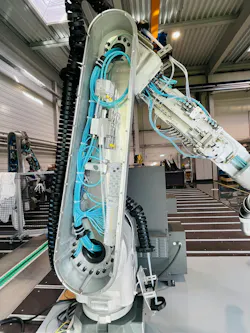
In a paint application process, this level of control helps ensure a highly uniform and repeatable finish, while also supporting optimal transfer efficiency and excellent material utilization. By precisely tailoring the atomization process to the application requirements, the system contributes to consistent coating quality, reduced overspray and improved process stability.
Pre-Engineered Systems Simplify Design Work for OEMs
Some suppliers offer the advanced pressure regulator and flow sensors as part of a pre-engineered, pre-programmed panel. In addition to these components, the compact panel also includes a proportional valve for atomizer control and lightweight valve terminal with AES I/O.
All components are attached to a metal plate that machine builders can install inside a robotic arm and simply plug in pneumatic tubing and electrical connections.
An integrable dew point measurement system also makes it possible to monitor the painting process in real time and take action as soon as the pressure dew point temperature of the spray air falls outside the recommended range of > -30 CTD. This can prevent further scrap and production delays before they occur.
By using plug-and-play offerings when manufacturing automated paint systems, OEMs can streamline component sourcing and minimize in-house engineering. This gives OEMs an advantage by speeding up production, getting to market faster and meeting demand.
Maximizing Paint Spray Transfer Efficiency Minimizes Manufacturing Costs
Overspray is an expensive paint booth challenge. But paint robot OEMs can minimize media waste, paint sludge treatment and process inefficiency using highly responsive proportional control. Accurate paint application with tight controls on material usage can significantly reduce costs related to sludge disposal and media waste as well as environmental impact while achieving higher quality paint finishes.
By engineering robotic arms with superior control behavior, paint robot OEMs optimize paint processes and minimize overspray for automotive OEMs. Robots that are equipped with highly responsive and consistent proportional technologies can dynamically adjust the paint process in real time, ensuring optimal coatings from start to finish.
This article was written and contributed by Manuel Görbert, Segment Marketing Manager, Factory Automation, Emerson.
Understanding the High Cost of Overspray
The media sprayed during automated paint processes is more than just paint. It’s also compressed air, otherwise known as shape air. These two elements combine inside a robotic sprayer arm that then releases the mixed media stream.
Overspray occurs when some paint particles are blown into the air rather than onto the surface of the vehicle. And it’s estimated to cost automotive manufacturers well over $100 million a year worldwide.
The costs add up in two primary ways: excess material cost and waste treatment.
Consider first material cost. High-end cars, for instance, require three to four coats of paint, which can total up to $7,600 per car. If 30-40% of paint becomes waste due to overspray, that’s $2,280-3,040 in media waste per car.
Then, add in waste treatment. Overspray results in about 3-5 kilograms (kg) of PS per car. PS cannot be landfilled, which means that factories must treat it before disposal. This incurs extra labor and process costs that can range in amount depending on region. In the United States, for example, it’s typically $300-500 per ton.
There were 96.4 million cars produced globally in 2025. If painting each of these automobiles results in 3-5 kg of PS, then paint processes generated approximately 341,000 tons of PS. If it costs $300-500 per ton on average to treat paint sludge for disposal, then the worldwide total for 2025 can be estimated at about $136 million.
Added to the cost of media waste, it’s easy to see that minimizing overspray presents a great cost savings opportunity for automotive manufacturers.
About the Author
Manuel Görbert
Segment Marketing Manager, Factory Automation, Emerson
Manuel Görbert is segment marketing manager, Factory Automation, Fluid & Motion Control, at Emerson. With extensive experience in pneumatic and motion control applications for the packaging industry, he partners with OEMs and end users to develop precision control architectures that improve throughput, reliability, and sustainability in high-speed production environments. Manuel supports the AVENTICS™ portfolio of pneumatic solutions for specific target applications.