Robot Makes Elevator Installation a Safer and More Productive Process
Key Highlights
- The Schindler Robotic Installation System for Elevators automates installation of elevator guide rails which has traditionally been a lengthy and physically demanding process.
- Pneumatics play an important role in the operation of the robot by enabling it to perform various tasks such as connecting tools and stabilizing the robot.
- Schindler R.I.S.E demonstrates a growing trend of employing robots in the construction industry to overcome labor challenges while also improving safety and productivity.
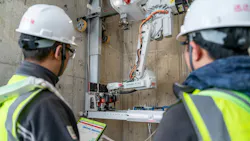
Elevators are a critical part of many buildings, helping people more easily get from one floor to another. But installing those elevators can be a long, labor-intensive process.
The Robotic Installation System for Elevators (Schindler R.I.S.E) developed by elevator manufacturer Schindler aims to change this.
The robot’s intent is not to reduce manpower, “but to remove the repetitive, very labor-intensive, dusty and noisy work from people, and giving it to a machine,” said Faruk Osmanbasic, lead advanced installation technologies at Schindler, in an interview with Power & Motion.
By having a robot take over some of the work — particularly installation of the elevator guide rails which can be a noisy and physically demanding job — the health and safety of personnel can be improved. And skilled technicians can instead focus their attention where it matters most, ensuring precision alignment, guide rail installation and overall ride quality.
During our interview, Osmanbasic offered insight into the technology behind Schindler R.I.S.E, how pneumatics is employed as well as his thoughts on the growing use of robotics in the construction industry.
How the Schindler Robotic Installation System for Elevators Works
The primary function of Schindler R.I.S.E is to install the guide rails critical to the operation of any elevator system. These rails are long, precisely aligned steel tracks that ensure smooth vertical travel which are secured to the elevator shaft walls using brackets, each fixed with multiple anchor bolts.
Installing these bolts has traditionally been a weeks-long project requiring heavy drilling, especially in high-rise buildings that are several stories tall. It is physically demanding work that is performed meter by meter as technicians climb working platforms inside confined shafts. The drilling leads to a lot of vibration and dust exposure for workers to contend with as well.
But Schindler’s robot allows humans to be removed from the strenuous guide rail installation process.
To do so, the robot is mounted on a four-wheel transportation trolley and positioned at a shaft opening, preventing human workers from having to climb into the elevator shaft to place the robot said Osmanbasic. He went on to explain that a built-in driver on the trolley allows the robot to slowly slide into position.
Schindler R.I.S.E is equipped with a winch system that enables it to be suspended and secured by integrated safety mechanisms, allowing it to safely and autonomously move up and down within the elevator shaft and complete its work.
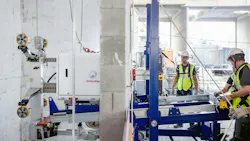
Once in place, the system braces itself securely within the shaft and begins scanning the concrete surface to avoid drilling into steel reinforcement. It drills holes with high precision and installs anchor bolts at pre-programmed heights and positions. Every step follows a detailed digital layout that has been prepared in advance for the specific building.
“We preload the layout of an elevator first,” said Osmanbasic. “Then the robot knows [it has] to stop, for example, at a 5 m height and drill four anchor bolts in the left wall and two on the opposite wall.”
Throughout this process the robot is checking the environment in which it is working to ensure safety and accuracy, and executing the commands it receives.
Osmanbasic noted that the robot uses some of the same technologies as Schindler’s elevators to understand what height it is working at and ensure it is in the correct position. This includes a coated magnetic band and sensors.
Operators are able to monitor the entire process via a tablet interface, where they can follow progress in real time through live camera feeds and performance data.
Watch Schindler's video below to see its elevator installation robot in action.
The Role Pneumatics Play in the Robot Design
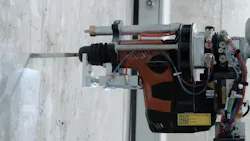
Schindler R.I.S.E relies on pneumatics for various tasks such as stabilizing the robot, connecting tools, as well as cleaning out drilled holes.
Osmanbasic explained that when the robot is in the position where it needs to do its work, it braces itself between two walls using a pneumatic cylinder. “This allows a stable position for drilling,” he said.
The robot also has to use different tools such as the rebar scanner and drilling machine, both of which need to be grabbed by the robot which is pneumatically driven.
“There is an interface [on the robot] so when it needs one tool, it will put the other back on a tool station and grab another one. [Pneumatics create a] rigid connection to that tool,” explained Osmanbasic.
He said there is also a cylinder on top of the robot’s drilling machine which uses pressurized air to clean out drilled holes. Any remaining dust in the drilled holes is removed as is required before inserting the guide rails’ anchor bolts.
Osmanbasic pointed out the many benefits of using pneumatics with Schindler’s robot. For instance, pneumatics is able to handle the tolerances of the elevator shaft wall because high rise buildings are not constructed with millimeter level precision.
“There are some deviations and the stroke of the pneumatic cylinder doesn’t [care] if we are stopping 10 or 20 mm before it reaches its end,” he explained.
Being able to use compressed air for multiple tasks is another benefit he noted.
In addition, Osmanbasic said the widespread availability of pneumatic technologies around the world is also beneficial. This makes it easier to repair or replace parts when necessary or even add something new to the robot.
Robots will Become a Bigger Part of the Construction Industry
Although parts of the construction industry continue to rely on manual work and in general the industry has been relatively conservative about adopting new technologies, that is changing.
A lack of skilled labor entering the industry and the need to increase productivity is driving adoption of advanced technologies, particularly automation — which includes rising use of robots.
Schindler is already seeing this. Since first brought to the market 5 years ago, demand for its Robotic Installation System for Elevators has grown. There are now seven robots operating on projects around the world.
When not at construction sites, the robots are maintained at strategically located hubs where they are serviced between projects. These hubs are positioned in regions where demand is strongest, allowing them to be dispatched quickly and efficiently.
Schindler currently operates hubs in Switzerland, Hong Kong and Australia, and additional hubs are under evaluation in high-growth markets.
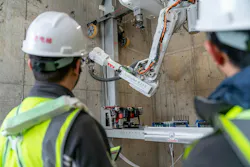
“I think there’s a big future for robots [and automation] in different applications,” said Osmanbasic.
He noted there are already several types of robots being used within the construction industry, such as those for painting, finishing floors or drilling like the Hilti Jaibot.
Besides helping alleviate some of the labor challenges facing the construction industry, robots like Schindler R.I.S.E are also helping to create safer work environments for those on job sites.
They also help to maintain and even improve productivity in many cases. As Osmanbasic noted, the robot can be working continuously overnight if desired so that when workers return to the job site in the morning they can then move on to the next step in the installation process.
Schindler estimates its robot delivers a time savings of up to 40% during elevator shaft preparation and installation. This can greatly benefit project timelines and cost savings.
As the number of infrastructure and other construction projects around the world continues to rise in the years ahead to meet the needs of a growing global population, use of robots like Schindler R.I.S.E will be necessary to ensure they are completed in a safe, productive and efficient manner.
About the Author
 Sara Jensen
Sara Jensen
Executive Editor, Power & Motion
Sara Jensen is executive editor of Power & Motion, directing expanded coverage into the modern fluid power space, as well as mechatronic and smart technologies. She has over 15 years of publishing experience. Prior to Power & Motion she spent 11 years with a trade publication for engineers of heavy-duty equipment, the last 3 of which were as the editor and brand lead. Over the course of her time in the B2B industry, Sara has gained an extensive knowledge of various heavy-duty equipment industries — including construction, agriculture, mining and on-road trucks —along with the systems and market trends which impact them such as fluid power and electronic motion control technologies.
You can follow Sara and Power & Motion via the following social media handles:
X (formerly Twitter): @TechnlgyEditor and @PowerMotionTech
LinkedIn: @SaraJensen and @Power&Motion
Facebook: @PowerMotionTech