Automatic Air-Actuated Collet Closer Eases CNC Operation
Key Highlights
- CNC machine manufacturer Tormach has developed an automatic collet closer that eliminates the need for manual tightening, improving ease of use and productivity for machine operators.
- Use of air actuation for the collet closer brings operational benefits such as lower maintenance as well as the ability to provide consistent and repeatable holding force.
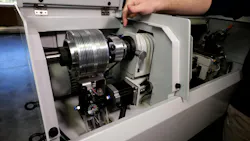
Consistent clamping of tools and parts in CNC machines is necessary to ensure accurate and repeatable machining of products. Collet closers are a commonly used device for holding tools and work pieces on these machines.
Tormach, a U.S.-based manufacturer of CNC machines and automation tools, recently introduced an Automatic Collet Closer for its 8L Lathe. It provides air-actuated clamping for standard 5C collets and integrates with the company’s control software for CNC machines.
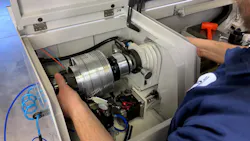
“Without an air actuated collet closer, every time an operator needs to open or close a collet on their lathe, they need to access the rear of the spindle and tighten/loosen a drawtube manually,” explained Nolan Serink, Engineering Manager at Tormach, in an interview with Power & Motion.
By developing a collet closer that can be clamped and unclamped at the push of a button, Tormach aims to eliminate this manual work and provide customers with an easier to use option that will aid their overall productivity. Use of air actuation for the collet closer brings operational advantages as well.
How the Automatic Collet Closer Works
The Automatic Collet Closer is integrated with Tormach’s PathPilot control system to automate the clamping and unclamping of the collet closer. This not only eliminates the need to manually tighten the collet but also helps to ensure this action is done accurately each and every time.
Clamping force is controlled by regulating input air pressure, allowing users to achieve repeatable, adjustable part retention without the need for manual drawtube operation.
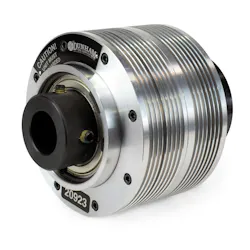
Eliminating manual tightening reduces repetitive operator tasks while improving consistency across runs, particularly in applications requiring frequent part swaps, small-batch production or careful handling of delicate materials. The air-actuated design also enables more repeatable setups, helping machinists maintain part quality while reducing downtime between operations.
“This saves time, adds consistency of clamping force, and enables increased efficiency/automation of part production,” said Serink.
He explained that the collet closer is actuated through Tormach’s PathPilot control software. “The collet closer can be actuated via on-screen control or M-codes in a G-code program. This lets our control software enable safe operation of the collet closer. Customers can not start the spindle when the closer is in the unclamped position,” he said.
“We also have built in bar puller and part counting support in our conversational programming interface that allows users to quickly and easily transition from making a single part to prove out a program to a larger batch.”
The Automatic Collet Closer is compatible with standard 5C collets which Serink said are a popular toolholding option because they offer quick set-up time, good accuracy, and are readily available.
These aspects make them a more desirable option than many others in the market. “Self-centering three jaw chucks are easy to use, but not very accurate. Independent 4-jaw chucks can be very accurate but can take a long time to set up,” said Serink.
And with the Automatic Collet Closer technology, ease of use can be improved for customers using a 5C collet with their 8L Lathe.
Ease of use is an increasingly important design factor for machine builders and their customers — and a key driver for the creation and use of automation solutions — as industries face a skilled labor challenge while also needing to increase productivity to meet continually rising demand for goods.
Tormach’s Automatic Collet Closer demonstrates how technology developers are addressing this industry need in addition to offering an example of the many ways automation is being implemented.
Why Air Actuation was Chosen for the Automatic Collet Closer
Serink said Tormach offers air-actuated collet closers for its lathe machines, all of which can use a 5C collet, although hydraulic-actuated collet closers tend to be more popular in the CNC lathe industry than air-actuated versions.
“Both do the same job of pushing and pulling a drawtube,” he said. “However, as machines and their workpieces get larger, more force is needed to hold larger and heavier work pieces. That higher force requires higher pressure or a larger piston. This is where hydraulic control overtakes air in its practicality and safety.”
Since Tormach lathes use 5C collets, Serink said workpiece sizes are limited to those which are relatively small and lightweight. This is where air actuated collet closers can be very successful.
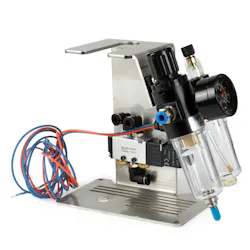
Benefits he noted for using air-actuation instead of hydraulic include air being widely accessible at many customer locations. “Air compressors are readily available, and knowledge of their use is well known. Most customers already have shop air available and do not need to pay for a dedicated hydraulic system for their fluid power source,” he explained.
Another advantage of using air actuation that Serink noted is the lower maintenance offered by pneumatic systems. Although air leaks are common, they do not create a mess like hydraulic leaks do which could damage machined parts or cause environmental concerns. He also pointed out that the lower pressure seals and components used within these systems are more readily accessible and easy to replace.
He said air actuation also provides an easily adjustable and repeatable clamping force. “Having a simple air pressure regulator in the system allows for quick adjustment of clamping pressure.
“When speaking to repeatability, the biggest advantage that the air-actuated collet closer has compared to other work holding alternatives, including manually tightening a collet with a draw tube, is the consistency of the holding force,” he continued. “Keeping the clamping force consistent allows for an increase in repeatability by removing a variable that can affect part consistency. This is especially true for delicate work materials or parts or stock with thin walls.”
Serink concluded by saying that Tormach sees pneumatic systems as an important technology. “It is a clean, readily available, and easy to maintain source of fluid power that enables enhanced automation of CNC machine tools.”
About the Author
 Sara Jensen
Sara Jensen
Executive Editor, Power & Motion
Sara Jensen is executive editor of Power & Motion, directing expanded coverage into the modern fluid power space, as well as mechatronic and smart technologies. She has over 15 years of publishing experience. Prior to Power & Motion she spent 11 years with a trade publication for engineers of heavy-duty equipment, the last 3 of which were as the editor and brand lead. Over the course of her time in the B2B industry, Sara has gained an extensive knowledge of various heavy-duty equipment industries — including construction, agriculture, mining and on-road trucks —along with the systems and market trends which impact them such as fluid power and electronic motion control technologies.
You can follow Sara and Power & Motion via the following social media handles:
X (formerly Twitter): @TechnlgyEditor and @PowerMotionTech
LinkedIn: @SaraJensen and @Power&Motion
Facebook: @PowerMotionTech