iVT Expo 2026: Key Trends Driving Off-Highway Machinery Designs
Produced with support from HYDAC
This show takeover was sponsored by our iVT Expo USA 2026 coverage partner, HYDAC. See more coverage on our iVT Expo USA 2026 page.
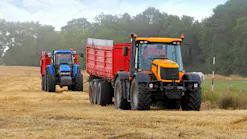
iVT Expo USA is an annual event geared toward engineers and design teams developing mobile off-highway machinery and the technologies utilized in them. The 2026 event took place August 19-20 in Rosemont, IL.
iVT Expo USA 2026 once again provided a look at the technological trends driving off-highway equipment designs. From the conversations I had with companies exhibiting at this year’s show and conference sessions I attended, there were a few key trends and design themes that especially stuck out to me.
Automation Continues to be a Top Design Priority
Development of automated functions and the desire to fully autonomous machine operatoin continues to be a design priority for the off-highway equipment industry. Finding skilled labor is a key challenge for this sector, and will not get any easier as experienced machine operators reach retirement age and leave the industry.
Automation is seen as the way to help overcome this as it can help ease operation for those who are less skilled because the machine can perform certain functions, or complete work that was once reliant on human labor that is no longer available.
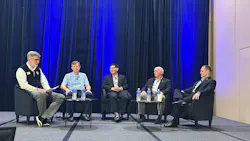
Jason Looman, President of Scanreco North America, said during a panel discussion about automation and the role of hydraulics in enabling it that we’re in a middle ground area with autonomy at the moment where the machine is starting to do some stuff on its own but a human operator is still making the decisions.
Keith Simons, President of OEM Controls, agreed that there are more operator assistance functions on machines now, aiding the move toward higher levels of autonomy.
With the operator still involved in many machine decisions, it is necessitating development of HMI (human machine interface) technology that enables multiple movements to occur at the push of a button or joystick.
As the off-highway equipment industry pushes toward higher levels of autonomy, panelists noted there will be a need for further advancements in sensor technology. In particular, they will need to get smaller and more reliable to help capture all of the data that will be required to enable autonomous operation.
And because the duty cycles in construction and other off-highway applications vary so much, it will be necessary to look at each individual use case or application and design for that to ensure the benefits of autonomy are achieved.
Cybersecurity Will be a Greater Concern Going Forward
Another aspect brought up during the panel discussion on automation was the importance of cybersecurity going forward. In fact, this topic came up during several discussions I had at the show, not all of which were even related to automation.
Because components and systems are becoming more connected and communicating with the cloud or other devices, they are more susceptible to security risks. This means cybersecurity is becoming increasingly important to take into account during the design process.
Batteries and battery chargers, for instance, communicate with the rest of a machine’s powertrain system to indicate charge levels. This means they could be susceptible to security risks which is why cybersecurity features are integrated during the design phase noted Rod Dayrit, Global Director, Business Development for ZAPI GROUP’s charging solutions, during our discussion at iVT Expo USA.
And if you sell products into the European Union (EU), they will soon need to meet the cybersecurity requirements set out by the Cyber Resilience Act (CRA). Hardware and software with digital elements will need to meet these requirements, making it necessary to take cybersecurity into account when developing components and systems for many going forward.
Increased Emphasis on System Solutions
Not a new trend by any means, but the emphasis on providing a system solution that brings together multiple technologies could not be missed at this year’s iVT Expo. A theme that prevailed throughout CONEXPO earlier this year as well, providing system solutions helps ease the design process for equipment manufacturers.
As Chris Kolbe, Senior Vice President of Sales & Marketing at HYDAC, told me, engineering resources are scarce at many OEMs, especially small to large manufacturers, and technology is moving quickly.
Partnering with a company able to offer a system solution can help overcome these challenges though. The technology partner can use its expertise to create a system that meets the application requirements, leaving the OEM free to focus its attention on what it does best, the remainder of the mache design.
Rising implementation of electrification, digitalization and automation in particular are driving the need for system solutions, and with that system integrators capable of helping OEMs develop the systems required to meet these trends.
Many OEMs do not have engineers on staff with knowledge of the technologies used within these systems and so can greatly benefit from working with a supplier or system integrator that can bring together electrification and hydraulic components, for instance, which can then easily be placed into a machine.
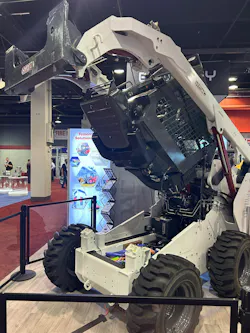
To show how it can offer full system solutions to OEM customers, HYDAC had a skid steer at its booth equipped with several of its technologies — including filters, sensors, hydraulic components, controls and more. The goal is to not only demonstrate the various technology areas in which HYDAC works but also how various components and systems work together to aid machine operation.
Kolbe noted during our discussion that the company is utilizing a new Integrated Systems Approach which looks at how various systems like hydraulics and electronics on a machine work together to better optimize performance.
In addition, the company is using the approach to cross train its engineers. Those with a background in hydraulics are also being educated on sensor and other electronics technologies, and those with a background in electronics are being educated on hydraulics. This way, the company’s engineers can better understand how these two disciplines can be used together and thus be better able to help OEM customers with their design projects.
Through this approach HYDAC is also training its engineers on how a machine or a system works. “We're training our people on these three disciplines, so that when we come to a customer, we can really say holistically, here's what you're trying to achieve, here's some technology and how we can help [you] integrate a system solution for that,” said Kolbe.
Electrification Remains a Design Focus for Off-Highway Machinery
It was evident at iVT Expo that electrification is still a design priority for many OEMs in the off-highway equipment industry. Several companies showed their electric motors and other electrification products — including many from the fluid power industry who were demonstrating how they can bring hydraulic and electric technologies together (again, that whole system solutions things).
A number of presentations during the National Fluid Power Association’s (NFPA) Advanced Hydraulics Conference, held in conjunction with iVT Expo, also focused on how hydraulic systems are evolving to meet the needs of electrification.
Hydraulics will remain important to the functionality of off-highway equipment due to the power density they can provide, even as excavators, telehandlers and other machinery become more hybridized and electrified.
But it is necessary to improve the energy efficiency of hydraulic systems used on electric machines. Doing so reduces battery draw, and thus extends the operational time of electric-powered equipment. To achieve these efficiency gains, it will be necessary to rethink system architectures and incorporate more electrohydraulic technologies, factors discussed by many presenters during the NFPA conference.
Adoption of electrification within mobile off-highway equipment continues to be on an application-by-application basis. What works for one customer or machine type may not work for another, and so much of the development today is focused on determining where and how electrification makes the most sense.
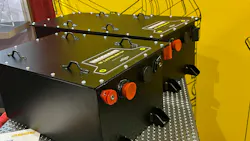
One industry both Vanguard — Briggs & Stratton’s battery brand — and ZAPI GROUP noted during my discussions with them that they are seeing increased interest in electrification is from the agriculture sector. This has traditionally been a difficult sector to electrify due to the long hours machinery spends in the field and the lack of charging infrastructure that would be available.
Vanguard’s Luke Trudell told me the company has seen interest from the agriculture sector really pick up over the last 6-12 months. Some of that has to do with them wanting equipment that is safe to use around their animals and crops, so has no emissions or chances of oil leaks. Growing adoption of automation technologies is also driving the need for more electric technologies on machinery as well — an aspect ZAPI GROUP’s Dayrit also mentioned during our conversation.
Trudell also clarified that the Vanguard technologies are for lower voltage applications, so they won’t be used to power a tractor working all day in a field several miles away from a farm. But, they may be part of a hybrid or idle mitigation system in a small machine that does its work on the farm or within close proximity to it.
This enables a farm to get some of the benefits of electrification, such as reduced emissions and fuel use, without having to worry about operating range which is a concern for many when transitioning to electric-powered machinery.
These trends are of course by no means the only ones influencing off-highway equipment designs. But they help offer a look at where the industry is headed and how hydraulics and other technology suppliers to the sector are adapting to meet ever-evolving machine requirements.
About the Author
 Sara Jensen
Sara Jensen
Executive Editor, Power & Motion
Sara Jensen is executive editor of Power & Motion, directing expanded coverage into the modern fluid power space, as well as mechatronic and smart technologies. She has over 15 years of publishing experience. Prior to Power & Motion she spent 11 years with a trade publication for engineers of heavy-duty equipment, the last 3 of which were as the editor and brand lead. Over the course of her time in the B2B industry, Sara has gained an extensive knowledge of various heavy-duty equipment industries — including construction, agriculture, mining and on-road trucks —along with the systems and market trends which impact them such as fluid power and electronic motion control technologies.
You can follow Sara and Power & Motion via the following social media handles:
X (formerly Twitter): @TechnlgyEditor and @PowerMotionTech
LinkedIn: @SaraJensen and @Power&Motion
Facebook: @PowerMotionTech