A Simulation-Driven Approach to Improving Compressed Air Efficiency
Key Highlights
- Traditional leak audits of compressed air systems are often not able to fully capture the sources of energy waste in these systems.
- A simulation-driven approach using digital modeling of an industrial operation's compressed air system can help better identify where inefficiencies exist and allow testing of improvement options before they are undertaken in the real world.
- Adopting a simulation-driven approach can help shift a manufacturing operation to take a more proactive data-driven strategy to repairs so efficiency, and thus operational costs, is not compromized.
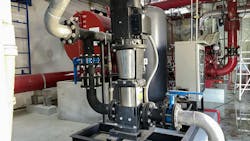
Compressed air is often the most expensive utility in a manufacturing plant, yet it is frequently managed through guesswork and safety margins. While traditional leak audits provide a snapshot of losses, they fail to account for the complex dynamics of distribution and end-use demand.
This article explores how a simulation-driven approach using digital modeling can help reduce operational costs by up to 50% by identifying areas in which efficiency gains can be achieved as well as actionable insights to provide a return on investment (ROI)-ranked roadmap for plant leadership.
How Energy Waste Typically Occurs in Compressed Air Systems
Plant engineering teams rarely choose to waste energy, they typically inherit it. Over years of operation, pneumatic systems undergo "drift" — production lines expand, quick fixes become permanent, and filters or dryers add pressure drops as they age.
To compensate for these invisible inefficiencies, plants often default to a high-risk strategy: raising header pressure. This band-aid fix masks local pressure drops but creates a "hidden tax" on the entire facility. Every unnecessary increase in pressure amplifies leak rates and drives up the compressor’s power consumption.
Simulation-driven engineering, however, can help make these hidden costs visible. By digitally modeling airflow and pressure drops, plants can test improvement scenarios, such as piping resizing or end-use substitutions, before spending a dollar on hardware.
Case Study: Aluminum Recycling Plant Improves Efficiency with Digital Modeling
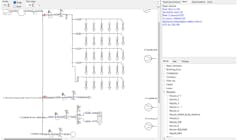
To demonstrate the positive impact digital modeling can have on improving a manufacturing facility’s compressed air system, let’s analyze an aluminum recycling plant system with an annual compressed air operating cost of approximately $365,000. The baseline assessment revealed an average demand of 2,295 scfm (standard cubic feet per minute, i.e., the flow rate of gas or air) at a compressor room pressure of 94 psi (6.5 bar).
By creating a digital twin of the facility, the model was calibrated to monitor demand with a deviation of only 5%. This high degree of accuracy allowed the engineering team to pinpoint exactly where the money was being lost.
Finding 1: The High Cost of Peak Demand
On Production Line 1, the model connected specific operating phases to massive consumption peaks. Specifically, a cleaning phase and a main operating block were quantified at 549 scfm, costing the plant $135,000/year.
The simulation revealed that high pressure losses at the air knives — a tool for blowing material off of a product — were forcing the plant to maintain a higher overall setpoint just to keep this one line functional.
Finding 2: The "Utility Misuse" Trap
On Production Lines 2 and 3, the model showed that pneumatic actuators (cylinders) represented less than 5% of total air consumption. The real culprits were high-flow utility users: cooling, blow-offs, and open tubes.
This is a common pattern in mature recycling plants; actuators get the maintenance attention because they move, but static blow-offs consume the budget.

Simulation Identifies Opportunities for Efficiency Gains
The simulation identified two primary levers that consistently deliver the highest ROI for heavy industrial environments.
Read More About Efficiency in Pneumatics and Other Systems
Improve Pneumatic System Efficiency: Key Steps to Follow
Intelligent and Efficient Designs Key to Longevity of Pneumatics
Filters Play Important Part in Compressed Air System Efficiency
Industrial Applications Require Smart and Efficient Fluid Power Systems
Efficient Technology Development is on the Rise
Lever A: Optimizing Distribution
Pressure loss is a tax paid twice: once at the compressor and again in reduced tool performance. For Line 1, the model recommended increasing internal diameters to ≥1.57 in. (4 cm) for the main tube.
By reducing distribution constraints, the simulation proved the plant could safely lower compressor pressure to 83 psi (5.7 bar) without starving critical end-users during peak casting cycles.
Lever B: Fit-for-Purpose Substitutions
The model identified opportunities to replace high-flow open tubes with electric blowers or high-efficiency nozzles. These substitutions directly reduce flow demand, providing a faster payback than system-wide piping overhauls.
Simulation Results Provide Actionable Steps for Plant Personnel
Many energy auditing campaigns fail because they lack a path to execution. The "Actions Layer" converts simulation results into a project portfolio that aligns four key stakeholders at a manufacturing plant:
- Operations: Validates that changes won't disrupt uptime.
- Engineering: Provides the technical specs for piping and nozzle retrofits.
- Finance: Receives a defensible ROI based on modeled energy savings.
- Sustainability: Tracks measurable reductions in carbon footprint.

Simulation-driven efficiency moves plant management from a reactive "fix-on-fail" mindset to a proactive, data-driven strategy. By making the compressed air chain transparent — from the compressor room to the air knife — industrial operations such as aluminum recycling plants can unlock savings of 20-50%.
More importantly, they gain a living model that can evolve alongside their production needs, ensuring that today's efficiency gains aren't lost to tomorrow's system drift.
This article was written and contributed by Dr. Elvira Rakova, CEO of Direktin which offers simulation software for compressed air systems.
About the Author
Dr. Elvira Rakova
CEO, Direktin
Dr. Elvira Rakova is the CEO of Direktin, a developer of simulation software for compressed air systems. She specializes in simulation-driven methods for industrial compressed air and pneumatic efficiency. Her work helps manufacturing plants reduce energy costs and improve system reliability through demand-side modeling and return on investment (ROI)-ranked implementation roadmaps.