Simulation Improves Hydraulic Seal Development
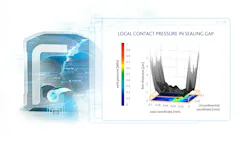
Freudenberg Sealing Technologies has created its first pressure seal developed entirely through use of simulation. Doing so enabled the company to improve the design of its Simmerring radial shaft seals for hydraulic systems in terms of service life and reliability.
The company used an in-house development tool called FIRS3T, or Freudenberg Integrated Radial Shaft Seal Simulation Tool, created by Freudenberg Technology Innovation — the central corporate research department of the Freudenberg Group.
Freudenberg Sealing Technologies supplied all the practical development parameters for the pressure seal to the innovation team which used this information to program the fully coupled EHL (elastohydrodynamic lubrication) simulation model that would be used to design the seal.
According to the company, this was a challenging task because of the various design factors which need to be considered such as the complex fluid dynamics that occur when the shaft rotates relative to the sealing ring. But through the close collaboration of the two Freudenberg teams, and several years of development, they were able to develop a usable simulation model.
How Simulation Improved the Seal Development Process
Simulation tools are commonly used throughout the development process today to test and determine design attributes. They make it easier to evaluate several iterations quickly, leading to faster product development and opportunities to improve designs — both of which Freudenberg was able to achieve with its simulation-developed seal.
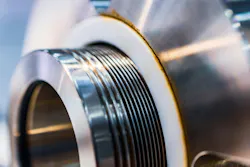
While radial shaft seals are commonly used in a variety of industries, and therefore a relatively understood technology, Freudenberg said in its press release announcing its new seal design that many aspects of what exactly happens in the contact between the seal and the shaft remain unclear because they are not easily observable.
Use of the FIRS3T simulation model, however, is able to provide better visibility into how the seal works because it provides precise, traceable predictions of the sealing performance under varying loads and conditions.
This is enabled through the vast amount of knowledge built into the simulation model, including that related to influencing variables such as:
- realistic surfaces in contact between the sealing ring and shaft,
- macroscopic aspects such as a contact pressure distribution,
- the distortion of the seal in dynamic operation, and
- lubricant simulation with viscosity and flow factors on the surfaces.
These variables can all be adjusted as desired in the simulation to gain better insight into how they will influence seal performance so that an optimized final design is chosen. With this capability, the company was able to find ways to improve upon its existing seal design.
Like many simulation tools, FIRS3T helped Freudenberg speed up the overall design process as well. The company said it was able to get to the prototype stage in days. And it was only necessary to physically validate one prototype.
In the past, several prototypes were required which created a months-long development process. It was labor- and cost-intensive due to the tooling and physical validation required for each prototype.
This could all be reduced though because so much of the seal’s design could be proofed out in the simulation model, leading to more confidence about the design going into the prototyping stage.
“For the radial shaft seal, the results from FIRS3T closely matched the values actually measured with the prototype seal. This confirms the high reliability of the simulation process,” said Dr. Daniel Frölich, Technical Director of the lead center Simmerring Industry at Freudenberg Sealing Technologies in the company’s press release.
“The simulation model is a milestone in our development process and holds strong potential for future applications,” said Dr. Frölich. “FIRS3T enables us to push physical boundaries and develop seals with even better performance parameters than ever before — and much faster.”
Design Features Achieved for the Pressure Seal
The pressure seal is available to customers. It is designed for use in a range of hydraulic pump and motor applications operating at various pressure levels noted Freudenberg Sealing Technologies in its press release.
Per the company, the seal features a redesigned sealing lip with an optimal contact width under all pressure conditions. This enables good wear behavior to be achieved at pressures up to 5 bar (73 psi). It also provides robust sealing at lower temperatures.
“This ability to withstand dynamic pressure cycles makes the seal ideal for demanding fluid system applications,” said Dr. Frölich in Freudenberg’s press release.
Watch Freudenberg's video below to learn more about its Simmerring radial shaft seals.
Freudenberg Sealing Technologies plans to make FIRS3T a standard tool used during the development process going forward. The company sees it benefitting the development of seals for various applications, including those used in wind turbines that can have diameters as high as 2 m (78.7 in.) — and typically require a high level of prototyping and testing costs.
Freudenberg expects the simulation tool will help reduce the amount of prototyping and costs associated with these seals as well. The simulation model will continue to be refined as well as it gets used more to further improve the seal development process.
About the Author
 Sara Jensen
Sara Jensen
Executive Editor, Power & Motion
Sara Jensen is executive editor of Power & Motion, directing expanded coverage into the modern fluid power space, as well as mechatronic and smart technologies. She has over 15 years of publishing experience. Prior to Power & Motion she spent 11 years with a trade publication for engineers of heavy-duty equipment, the last 3 of which were as the editor and brand lead. Over the course of her time in the B2B industry, Sara has gained an extensive knowledge of various heavy-duty equipment industries — including construction, agriculture, mining and on-road trucks —along with the systems and market trends which impact them such as fluid power and electronic motion control technologies.
You can follow Sara and Power & Motion via the following social media handles:
X (formerly Twitter): @TechnlgyEditor and @PowerMotionTech
LinkedIn: @SaraJensen and @Power&Motion
Facebook: @PowerMotionTech