Hydraulic Cylinder Seal Selection: A Material Compatibility Guide
What You'll Learn
- The four elastomer materials commonly used for hydraulic cylinder seals.
- The pros and cons of each elastomer type and when to use each.
- Steps for choosing the right seal material for a hydraulic cylinder.
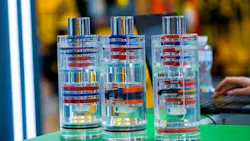
Selecting the wrong O-ring material for a hydraulic cylinder is one of the most expensive mistakes in fluid power maintenance. The seal itself costs a few dollars. But the unplanned downtime, fluid cleanup, and cylinder rebuild that follow a premature seal failure cost orders of magnitude more.
The challenge is that hydraulic cylinders operate across a wide envelope of fluids, pressures, temperatures, and duty cycles. A material that performs reliably in a 70-bar mineral oil circuit will dissolve within weeks in a phosphate-ester fire-resistant system.
Getting material selection right at the specification stage eliminates the single largest category of preventable seal failures in hydraulic service.
This guide covers the four elastomer families that account for the vast majority of hydraulic cylinder seal applications, matched against the fluid types and operating conditions where each one belongs.
The Four Primary Elastomer Families Used for Hydraulic Cylinder Seals
Seals can be made from various materials, but those used in hydraulic cylinders are commonly made from one of four elastomer families:
- nitrile butadiene rubber (NBR)
- fluoroelastomer (FKM)
- ethylene propylene diene monomer rubber (EPDM)
- perfluoroelastomer (FFKM)
Each type has its pros and cons as well as use cases for which it is best suited.
NBR: The Mineral Oil Workhorse
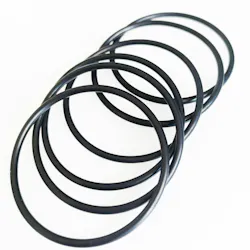
Nitrile butadiene rubber, commonly referred to as nitrile rubber or NBR, is the default seal material in conventional hydraulic systems for good reason. It offers excellent resistance to petroleum-based hydraulic fluids — HH, HL, HM, and HV grades per ISO 6743-4 — along with good mechanical properties, low compression set, and a favorable cost profile.
NBR is suitable for continuous service from -40 to 120 C (-40 to 248 F). Most 70 Shore A NBR compounds handle working pressures up to 25 MPa in static seal applications with properly designed grooves, without backup rings.
However, NBR has no resistance to phosphate-ester fluids (HFD-R), poor resistance to polyol-ester biodegradable fluids (HEES), and degrades with prolonged exposure above 120 C. It is also unsuitable for systems where ozone exposure is significant, such as outdoor mobile equipment with long idle periods.
NBR is Best for: Standard industrial hydraulics, mobile equipment running mineral oil, and applications with low-to-moderate temperature service.
Fluoroelastomer: Best for High Temperature and Synthetic Fluids
FKM — sometimes referred to as Viton, the brand that develops it — is the step-up material when NBR reaches its limits. It handles continuous service temperatures from -20 to 240 C (-4 to 464 F). FKM resists most petroleum-based fluids, synthetic hydrocarbons, and many aggressive chemicals that would destroy NBR.
In hydraulics, FKM is the correct choice for:
- Systems operating above 100 C (212 F) continuous fluid temperature.
- Circuits using polyalphaolefin (PAO) or other synthetic hydrocarbon fluids.
- Applications where fluid contamination with fuels, solvents, or cleaning agents is possible.
- High duty cycle cylinders where adiabatic heating at the rod seal generates localized temperatures well above bulk fluid temperature.
The primary limitation of standard FKM in hydraulic applications is poor low-temperature performance. Standard FKM compounds stiffen significantly below -15 C (5 F). For cold-climate mobile equipment, low-temperature FKM grades (GFLT-type) extend the range to approximately -40 C at additional cost.

FKM is Best for: High-temperature hydraulics, synthetic fluid systems, mobile equipment near heat sources, and cylinders with aggressive duty cycles.
EPDM: A Good Option for Use with Phosphate-Ester Fire-Resistant Fluids
Ethylene propylene diene monomer rubber is a niche material in hydraulic applications, but it fills a critical role — it is one of the few elastomers compatible with phosphate-ester fire-resistant hydraulic fluids (HFD-R per ISO 12922).
These fluids are standard in steel mills, aluminum smelters, foundries, and other facilities where a hydraulic line rupture near molten metal or open flame would create a catastrophic fire hazard.
EPDM offers excellent resistance to phosphate esters and water-glycol fluids (HFC per ISO 12922). Its temperature range of -50 to 150 C (-58 to 302 F) is adequate for most fire-resistant fluid applications.
The critical constraint with EPDM is that it is completely incompatible with petroleum-based fluids. It will swell rapidly and fail in any system running mineral oil, and even trace contamination with petroleum products can cause problems. This means EPDM seals must be segregated during storage and handling — a stray EPDM O-ring installed in a mineral oil cylinder will fail in days.
EPDM is Best for: Fire-resistant hydraulic systems using phosphate-ester or water-glycol fluids. This material is not suitable for any petroleum-based system.
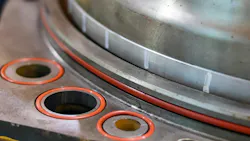
FFKM: Suitable for Extreme Chemical and Temperature Service Applications
Perfluoroelastomer is the material of last resort when no other elastomer can survive the operating environment. It offers near-universal chemical resistance comparable to PTFE (polytetrafluoroethylene), combined with the elasticity and sealing performance of a true elastomer. Temperature ratings extend to 300 C (572 F) continuous for most compounds.
In hydraulic systems, FFKM is well suited for:
- Chemical processing hydraulics where the sealed fluid is highly aggressive (strong acids, amines, steam).
- Ultra-high-temperature applications exceeding FKM's upper limit.
- Semiconductor and pharmaceutical systems requiring extreme purity and broad chemical compatibility.
FFKM seals cost 50-100 times more than equivalent NBR options. This cost is rarely justified in conventional hydraulic service, but for the applications where it is needed, no other elastomer will survive.
FFKM is Best for: Extreme chemical exposure, ultra-high temperatures, and applications where seal failure has catastrophic safety or contamination consequences.
Seal Material Selection Requires an Understanding of More Than Just Fluid Compatibility
As a general rule, NBR and FKM are the go-to materials for petroleum-based hydraulic systems, while EPDM is reserved for phosphate-ester and water-glycol fire-resistant fluids.
FFKM covers the extremes where no other elastomer survives.
However, compatibility is never a simple yes-or-no decision. Ratings vary by specific compound formulation, additive package, operating temperature, and exposure duration. A compound that performs well in one manufacturer's HFC fluid may not behave identically in another's.
For any non-standard fluid or critical application, compound-specific immersion test data (ASTM D471) from the seal supplier is the only reliable basis for material selection — generic compatibility charts should be treated as a starting point for narrowing options, not as a specification basis.
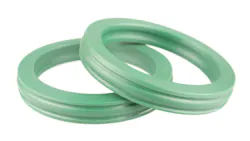
For engineers specifying hydraulic cylinder seals, there are six key steps to follow to ensure the right seal material is chosen:
- Identify the hydraulic fluid — not just the category, but the specific product and its additive package.
- Establish the temperature envelope — continuous operating temperature, peak transient temperature, and minimum cold-start temperature.
- Confirm pressure and dynamic requirements — working pressure, pressure spikes, and whether the seal is static, reciprocating, or rotary.
- Select the elastomer family based on the fluid compatibility outlined above.
- Verify groove dimensions — material selection and groove design are interdependent. Higher-hardness compounds for high-pressure service require tighter extrusion gap control. Using an O-ring groove calculator can help verify that squeeze ratio, gland fill, and extrusion gap are within specification for the selected material and operating conditions.
- Confirm with immersion test data — for any non-standard fluid or critical application, request ASTM D471 immersion test results from the seal supplier for the specific compound-fluid combination.
Hydraulic cylinder seal material selection can be reduced down to a systematic matching exercise: fluid chemistry drives the elastomer family, temperature range narrows the compound choice, and pressure determines the hardness and groove design requirements.
The four elastomer families covered here — NBR for mineral oil, FKM for high temperature and synthetic fluids, EPDM for phosphate esters, and FFKM for extreme service — address the full spectrum of hydraulic applications.
Getting this decision right at the design stage is straightforward. Getting it wrong though can trigger a predictable cycle of premature failures, repeat rebuilds, and escalating maintenance costs that far exceed the cost of selecting the correct material in the first place.
This article was written and contributed by Xing Hong, founder of WRKR Seal.