Designing Hydraulic Fluids and Lubricants for the Electrified Era
Key Highlights
- Electrification of industrial and mobile machinery is bringing a number of design changes, including to the hydraulic oils and lubricants utilized in these machine.
- Changes to system architectures and component types is placing new performance demands on the fluids used within machines.
- Future fluid strategies are likely to include increased use of synthetics, biodegradable options, and tailored formulations for specific subsystems.

As the power sources behind industrial and mobile equipment change, so too must the fluids that keep those systems running. While electrification brings efficiency and environmental gains, it also introduces new operational challenges — ones that demand smarter, more resilient hydraulic fluid and lubrication technologies.
In the past, the hydraulic and lubrication needs of construction and other mobile equipment were relatively predictable. Internal combustion engines supplied power to centralized hydraulic systems, and fluid formulations were optimized accordingly.
But today, the shift toward electrification, whether in the form of fully electric or hybrid designs, is changing not just the powertrain but the architecture of machines themselves. That evolution is creating more compact systems, higher heat loads, tighter tolerances, and new demands on every fluid in a machine.
Move to Compact Systems Increases Performance Demands for Hydraulic Fluids and Lubricants
Electrified drive systems and actuators are replacing or supplementing traditional hydraulics, creating opportunities for lighter, quieter machines through use of more compact systems. But those benefits come with trade-offs.
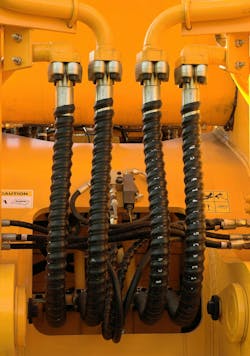
Smaller, distributed systems must still deliver the same, or better, performance under increasing thermal and mechanical stress.
As systems shrink and compartmentalize, fluid reservoirs are getting smaller. This means hydraulic fluids and lubricants must now withstand higher loads for longer periods without breaking down. Fluids today must demonstrate improved oxidation stability, thermal durability, and resistance to varnish and deposits.
For many applications, the bar for what qualifies as “high performance” is being raised.
Multi-Grade Fluid Formulations May Better Meet System Requirements in Electric Vehicles
In this new era of electric vehicles, there’s a renewed focus on fluid optimization, but some long-standing myths persist. A common misconception is that using a higher-viscosity fluid in warmer climates (or a lower-viscosity one in colder regions) is a smart seasonal swap. In practice, this approach introduces inefficiencies and compromises equipment longevity.
Multi-viscosity fluids, whether mineral, semi-synthetic, or fully synthetic, are designed to perform across a broad temperature range, eliminating the need for seasonal change-outs. And contrary to another myth, high-viscosity-index (VI) fluids are not exclusive to synthetics. Advanced mineral-based fluids can achieve wide operating windows with proper formulation, offering a balanced option between conventional and synthetic performance.
The key is not about going lower or higher in viscosity; it’s about hitting the optimal range for the equipment. When the fluid is too thick, it strains the system. Too thin, and protection suffers.
Multi-grade formulations, when properly engineered, provide shear stability, cold-start protection, and sustained performance even in high-load or high-temp applications, which are qualities increasingly vital in today’s compact, electrified systems.
Electrification Places Greater Emphasis on Fluids Enabling Cleaner, Quieter, Longer Lasting Systems
Electrification also puts a spotlight on fluid cleanliness and lifecycle. With electric systems reducing engine noise, secondary noises (like those from actuators, pumps, and even grease-lubricated joints) are suddenly more noticeable.
Improper lubrication of hinge or pivot points, for instance, can lead to noisy, worn-out joints that degrade the performance of equipment and disrupt job site operations.
There’s also less room for contamination. Advanced servo valves and electronically controlled actuators demand extremely clean oil to operate reliably. Whereas older systems may have tolerated some dirt, modern equipment requires ISO cleanliness levels that are much tighter, down to 18/16/13 or even lower. That means fluids must not only perform better but also interact more precisely with onboard sensors that track degradation and performance in real time.
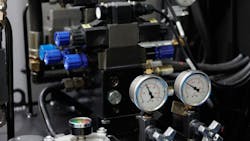
Varnish control is also becoming a more urgent priority. Increased thermal and mechanical loads in newer systems make hydraulic fluid more prone to deterioration. This oil degradation leads to the formation of varnish, which typically deposits in the cooler, low-flow zone.
Varnish buildup can degrade valve performance, increase downtime, and skew sensor readings. To mitigate these issues, operators and equipment owners should select hydraulic fluids formulated with varnish-resistant additive technologies that help prevent deposit formation, maintain valve responsiveness, and support cleaner system operation over time.
At the same time, OEMs are pushing for extended drain intervals of 6,000-8,000 hours or more, which means fluids must maintain their protective and performance properties longer than ever before. These demands are accelerating the industry-wide shift to more thermally stable base oils and carefully balanced additive packages.
Future Design Considerations for Hydraulic Fluids and Lubricants
One might assume that as electrification grows, fluid complexity declines. But in fact, the opposite is true. The rise of electrified subsystems, each with its own power unit and actuator, gives OEMs more freedom to optimize at the component level. That means some systems may use synthetics while others operate on mineral or biodegradable fluids.
Fill-for-life strategies may apply in some areas, while others still require regular fluid change-outs. One size no longer fits all.

Meanwhile, the role of digitalization in fluid management is expanding. Smart equipment can track everything from temperature spikes to contamination levels, enabling condition-based monitoring and maintenance. That creates an opportunity — and a responsibility — for fluid suppliers to design products that not only perform well but register clearly and consistently in sensor readings.
Looking ahead, data will reshape not only fluid monitoring but system design itself. As operators collect more granular performance data, OEMs are gaining insights into which hydraulic subsystems are being overworked, underused, or wearing out prematurely.
That knowledge can help inform decisions about redesigning centralized hydraulic systems into smaller, specialized units that are better tailored for specific tasks. These smaller, task-specific systems may call for their own optimized fluids, further fueling demand for precision chemistry.
In tandem, expect to see:
- Continued development of oxidation-resistant, varnish-mitigating hydraulic fluids.
- Greater adoption of synthetic and multi-viscosity products across a wider range of environments.
- Increased demand for biodegradable and environmentally acceptable fluids, especially in applications near sensitive ecosystems.
- Closer collaboration between OEMs and fluid suppliers to align fluid specs with evolving system designs.
Ultimately, the transition to electrified equipment doesn’t eliminate the need for high-performance fluids; it elevates it. In a world where efficiency, uptime, and sustainability are more critical than ever, choosing the right hydraulic fluid and lubricant is no longer just a maintenance decision. It’s a strategic one.
This article was written and contributed by Zhen Zhou, Senior Scientist, Chevron.