CONEXPO 2026 to Highlight Rising Emphasis on Full-System Solutions
Key Highlights
- Ajay Gandhe and Garrett McClain from Danfoss Power Solutions see the need for full-system solutions increasing in the construction equipment industry.
- In addition to advancements in fully integrated systems, Gandhe and McClain anticipate developments related to automation and digitalization to be showcased at CONEXPO 2026.
- Greater integration of electronics and software into hydraulic systems over the coming years will help meet the need for fully integrated solutions and other construction equipment design requirements.
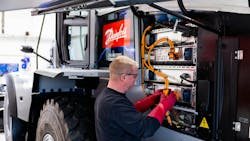
Technological advancements in automation and digitalization, as well as other broad industry trends impacting the design of construction equipment and the hydraulics utilized in these machines, are expected to be among the highlights at CONEXPO-CON/AGG 2026.
But for Ajay Gandhe, Vice President, Regional OEM Sales and Garrett McClain, Director, Application Engineering, at Danfoss Power Solutions, a key theme they expect to see at this year’s show is the increasing emphasis construction equipment manufacturers are placing on the need for full system solutions.
According to Gandhe, having the ability to offer a complete system helps OEM customers speed up time to market as well as manage costs and risks. These are increasingly important factors for OEMs as they look to navigate evolving, and sometimes challenging, market dynamics.
CONEXPO-CON/AGG is one of the largest events for the construction industry, and thus the hydraulics and other technology suppliers to it. Visit our CONEXPO 2026 page for more content related to this year's show, including additional Q&As with fluid power companies exhibiting at it.
Power & Motion spoke with Gandhe and McClain about the growing requests they see from OEMs for full-system solutions, other trends they expect to see showcased at CONEXPO 2026 as well as how they see hydraulics used in construction equipment evolving over the next several years.
*Editor’s note: Questions and responses have been edited for clarity.
Power & Motion: What are some of the technologies or other aspects you are most looking forward to seeing at CONEXPO 2026?
Ajay Gandhe: CONEXPO has always set the technology and innovation roadmap for the next decade, and 2026 feels particularly significant. After several years shaped by COVID, supply chain disruption, and geopolitical uncertainty, this will be a truly full‑scale CONEXPO, addressing both near‑term market realities and long‑term transformation.

Beyond technology, CONEXPO 2026 will also reflect broader industry dynamics. Regionalization, geopolitical influences, and the pressure to accelerate time‑to‑market will shape OEM strategies. I am particularly interested in the growing influence of Far East OEMs in the Americas and how this impacts platform strategies and competitive positioning. Rental companies, which play a critical role in the North American construction equipment market, will also have an important voice, especially around balancing advanced features, tariffs, and the need for standardized, cost‑effective platforms.
From a Danfoss perspective, it will be exciting to see how OEMs translate innovation into execution. We are especially interested in how system‑level solutions improve productivity, efficiency, and sustainability in real‑world applications.
Power & Motion: What do you think will be some of the biggest themes or technological trends exhibited at this year’s show?
Ajay Gandhe: Given the current business environment, one of the biggest themes will be speed — specifically, how OEMs can accelerate time‑to‑market while managing cost and risk. This is driving a stronger need for Tier 1 partners who can provide complete system solutions, support concurrent engineering, and take a more active role in validation.
Danfoss is uniquely positioned to support this shift. Our global Application Development Centers, including world‑class capabilities in the United States, allow us to partner closely with OEMs on co‑development, system validation, and machine testing. This approach helps customers reduce development cycles and move more quickly from innovation to revenue realization.
Power & Motion: Are there new trends entering the hydraulics and construction equipment industries that are likely to be showcased, or will it be some of the same trends we’ve seen over the years such as automation and electrification?

Garrett McClain: The industry is clearly evolving rather than resetting. Automation and electrification remain major trends, but the conversation has moved beyond individual components toward fully integrated systems. It is no longer just about an electric motor; it is about a complete electric or hybrid solution that includes controls and software to optimize performance.
We are also seeing a much stronger emphasis on digitalization and autonomy. Machines are becoming smarter and more connected, enabling improvements in efficiency, safety, and uptime. At CONEXPO 2026, these technologies will be showcased as part of cohesive, optimized system architectures rather than standalone innovations.
Power & Motion: Electrification has been a dominant trend in recent years, but seems to have cooled some in the past year or so. Is electrification still an important development area for your company and its customers in the construction equipment and other mobile equipment applications?
Ajay Gandhe: Electrification remains important, but the discussion has become more pragmatic. With incentives declining, OEMs are focusing on two key areas: the readiness of the supporting ecosystem — such as charging infrastructure, power costs, and battery capacity — and the return on investment without subsidies.
As a result, many electrification efforts today remain technology demonstrators, and full commercialization may take additional time. Hybrid solutions are gaining momentum as a practical alternative, offering efficiency and emissions benefits while working within existing infrastructure constraints.
Garrett McClain: While some of the early hype has cooled, electrification continues to be a critical development area for Danfoss and our customers. We see it as one of several important pathways to decarbonization and improved efficiency. That is why we continue to invest across fully electric and hybrid solutions.
At CONEXPO, our booth will feature a direct comparison of hydraulic and electric architectures. This reflects our application‑driven approach, selecting the best technology for the job rather than promoting a one‑size‑fits‑all solution. We offer both pre‑engineered and fully customizable systems to meet specific customer needs.
Power & Motion: Are you able to share what themes or technology areas your company will be showcasing at its CONEXPO booth this year?
Garrett McClain: The Danfoss booth will showcase our expertise across the full spectrum of mobile machinery technologies. This includes our core strengths in hydraulics and eHydraulics, as well as electrification, digitalization, autonomy, and software.
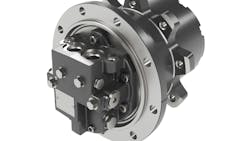
We will focus on critical subsystems — propel, work, steer, and control — demonstrating how integrated hardware and software solutions deliver higher performance, precision, and safety. We will also be launching new products such as the BMV Integrated Drive Motor and the ICMB Industrial Cam Lobe Motor. Our objective is to show how a systems approach helps customers build more efficient, precise, and safe machines.
Ajay Gandhe: In parallel, we will emphasize how we work with our customers. Danfoss has invested significantly in Application Development Centers to strengthen our ability to partner on co-development, system validation, concurrent machine testing, and optimization of existing architectures.
Beyond products and systems, cybersecurity will be another important focus. As machines become more connected, meeting the latest cybersecurity standards is essential, and Danfoss is committed to helping customers address this critical requirement.
Power & Motion: What are some of the features or capabilities OEMs in the construction equipment market are looking for currently from their hydraulic components and systems?
Ajay Gandhe: OEMs are increasingly focused on regionalization, modularity, and scalability. They are looking for tiered product offerings (e.g. value, standard, and premium) that allow them to address different market segments while maintaining common platforms. Speed to market and the ability to partner closely on product engineering are also key expectations. Leveraging a global footprint to deliver “local for local” manufacturing and support is becoming increasingly important, not just in North America but across all regions.
Garrett McClain: In addition to these priorities, OEMs are looking for partners who can deliver complete, optimized systems rather than individual components. This includes deeper integration of hardware and software to enable precise control, improved efficiency, enhanced safety, and data driven insights.
Flexibility and customization are also critical. Modular, scalable solutions allow OEMs to tailor systems to specific machine requirements. Through our Application Development Centers, we work closely with customers to test, benchmark, and validate solutions that meet evolving performance, connectivity, and uptime needs.
Power & Motion: How do you see the use of hydraulics in construction equipment continuing to evolve in the next 5 years?
Garrett McClain: Hydraulics will remain a core technology, but it will become increasingly integrated with electronics, software, and electrification. The future lies in eHydraulics, combining the power density of hydraulics with the intelligence of advanced controls to deliver greater precision, efficiency, and automation.
Sustainability will also drive evolution, extending beyond energy efficiency to include lifecycle considerations such as sustainable materials, green manufacturing, and circular design. As machines become more connected, cybersecurity will become even more critical, along with IoT (internet of things) and data analytics that enable predictive maintenance and data‑driven optimization.
Ajay Gandhe: I also see autonomy becoming increasingly real in practical applications. Electrification will continue to make inroads, particularly in small and mid‑size machines, as the supporting ecosystem matures.
With our broad product portfolio, system expertise, software capabilities, manufacturing footprint, and application development strength, Danfoss is well positioned to continue leading the industry as hydraulics and mobile machinery technologies evolve.
About the Author
 Sara Jensen
Sara Jensen
Executive Editor, Power & Motion
Sara Jensen is executive editor of Power & Motion, directing expanded coverage into the modern fluid power space, as well as mechatronic and smart technologies. She has over 15 years of publishing experience. Prior to Power & Motion she spent 11 years with a trade publication for engineers of heavy-duty equipment, the last 3 of which were as the editor and brand lead. Over the course of her time in the B2B industry, Sara has gained an extensive knowledge of various heavy-duty equipment industries — including construction, agriculture, mining and on-road trucks —along with the systems and market trends which impact them such as fluid power and electronic motion control technologies.
You can follow Sara and Power & Motion via the following social media handles:
X (formerly Twitter): @TechnlgyEditor and @PowerMotionTech
LinkedIn: @SaraJensen and @Power&Motion
Facebook: @PowerMotionTech