From the Editor’s Desk: How John Deere is Bringing AI to the Farm
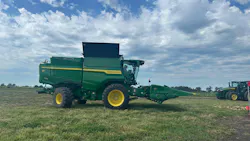
This week I had the opportunity to attend a media event hosted by John Deere to learn about the latest automation and maintenance systems for its agricultural equipment. But the big announcement at the event was the introduction of the company’s new AI assistant known as JD.
With this technology, the company is hoping to answer a question the mobile equipment and other industries have been asking for years — how to make sense of all the data collected about an operation or a machine.
You may be asking yourself, what does this have to do with fluid power and other motion control technologies? Well, the answer is twofold:
- It demonstrates how AI (artificial intelligence) is starting to be employed in a key customer market, the agricultural equipment industry.
- It shows what could be possible in other sectors, as well as what may be needed from suppliers to the industry, such as the greater integration of sensors and other electronics into the hydraulics still critical to the operation of farm machinery, to enable them to provide the data that can be fed into AI and other systems.
Employing AI to Make Sense of the Data
As sensors, telematics, controllers and software have become a more common part of agricultural equipment, as well as construction and other mobile machinery, the ability to collect data about any and everything has increased.
But with that has also come the need to be able to sift through and make sense of the data.
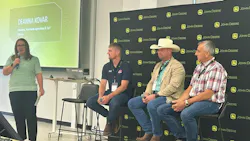
During its media event, John Deere had a panel discussion with three farmers who use the company’s equipment on their farm. Each has a different type of operation and noted the many benefits they have seen from the data provided through John Deere’s various systems — from understanding what crops have done best year over year and in which locations on a farm to receiving maintenance alerts that have allowed them to prevent unplanned downtime.
“Data in agriculture isn't really just about what's happening in the moment…but what happened last year, what happened last season,” said Deanna Kovar, President, Worldwide Agriculture & Turf Division, John Deere, so that farmers can make informed decisions on potential improvements to make.
The amount of data, and benefits, they receive seemed to my untrained eye overwhelming. And the whole time I kept thinking ‘Is it ever too much data and how do you work with all of it.’
Dashboards within John Deere Operations Center, an online farm management system accessible on the web as well as a mobile device, do a good job of showing the vast amounts of collected by various machine systems in a visual and easy-to-understand format.
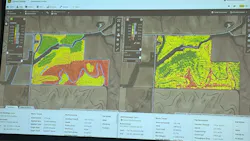
But there is still so much information that a farmer can look through, which I would imagine could be overwhelming especially when there is so much other work to do on a farm.
When the panel of farmers was asked what future digital capabilities they’d like to see, Kelly Garrett, a sixth-generation farmer and owner of Garrett Land & Cattle in Arion, Iowa, where he manages more than 7,000 acres of corn, soybeans, and winter wheat, said AI would be a useful tool.
“I think some of the some of the yield losses that we didn't know we were experiencing or understand why we were experiencing them, the AI will help [us] analyze that and pick a way to be more efficient, and it's it doesn't really cost any more money to do that,” he said. “It's just data management and data understanding, and adopting AI is the next round of technology that can make us more efficient.”
And then John Deere announced it was launching its AI assistant JD within Operations Manager to help customers better make sense of all the data they collect on their operations.
“This AI Assistant is there to help you get more value for the data that already exists in your Operations Center account,” said Jackson Baca, product marketing manager at John Deere. “JD helps you get answers, discover insights, and take actions based on your fields, based on your machines, because we know that every season is different.
“We know that every field is different, and we know that every decision that you make is different from your neighbor. And so, really, that's why JD provides you answers reflected on your data and not generic advice built for someone else,” he said.
It was explained during the media event that instead of having to search through several dashboards and reports, farmers can ask the AI assistant questions, like one would any other AI assistant now widely available, such as:
- How did my fuel use during tillage this year compare with the last three years? — Helping identify best practices and result in fuel savings.
- How did singulation compare across my fields, and what impact did it have on yield? — Enabling a better understanding of how equipment settings can impact yield.
- Which sprayer operator is covering the most acres per hour? — Resulting in understanding operational efficiencies.
- When is the optimal time to harvest based on historical trends? — Enabling better planning and management of labor.
These and many other questions can be asked of JD which then uses the farmer’s own data to determine the best answers. They are not based on generalizations made by processing data from several other farmers; it is solely based on the individual farmer’s data and tailored to his or her operational requirements.
Watch the below video from John Deere to see how the JD AI Assistant works.
An AI Agent for All Machine Types
John Deere plans to start rolling JD out first as part of Early Access Program for customers interested in trying it out, and will have it more broadly acceptable in Operations Center by the end of 2026.
As customers become accustomed to using the AI assistant, the company is looking to bring it to other digital systems as well, like those it offers for machine maintenance and repair. Currently, its digital service systems do have an AI tool in them that helps answer maintenance questions — a start for the AI capabilities John Deere hopes to continue building in its machines.
For instance, if a customer has an alert that a fuel sensor may need to be fixed but does not know where that sensor is located on the machine, he or she can ask the AI search built into the digital service tool — just like you would any search engine today — where that sensor is located. It will then provide a schematic and drawings to show where the fuel sensor is on the machine.
This can be greatly beneficial for machine owners and maintenance personnel of all skill levels, but especially those who may be new to farming or maintaining agricultural equipment. Like so many industries, agriculture is facing a generational shift in which those with years of knowledge are leaving, taking all their expertise with them. So, anything that can be done to help make it easier for the next generation of farmers to use and maintain their equipment.
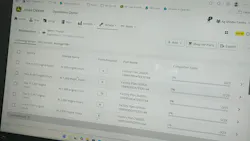
John Deere plans to continue developing JD and getting customer feedback on it. Eventually, the company John Deere plans to introduce capabilities tailored to customers across turf, construction, roadbuilding, and forestry to help serve machine owners in all the markets in which its various machines are used.
There’ll be more to come in the weeks ahead about the automation and maintenance technology advancements John Deere showcased at its media event, and how fluid power systems are involved with them, so be sure to stay tuned for that.
But with the introduction of JD, John Deere is showing how it is continuing to adapt and evolve its technologies to meet the needs of its customers and enable them to be more productive and efficient. While also demonstrating how use of AI is growing in a range of sectors, and the potential benefits it can provide, especially when it comes to data analysis.
Read more AI related content below to learn about its potential use cases, including within the hydraulics and pneumatics industry.

 An image depicting artificial intelligence
About the Author
 Sara Jensen
Sara Jensen
Executive Editor, Power & Motion
Sara Jensen is executive editor of Power & Motion, directing expanded coverage into the modern fluid power space, as well as mechatronic and smart technologies. She has over 15 years of publishing experience. Prior to Power & Motion she spent 11 years with a trade publication for engineers of heavy-duty equipment, the last 3 of which were as the editor and brand lead. Over the course of her time in the B2B industry, Sara has gained an extensive knowledge of various heavy-duty equipment industries — including construction, agriculture, mining and on-road trucks —along with the systems and market trends which impact them such as fluid power and electronic motion control technologies.
You can follow Sara and Power & Motion via the following social media handles:
X (formerly Twitter): @TechnlgyEditor and @PowerMotionTech
LinkedIn: @SaraJensen and @Power&Motion
Facebook: @PowerMotionTech