AI in Fluid Power: Use Cases and Opportunities are Expanding
Key Highlights
- Results from Power & Motion’s 2025 Salary & Career Survey show use of AI is still under evaluation by many in the fluid power industry.
- Those currently using AI mainly do so to help optimize designs and as a tool for documentation and research.
- Artificial intelligence also offers opportunities to enable automation, predictive maintenance, onboard processing and performance improvements for fluid power systems and the machines onto which they are installed.

Today, it feels like AI is everywhere, and to some extent it is. But what are the use cases for it in the hydraulics and pneumatics industry?
That’s a question myself and many others continue to ask as the capabilities and potential uses for artificial intelligence (AI) increase.
Results from Power & Motion’s 2025 Salary & Career Survey show AI is having an impact on hydraulics and pneumatics, but it remains limited at the moment. When asked which technologies were having a major impact on their designs, just 20.51% of respondents indicated machine learning and artificial intelligence were having an impact.
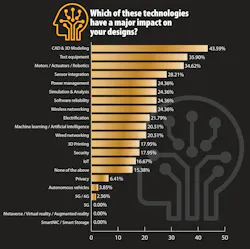
This is just slightly higher than the previous year with 16% of respondents indicating these technologies were having an impact on designs in our 2024 survey.
However, it is evident from our survey results as well as discussions with members of the fluid power industry that while uses are currently limited, there are many opportunities for AI within the hydraulics and pneumatics sector.
How are Engineers in the Fluid Power Industry Using AI?
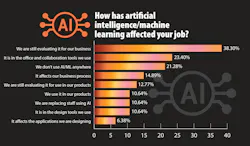
When asked how, if at all, AI and machine learning (ML) are affecting their jobs, most respondents to our 2025 Salary & Career survey, at 38%, said the technologies are still being evaluated for their business.
This was followed closely by those indicating it is in office and collaboration tools, 23.40%, and 21.28% responding they do not use AI or ML anywhere. Just 6% said it affects the applications they are designing, further signifying use of these technologies in fluid power is still in the early stages.
In our survey, we also asked how respondents are using AI and ML. Most indicated their use as tools for documentation, research and work assistance.
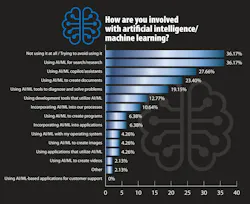
A large number, 36%, also said they are not using it all or are trying to avoid using it, demonstrating the continued skepticism many have of these technologies.
This tracks with another question we asked — What do you think about AI and ML? The majority said it is not ready for use in their space and that the technologies need regulation. However, there were also many respondents who see the technologies having a positive impact on their tools and processes, almost 24%, as well as the products they are developing, 17%.
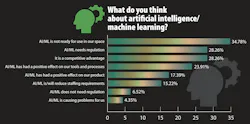
This was all pretty similar to responses received for our 2024 survey, demonstrating the slower acceptance and adoption of AI in the fluid power industry.
However, more respondents to the 2025 survey said they see AI and ML as a competitive advantage, with 28% indicating as such versus just 12% saying as such in the 2024 survey. This may be an indicator the industry is increasing its ability to effectively use AI and ML.
The Potential Use Cases for AI in Hydraulics and Pneumatics
Are you using AI in your hydraulic and pneumatic designs? Take our new poll to let us know and offer your perspectives on opportunities for this technology in the fluid power industry.
In early 2025, we polled our audience to find out if they were using AI and ML in their fluid power designs. While most respondents said they were not currently using them they did see opportunities to do so in the future.
Opportunities respondents to that poll said they see for AI and ML in fluid power systems include using it for design optimization, improving efficiency, enabling automation, as well as tracking faults and predictive maintenance.
These are in line with ways members of the fluid power industry I’ve spoken to see AI and ML being used as well.
Dave Ruxton, Application Engineering Manager at HydraForce, told me during an interview that a good place for the fluid power industry to start with AI is having it help manage some of the redundant tasks typically placed on skilled machine operators. Functions like digging into a pile at a certain angle over and over could be learned by AI and then automated, leaving operators free to focus on other things while also ensuring continued accuracy for both skilled and unskilled operators.
Most recently, I asked members of Power & Motion’s Editorial Advisory Board how they are seeing AI being used and the potential benefits they think it could provide. Following are insights from three of our board members on how they see AI being used in the hydraulics and pneumatics industry.
John Fenske, Director of Marketing and Product Management, Tolomatic
We are seeing our customers leverage AI-enabled tools to better understand how machine behavior impacts product quality, throughput, and reliability. That should sound pretty familiar. It has been the vision of Industry 4.0 and Industrial IoT (internet of things) for some time. But now, advances in AI are lowering the barrier to extracting actionable insights from machine data.
Historically, developing predictive models or identifying meaningful correlations and anomalies required significant computing power, software development, and data science expertise, which made the ROI (return on investment) difficult to prove. Today, AI tools can significantly accelerate data analysis, anomaly detection, and pattern recognition, allowing engineering teams to uncover insights faster and easier. As a result, we see customers renewing their efforts to extract and contextualize machine-level data.
This trend will drive demand for smarter, more connected machine components that can improve uptime, process consistency, and overall equipment effectiveness. For real this time.

Nate Keller, Ph.D., Business Development Manager, Moog Construction
In the off-highway mobile equipment market, the most meaningful impact of AI will come from moving computation onto the machine itself. These machines operate in remote and often disconnected environments, so onboard or edge-based AI enables real-time decision-making without relying on network connectivity.
This allows machines to continuously adjust hydraulics, motion, and power usage based on terrain, load, and task, improving efficiency, consistency, and overall performance while reducing dependence on operator skill.
AI also complements the industry’s move toward electrification. Electric machines require tighter energy management and more precise control, and AI can optimize power distribution, extend battery life, and ensure energy is used efficiently. At the same time, AI is not limited to electrified platforms — it can be applied today on traditional diesel-hydraulic machines to deliver many of the same gains in performance and efficiency. It is a technology that scales across machine types, sizes, and architectures.
In parallel, onboard processing improves how data is handled by filtering and prioritizing what is sent offboard, and simpler interfaces such as voice control can reduce operator burden and improve safety.
Overall, AI will make machines more capable, more efficient, and easier to use, while supporting both current equipment and the transition to electrified systems.

Mike Terzo, P.E., CEO of Xirro, LLC and Co-Founder of HeavyTech, Inc.
Outside of the now common use of Chat GPT style conversational AI, we are using several deeper AI tools on an almost daily basis:
- Our research is now almost exclusively done on several AI platforms such as NotebookLM. The ability to quickly search for whitepapers, applications, and overviews of current technology or trends is a major benefit that is very mature.
- Data intelligence. We use AI tools, such as Snowflake, for the majority of our data analysis and analytics. While this is a benefit, it must be very closely watched and we have seen only very experienced folks who can identify the common hallucinations that all AI has and ensure that does not cascade into your outputs.
- For code and software development in off-highway vehicle control and hydraulic control, AI has been integrated into almost all the common tools like Visual Studio Code, Claude Code, Github Copilot, and Cursor. These tools significantly improve code development, debugging, and testing. We are already seeing the benefits of this in terms of saving almost 80% of software development time compared to even 3-4 years ago. We estimate this cuts software development costs by about 60% and time to market by 50%. This allows much smaller and more flexible teams to bring software to market quickly and efficiently.
- We don’t see AI being used for mechanical/hardware design or 3D CAD and don’t really see this happening any time soon.
- We use AI almost exclusively now for marketing purposes in terms of graphic and illustration development. AI assisted video creation is still a little bit rough but we are seeing this improve in video editing tools. Benefits are marginal though right now but we see this improving over the next 6-12 months.
- We have recently begun using in a very controlled and limited fashion, autonomous AI agents. These are usually in the form of desktop/PC assistants like Claude Cowork or OpenClaw but this type of agentic AI we only run on isolated PC’s due to security concerns. This type of Agentic AI gives a high level of authority over your computer and is still very concerning in terms of its ability to impact files in a negative way.
Overall, the benefits we are seeing are limited to software/code development, business operations (emails, presentations, strategy, etc.), and marketing. We don’t see much change or AI implementation in hardware design, hydraulic design, or motion control as these require deterministic and safety-based systems, and AI does not meet the requirement of this yet.
Clearly, there is a place for AI within the hydraulics and pneumatics industry, and the use cases will continue to unfold as the technology evolves.
Have topics around AI you’d like Power & Motion to explore in the future? Questions about the technology we should dive into? Want to share your own experience with using AI? Reach out to me at [email protected], I’m always interested in hearing from readers what they’re experiencing or would like to see us cover.
About the Author
 Sara Jensen
Sara Jensen
Executive Editor, Power & Motion
Sara Jensen is executive editor of Power & Motion, directing expanded coverage into the modern fluid power space, as well as mechatronic and smart technologies. She has over 15 years of publishing experience. Prior to Power & Motion she spent 11 years with a trade publication for engineers of heavy-duty equipment, the last 3 of which were as the editor and brand lead. Over the course of her time in the B2B industry, Sara has gained an extensive knowledge of various heavy-duty equipment industries — including construction, agriculture, mining and on-road trucks —along with the systems and market trends which impact them such as fluid power and electronic motion control technologies.
You can follow Sara and Power & Motion via the following social media handles:
X (formerly Twitter): @TechnlgyEditor and @PowerMotionTech
LinkedIn: @SaraJensen and @Power&Motion
Facebook: @PowerMotionTech