Understanding Forklift Battery Part Numbers and How They Can Aid the Selection Process
What You'll Learn
- How part numbers for forklift batteries provide information on performance characteristics that can help determine if a particular battery is the right fit for your application.
- Where the naming conventions used for both lead-acid and lithium-ion forklift batteries fall short.
- A different approach to part numbering one forklift battery manufacturer is taking to help ease the selection process.
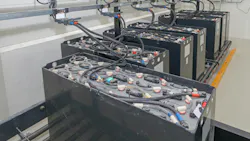
Electric forklifts are increasingly common in warehouses and manufacturing facilities as well as a range of other applications. The batteries which power these machines are critical to their operation.
But when it comes time to choose a battery for a new or existing machine, how do you pick the right one?
The forklift battery part number can be a good place to start as the naming convention used for lead-acid and lithium-ion batteries typically offers information on performance aspects such as voltage and capacity.
For system integrators and maintenance personnel who may need to spec a battery for an electric forklift, this article explains how forklift battery part numbers describe a battery and how these numbers can be used to help choose the right battery. A 48V Hyster E50XN is used as an example throughout the piece to show how the standard lead-acid code and a lithium battery product code can be employed during the battery selection process.
Batteries Need to Meet Forklift Manufacturers’ Specifications
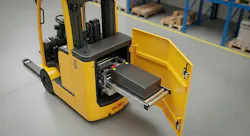
Every electric forklift has a battery spec. It is set by the forklift manufacturer and published in battery selectors and service manuals, providing specifics for required battery voltage, weight, compartment size, connector and cover.
The table below shows the battery spec set by Hyster for its E50XN forklift truck with a 33-in. battery compartment:
A battery needs to meet every line in this table. Otherwise, the forklift will not perform as desired which could lead to additional maintenance and battery replacement costs for end use customers.
This is where a battery part number can play a role. A part number that includes battery voltage, compartment size and other values in the spec sheet ensures the right battery is chosen the first time and thus prevents any potential performance issues from occurring.
Lead-Acid Battery Part Numbers Indicate Voltage and Capacity
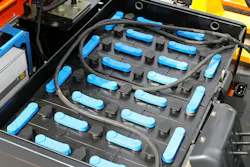
Most North American lead-acid forklift batteries are identified by three numbers separated by dashes which signify the number of cells in the battery, its capacity and the number of plates in each cell.
Using the Hyster E50XN again as an example, a common battery for this forklift model is a 24-85-21:
- 24 is the number of cells. Each lead-acid cell is nominally 2V, so 24 cells make a 48V battery.
- 85 is the capacity of one positive plate, in amp-hours, at the 6-hour discharge rate.
- 21 is the total number of plates in each cell. Every cell starts and ends with a negative plate, so 21 plates means 10 positive plates.
Capacity is the number of positive plates multiplied by the plate rating. For a 24-85-21, that is 10 x 85 = 850 Ah.
While this part number nomenclature tells a buyer the voltage and the capacity, it says nothing about other important aspects of the battery such as its dimensions which is also necessary information to have when spec’ing a battery.
One Forklift Truck, Multiple Battery Codes to Decipher
When running the Hyster E50XN-33 through the online selectors of three lead-acid battery manufacturers, each one returned a different battery model code, as shown in the table below:
Even though each manufacturer writes the code a little differently, such as adding an internal catalogue letter, their part numbers still utilize the three-number pattern utilized by most North American lead-acid forklift battery manufacturers.
And based on those in the table above it appears all three battery models would fit the Hyster E50XN-33 forklift truck.
But here again, that code only tells you so much – namely the battery capacity. Its dimensions and weight are not indicated in the part number, so a machine designer or fleet manager would need to find those to make a proper assessment on which battery to use.
As shown in the table above, each of the batteries have slightly different dimensions and weights, important factors for determining if a battery will fit into machine.
This is further illustrated in the table below where model code and capacity are the same, but all other aspects are different. The two batteries are electrically identical, but one is 7-1/2 in. longer than the other and thus may not fit within the allotted space in a forklift.
So, while the part number of a lead-acid battery can provide some information to help inform which option to choose, it doesn’t provide the whole picture and still requires further research to best inform battery selection.
Lithium-Ion Forklift Battery Part Numbers Offer Voltage and Amp-Hours Information
Today, lithium-ion (lithium) forklift battery model numbers mostly state voltage and amp-hours, sometimes with a product family name. Like the codes used for lead-acid batteries, they can be confusing and leave a buyer having to look up dimensions and weight elsewhere.
However, weight matters more with lithium batteries. Lithium cells are much lighter than lead plates and acid, so a lithium battery for a counterbalance forklift truck carries steel ballast to reach the truck’s minimum weight requirement.
If the weight (and dimensions) is not in the part number, it is necessary to confirm the specs separately before the battery goes in the fork truck to ensure the right option is chosen. This can add time to the spec’ing process, but is an important step since the part number alone cannot be relied on to provide all relevant information about the battery.
Creating a More Descriptive Product Number for Lithium-Ion Batteries
To help make the process of spec’ing a forklift lithium-ion battery easier for design teams and fleet managers, ENEROC USA uses a different methodology for its battery part numbers.
It writes the fork truck’s battery requirements into the product description code, allowing customers to gain all necessary information about the battery by simply looking at the code. This is done by creating a battery product code that puts voltage, capacity, dimensions, and weight in one string.
The intent is to minimize confusion and the amount of time associated with battery selection. Instead of looking through multiple spec sheets, customers can look at the part number to quickly and easily determine whether a battery is a good fit for their forklift.
The image below illustrates how this translates to an ENEROC battery for the Hyster E50XN-33:
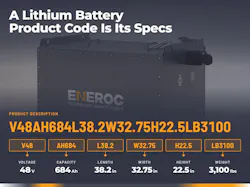
Each field starts with a letter tag to indicate what the number to the right of it relates to in terms of battery specs, which are explained in the table below. It is designed so it follows the same order as the fork truck’s battery specs outlined earlier in this article.
While the naming method used by ENEROC is not used by all forklift battery manufacturers, it demonstrates how a part number can be used to inform customers about a product’s specifications and a method others in the industry could consider ease the battery selection process.
Efforts are under way by the battery industry to standardize the part number nomenclature for forklift batteries. On October 6, 2026, Battery Council International (BCI) held the first meeting of its new Lithium Battery Subcommittee in Philadelphia. The subcommittee named a standardized nomenclature for lithium batteries used as motive power that parallels lead-acid standards as a priority during this meeting.
By using the same format for both battery types, not only would it ease battery selection for customers but also help if they are comparing lead-acid against lithium to ensure they are getting the same data for both.
Until a more standardized approach is achieved though, you can use this guide to gain a better understanding of the naming conventions used for lead-acid and lithium-ion forklift batteries so you can be sure to choose the right one for your application.
This article was written and contributed by Max Khabur, Marketing Director at ENEROC USA.
About the Author
 Maxim Khabur
Marketing Director, Eneroc
Maxim Khabur is a Director of Marketing at Eneroc USA, a manufacturer of industrial lithium batteries backed by CATL. Formerly, he led marketing at Bluwater and OneCharge Lithium Batteries, and was elected Chairman of the Advanced Energy Council, representing a group of companies — members of the MHI.org (Materials Handling Industry) Association.
Related
 View into the Battery Compartment of an Electric Forklift