Why Cycles Matter More Than Hours When Estimating Battery Life
Key Highlights
- The lifespan of lithium-ion batteries used in forklifts is more accurately measured in cycles, which account for actual charge-discharge events rather than hours of operation.
- Application factors such as load intensity, operating temperatures, and battery size can significantly influence how quickly a battery ages, making hours-based estimates less reliable.
- Using a calculation that includes warranted cycles can provide a better estimate of battery life.
The average human life expectancy in the USA is about 687,000 hours. That number is accurate, but it is also completely useless for estimating your individual lifetime.
Car makers don’t warrant engines in years of ownership; they warrant them in miles, because a delivery van and a leisure car can be the same age and in a very different state.
Yet walk the aisles of a material handling trade show, and you’ll hear the useful life of lithium-ion (Li-ion) forklift batteries quoted in hours of operation. Some manufacturers advertise “20,000 hours or 10 years, whichever comes first.” Others promise “8 years of 12,000 hours.”
Meanwhile, the engineering datasheets from serious lithium battery suppliers say something different: 4,000 cycles at 70% depth of discharge. They use cycles because that’s the unit a battery actually keeps count of and understands.
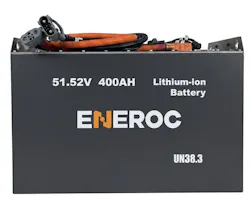
To be fair, even a Li-ion cycle rating is a laboratory number, measured at a controlled temperature, a set charge rate, and a defined depth of discharge. But at least it’s the right unit, stated with its conditions. A promise of battery hours is a lab number multiplied by assumptions nobody cares to explain.
For anyone developing or working with electric vehicle systems in some capacity who may need to spec a lithium-ion battery for their application — which today often includes those in the fluid power industry — it is important to understand why cycles is a better measure of battery life and how they can be used to more accurately calculate total lifespan.
A Lithium Battery Ages by the Cycle, not by the Clock
Every charge-discharge cycle takes a small, measurable toll on a lithium-ion cell. Run the same fork truck through the same 2,000 hours a year in two different operations, and the batteries will age at completely different rates.
Why? Because intensity defines how fast each hour drains the battery:
- Heavy work burns more energy per hour. Heavier loads, higher lift heights, and attachments like paper clamps or push-pull all require more amp-hours out of the battery pack. The battery depletes faster, cycles more often, and ages sooner in the same number of clock hours.
- Cold decreases capacity. In freezer and cold-dock applications, extra energy is used for heating the battery, or, without heating, usable capacity shrinks significantly. Either way, you charge the battery more often per shift.
- Higher Ah capacity stretches cycles. A bigger battery discharges more slowly. A 600 Ah pack doing the same job as a 400 Ah pack accumulates fewer cycles per year and lasts proportionally longer.
None of this shows up in a promise measured in hours. An hours-based number silently assumes one “average” duty cycle and never tells you which one.
How to Calculate Battery Life
Using cycles to determine battery life can be done through a few simple calculations.
A note on units first though: some battery manufacturers describe energy draw in watt-hours (Wh) rather than amp-hours (Ah). We’ll use Ah for simplicity, because the voltage is fixed by your forklift truck: you can’t buy a higher-voltage battery to get more power and energy. Your only variable is Ah capacity.
Your energy use per hour can be expressed in amp-hours, and your forklift truck manufacturer has already defined it. If the recommended 600 Ah battery is sized to last one 6-hour shift — a typical spec — the truck draws about 100 Ah per hour.
In real-life use, a Class I counterbalance forklift draws about 90-120 Ah per hour. That’s your consumption rate; or better, get the real-life number from a power study of your truck in your facility.
Below is an example of a mid-size distribution warehouse that runs a 36V counterbalance forklift truck 2,657 hours a year. The truck specification says it draws 100 Ah per hour, and its lithium battery is 600 Ah with a warranty for 4,000 cycles.
These four lines of arithmetic tell you everything you need to know.
Annual Energy Throughput: 2,657 hrs x 100 Ah/hr = 265,700 Ah/year
Cycles per Year: 265,700 Ah/year ÷ 600 Ah = ~443 cycles/year
Life Expectancy (in cycles): 4,000 cycles ÷ 443 = ~9 years
Life Expectancy in Hours (in this case only): 9 yrs × 2,657 hours = ~24,000 hours
The battery in this operation would beat a “20,000-hour” marketing promise by 20%. But move the same lithium-ion battery to a cold-storage operation and add a clamp attachment to draw 120 Ah per hour, and the math collapses to 20,000 hours, under the same 4,000-cycle rating. The cycle number never changed, so the hours never meant anything.
Ask for the Number the Battery Understands – Cycles, Not Hours
Lithium battery cycle life is measured in cycles, full stop. Hours are not a specification; they’re a calculation, and it’s only honest when it’s built on your numbers, not the vendor’s assumptions.
So, when a supplier promises you hours, ask four questions instead:
- How many cycles and at what temperature were they measured?
- At what depth of discharge?
- At what charge rate?
- And what counts as end of life — 80% capacity remaining, or 70%?
Each answer moves the real number; a supplier who can answer them clearly is quoting a specification, and one who repeats the headline figure is quoting a billboard.
The Industrial Battery Lifetime Calculator is based on this simple formula and can be used to determine the life of a battery:
Life (years) = Warranted Cycles / (Hours per Year × Energy Use per hour (Ah) / Battery Ah Capacity)
If a vendor can’t show you that math, they’re not selling you a battery life. They’re selling you a warranty. The best advice to get a real answer for your fleet is to request a power study as part of the deal.
This article was written and contributed by Max Khabur, Marketing Director at Eneroc USA.
About the Author
 Maxim Khabur
Maxim Khabur
Marketing Director, Eneroc
Maxim Khabur is a Director of Marketing at Eneroc USA, a manufacturer of industrial lithium batteries backed by CATL. Formerly, he led marketing at Bluwater and OneCharge Lithium Batteries, and was elected Chairman of the Advanced Energy Council, representing a group of companies — members of the MHI.org (Materials Handling Industry) Association.