Where Are Retaining Rings Used: Industry Examples and Use Cases
Key Highlights
- Retaining rings control axial movement using compact, groove-installed retention solutions
- Reduce part count, weight, and assembly time versus traditional fastening methods
- Enable compact, high-performance designs across motors, pumps, and connectors
- Maintain alignment and reliability under vibration, load, and pressure conditions
- Used across industries from aerospace and medical to consumer products

Retaining rings are used across industries like automotive, aerospace, fluid power, medical, and consumer products. They are commonly found in assemblies such as motors, pumps, connectors, and tools where components must be securely positioned on a shaft or inside a housing.
What Do Retaining Rings Do?
Retaining rings control axial movement by creating a fixed stopping point within an assembly. Installed in a groove, they form a shoulder that prevents components from sliding out of place, replacing machined shoulders or multi-component retention methods. They are typically designed for use on shafts (external rings), inside bores (internal rings), or both (ID/OD), depending on where axial movement must be controlled.
Comparing Retaining Rings to Alternative Retention Methods
Retaining rings offer a space-efficient solution that can reduce part count and simplify installation, influencing assembly time, system weight, and overall cost efficiency. These characteristics are especially valuable in designs that require streamlined manufacturing or frequent service and disassembly.
Spirolox® retaining rings build on these advantages through a flat-wire construction formed by an edgewinding process, creating a gapless 360° retaining surface with no protruding lugs. This design provides uniform load distribution and avoids interference with mating components, allowing for more compact designs and simplified surrounding part geometry.
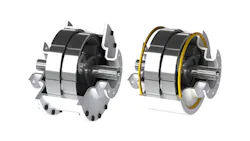
Gear assembly featuring multiple components vs two spiral retaining rings
How are retaining rings used in electric motors and motion systems?
Retaining rings secure rotating components while maintaining alignment at high speeds.
Applications: Electric Motor, Needle Bearing, Bearing Retainer
- Prevent axial drift during rotation
- Reduce wear from misalignment
- Enable compact motor designs
Performance insight:
Retaining rings replace machined shoulders or fasteners, reducing machining time and part count.
How are retaining rings used in gears and power transmission systems?
Retaining rings keep gears and pulleys positioned under load without adding bulk.
Applications: Gear Assembly, Gear Bracket, Gear with Ring Replacing Bolts, Belt Pulley, Angle Transmission
- Maintain gear alignment
- Reduce hardware like bolts or spacers
- Support high-load conditions
Performance insight:
Replacing bolts with retaining rings simplifies assembly and reduces weight, improving efficiency in power transmission systems.
How are retaining rings used in clutches and rotating mechanical systems?
Retaining rings secure internal clutch components under repeated motion and vibration.
Applications: Slip Clutch, Centrifugal Clutch, Pneumatic Clutch, Clutch
- Keep stacked components in position
- Handle dynamic forces
- Reduce component loosening
Performance insight:
Unlike threaded fasteners, retaining rings maintain consistent retention under vibration, reducing maintenance and improving long-term reliability.
How are retaining rings used in fluid power and pressure systems?
Retaining rings hold critical components in sealed systems where pressure and vibration are present.
Applications: Pneumatic Fitting, Pneumatic Elbow, Hose Fitting, Hose Connector, Hose Connection, Air Nozzle, Pressure Gauge, Axial Piston Pump, Actuator Valve
- Secure fittings and internal assemblies
- Support leak-free performance
- Withstand pressure cycles
Performance insight:
Retaining rings can replace threaded retention in select designs, simplifying sealing strategies and reducing potential leakage failure points.
How are retaining rings used in connectors and electrical components?
Retaining rings provide secure but removable connections in compact assemblies.
Applications: Electrical Coupler, Electrical Bayonet, Conduit Connector, Quick Disconnect
- Allow repeat assembly and disassembly
- Save space compared to threaded parts
- Simplify connector design
Performance insight:
Retaining rings enable faster, more repeatable assembly processes with fewer components, supporting high-volume production.
How are retaining rings used in industrial and general mechanical components?
Retaining rings provide reliable positioning across a wide range of mechanical assemblies.
Applications: Pulley, Knuckle, Conduit Connector
- Prevent component shift under load
- Reduce need for custom machining
- Simplify assembly processes
Performance insight:
Retaining rings reduce reliance on custom-machined features, lowering manufacturing costs and simplifying design standardization across assemblies.
How are retaining rings used in consumer products?
Retaining rings deliver low-profile, cost-effective fastening in everyday items.
Applications: Ground Lamp, Bike Lock, Rubber Boot
- Hidden from view
- Easy to assemble
- Durable over time
Performance insight:
Retaining rings minimize material usage while enabling fast, automated assembly, helping reduce production costs in high-volume manufacturing.
How are retaining rings used in medical devices?
Retaining rings enable precise, compact designs in critical applications.
Applications: Hip Replacement, Surgical Instruments, Diagnostic Machinery
- Maintain exact positioning
- Support high-reliability requirements
- Enable smaller device footprints
Performance insight:
Precision retaining rings support tight tolerances and repeatable performance, helping ensure reliability while enabling compact, minimally invasive designs.
Spirolox Retaining Rings vs Alternative Fastening Methods
The following table highlights key differences between retaining rings and other common retention methods:
|
Feature |
Retaining Rings |
Threaded Fasteners |
Bolt/Nut + Washer |
Machined Shoulders |
Cotter Pins |
|
Space required |
Minimal |
Moderate |
High |
High |
Moderate |
|
Weight |
Low |
Moderate |
High |
High |
Low |
|
Assembly time |
Fast |
Slower |
Slowest |
N/A (pre-machined) |
Moderate |
|
Part count |
Low |
Moderate |
High |
Low |
Moderate |
|
Adjustability |
Moderate |
High |
High |
None |
Low |
|
Serviceability |
Good |
Good |
Good |
Poor |
Good |
|
Vibration resistance |
High |
Moderate (can loosen) |
Moderate (can loosen) |
High |
Moderate |
|
Shaft damage risk |
None |
Possible |
Possible |
None |
Requires hole |
|
Manufacturing cost |
Lower overall |
Moderate |
Higher (more parts) |
Higher (machining) |
Moderate |
Summary
Retaining rings are used across nearly every industry because they provide a compact, efficient way to control movement and simplify assemblies. Compared to traditional fastening methods, they reduce space, part count, and assembly complexity while maintaining reliable performance. From heavy-duty industrial systems to everyday products, they serve as a practical solution for modern mechanical design.