Leggett & Platt IRM Sensor Provides Position Sensing for Hydraulic Cylinders
*Editor’s note: This article was originally published March 2, 2026 and updated April 15 with additional information.
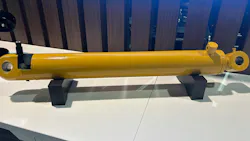
The Integrated Radar Measurement (IRM) Sensor from Leggett & Platt Hydraulics is a linear position sensor designed to provide direct stroke measurement of hydraulic cylinders. It features a compact design and can be mounted inside the cylinder cap, enabling easy servicing and replacement of the sensor when necessary.
Leggett & Platt exhibited the Integrated Radar Measurement Sensor at CONEXPO-CON/AGG 2026. Learn about other new technologies introduced at the show by visiting our CONEXPO 2026 page.
Legget & Platt’s Integrated Radar Measurement Sensor include several features that benefit its use in various applications:
- contactless time-of-flight system that does not require a piston-mounted internal magnet or gun drilling of the cylinder rod
- ability to measure multiple cylinder strokes with a single sensor, reducing part inventory
- exceeds stringent environmental, electrical, and electromagnetic compatibility requirements
- can be powered directly by 12 and 24V DC battery systems
- integration into hydraulic cylinders without increasing overall length
- available with M12- and DT-compatible connectors
- analog voltage output, digital PWM, and J1939 CANbus communications are possible
Applications for the IRM sensor include lift, tilt and steering cylinders. The sensor is durably designed for long-time use in construction, material handling, agriculture, industrial and other equipment operating in demanding environments.
How the IRM Sensor Eases Installation and Servicing
Power & Motion had the opportunity to speak with Luka Korzeniowski, Director Product Development, Leggett & Platt Hydraulics about the design of the IRM sensor, including the various aspects which make it easy to install and service.
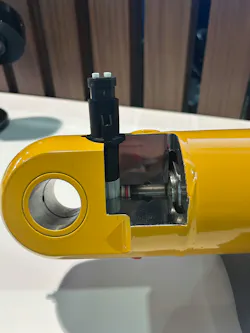
The IRM sensor features a compact design with built-in circuit board and a connector, either M-12 or Deutch is available, which connects it to a machine’s controller. A lens protects the sensor’s electronics from the high-pressure oil that moves through the hydraulic cylinder.
The sensor uses time-of-flight technology — a radar signal is sent which bounces off the cylinder’s piston. “We measure how long it takes for the signal to return to the sensor,” said Korzeniowski.
Installing the IRM Sensor requires just one hole drilled into the hydraulic cylinder, easing both installation and servicing.
Other hydraulic cylinder sensors typically require rod drilling through the middle of the cylinder, installation of a magnet as well as various screws to hold everything in place. “We don’t have any of that,” said Korzeniowski. “We don’t touch the piston, we don’t put a magnet in, we don’t do any modification [to the hydraulic cylinder].”
A magnet is included on the bottom of the sensor to help seat it, and just three screws are necessary to securely attach it to the cylinder.
If needing to replace the sensor, machine owners can easily do so in the field without having to disassemble the hydraulic cylinder, said Korzeniowski. They simply need to remove those three screws, lift the sensor out, drop in a new sensor and replace the screws. It can be done in minutes, greatly minimizing downtime.
Whereas other sensor designs would likely require replacement of the entire hydraulic cylinder. This could lead to several days of downtime for machine owners.
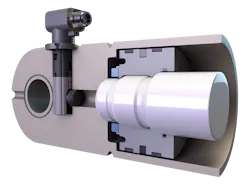
Another key benefit of the IRM sensor is its ability to use J1939 CANbus communication. This enables the sensor to provide information on position (where the cylinder is), velocity (how fast it’s moving), and the direction it’s going. “We can tell you what the temperature is inside the cylinder, and we can give you status updates,” he said.
As an example of the status updates that can be provided, Korzeniowski said the sensor was able to pick up there was an issue with another component on a customer’s machine. The sensor was being tested on a wheel loader for several months; a logger box attached to the machine was collecting data and pushing it to the cloud so Leggett & Platt could monitor the sensor’s performance in the field.
At one point while monitoring readings from the sensor, the Leggett & Platt team noticed some overvoltage spikes. The team began investigating why these spikes were happening. When they contacted the machine operator about the voltage issue, he noted the wheel loader’s alternator needed to be replaced and already had it scheduled to be fixed.
While the operator was already aware of an issue, the fact the sensor could provide an indication there might be a maintenance problem demonstrates its capabilities.
“We were able to see a problem that they had out there in the field remotely,” said Korzeniowski. The ability to detect potential downtime issues allows machine owners and operators to be more proactive about addressing the problem before it becomes a larger issue. Unplanned downtime is costly, and minimizing it is a key design priority for many mobile machinery manufacturers.
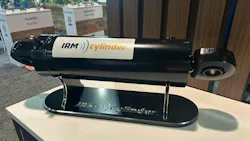
The IRM sensor can also be paired with hydraulic cylinders from Leggett & Platt’s Pacoma and Precision brands to provide a full system solution — something customers are desiring more and more. This Smart IRM cylinder provides a plug-and-play option that further eases installation for customers.
Both the sensor and smart cylinder are available globally.
About the Author
 Sara Jensen
Sara Jensen
Executive Editor, Power & Motion
Sara Jensen is executive editor of Power & Motion, directing expanded coverage into the modern fluid power space, as well as mechatronic and smart technologies. She has over 15 years of publishing experience. Prior to Power & Motion she spent 11 years with a trade publication for engineers of heavy-duty equipment, the last 3 of which were as the editor and brand lead. Over the course of her time in the B2B industry, Sara has gained an extensive knowledge of various heavy-duty equipment industries — including construction, agriculture, mining and on-road trucks —along with the systems and market trends which impact them such as fluid power and electronic motion control technologies.
You can follow Sara and Power & Motion via the following social media handles:
X (formerly Twitter): @TechnlgyEditor and @PowerMotionTech
LinkedIn: @SaraJensen and @Power&Motion
Facebook: @PowerMotionTech