Bailey Introduces Welded Cylinder with Improved Serviceability
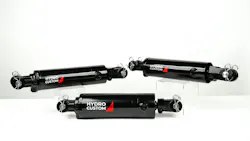
Tie-rod hydraulic cylinders are commonly used in agricultural and other machinery applications because they are easy to service. However, welded cylinders have started to replace them in some applications due to the higher pressure ratings and increased durability a welded design can provide.
To achieve all of these attributes in a single cylinder, Bailey International has introduced its Hydro Custom WC (Welded Clevis) Series. It combines the durability of a welded cylinder with the serviceability of a traditional tie-rod.
Daniel Stoltz, PMC, Product Lead, Bailey International, said in an interview with Power & Motion that development of the Hydro Custom WC Series cylinder came from conversations the company had with customers.
He said many customers told the company they liked Bailey’s existing Chief AT Hydraulic Cylinders which applied some of the features of a tie-rod to a welded cylinder. Based on this and additional customer feedback about features they’d like to see, Bailey’s engineering team developed the Hydro Custom WC Series.
Features of the WC Series Cylinders Aiding Serviceability and Durability
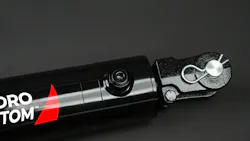
The Hydro Custom WC Series cylinder includes several features to provide customers with a hydraulic cylinder capable of meeting ease of service and durability requirements.
Stolz said Bailey added adjustable forged clevises and threaded rods to the cylinder design. These make it possible to change the cylinder mount in the field if needed, an aspect customers told the company they liked as it allows them to handle the repair themselves, reducing downtime and maintenance costs.
A screw-on gland design allows for quick and easy seal replacement. Stolz noted a span wrench is needed to spin the gland off, but this is common with welded cylinders and in general this gland design is more simplified and thus easier to use for seal replacement, further improving the serviceability of the WC Series.
He said seals from Hallite were chosen for the cylinder because it is a preferred seal manufacturer; its sealing technology helps to enhance the lifespan and dependability of the WC Series cylinder in tough applications.
Seal choice and the welded design of the WC Series help to create a durable hydraulic cylinder capable of use in various applications.
Stolz said features of the WC Series lend itself to use in traditional tie-rod applications which have historically been agricultural equipment because of the low cost and serviceability associated with tie-rods. But the welded design of the cylinder means it is durable enough to be used in construction equipment and other applications as well.
Also aiding use in various applications is the fact the cylinder is rated for 3,000 psi (207 bar), enabling it to provide the power necessary for lifting, pushing and controlling implements. Each cylinder is also burst pressure tested at 6,000 psi (414 bar) and has undergone a 20,000-cycle endurance test, further demonstrating its durability and high-pressure capabilities.
Read More About the Rising Importance of Efficiency
Compact, Efficient and Intelligent Hydraulics Desired for Construction Equipment
Efficient Technology Development is on the Rise
Agricultural Equipment Requires Smarter, More Efficient Hydraulics
Understanding cost is often a determining factor for using tie-rods, Bailey is using robotic welding to mass produce the WC Series cylinder. This helps to reduce the amount of labor necessary to build the cylinder and thus keeps it cost competitive while still integrating all desired features into the design.
The single cylindrical body of the WC Series reduces the overall weight of the hydraulic cylinder, helping provide further cost savings for customers. “Weight savings lends itself to fuel savings,” said Stolz.
When less fuel needs to be used to operate machinery, it can greatly reduce operational costs for machine owners. This is why development of more energy efficient products, as well as those which are lighter in weight, have become so important in the hydraulics and mobile machinery industries.
Stolz said the Hydro Custom WC Series cylinder is available in a full range of options starting at 2 in. bore and eventually will be available in up to 8 in. bore sizes.
About the Author
 Sara Jensen
Sara Jensen
Executive Editor, Power & Motion
Sara Jensen is executive editor of Power & Motion, directing expanded coverage into the modern fluid power space, as well as mechatronic and smart technologies. She has over 15 years of publishing experience. Prior to Power & Motion she spent 11 years with a trade publication for engineers of heavy-duty equipment, the last 3 of which were as the editor and brand lead. Over the course of her time in the B2B industry, Sara has gained an extensive knowledge of various heavy-duty equipment industries — including construction, agriculture, mining and on-road trucks —along with the systems and market trends which impact them such as fluid power and electronic motion control technologies.
You can follow Sara and Power & Motion via the following social media handles:
X (formerly Twitter): @TechnlgyEditor and @PowerMotionTech
LinkedIn: @SaraJensen and @Power&Motion
Facebook: @PowerMotionTech