
The 2026 edition of CES kicked off on January 6, bringing with it a wide range of technological innovations from various industries, including many relevant to the systems and industries we cover here at Power & Motion.
Previously referred to as the Consumer Electronics Show, the event has evolved into a showcase for all types of technologies, not just consumer electronics, and as such now goes simply by CES. Over 4,100 exhibitors across 2.6 m net sq. ft. are in attendance at CES 2026 to spotlight their developments in robotics, artificial intelligence (AI), mobility and more.
Among those exhibitors are motion technology companies like Schaeffler who is showcasing several of its actuation and other solutions, such as its solar tracker actuator and the company’s new planetary gear actuator for humanoid robots.
Off-highway equipment manufacturers are in attendance again this year as well — including Kubota and John Deere — to highlight the many technological developments taking place within the construction, agriculture and other heavy equipment industries. Not only does CES provide an opportunity to see the trends shaping the mobile machinery market but also get a glimpse of what these companies will be showing at CONEXPO-CON/AGG 2026 in March.
Check out more CES 2026 news from other publications that are part of Power & Motion’s parent company EndeavorB2B.
Oshkosh Airport Products to Show Electric ARFF at CES 2026 from Firehouse
At the 2026 Consumer Electronics Show from Electronic Design
Hailo Highlights Mass Market Edge AI Adoption at CES 2026 from Security Info Watch
CES and Your Favorite OEMs from Construction Equipment
JLG Wins CES Innovation Awards from Rental Equipment Register
CES has become a show to watch because of the range of technologies coming out of it. We’ve rounded up some of the news from this year’s show most applicable to the fluid power and electromechanical motion system sector to help our readers gain a better understanding of the technologies and trends shaping the markets in which they work so they can be prepared with their own technological developments that will meet customer requirements.
Heavy Equipment Manufacturers Highlight Advancements in AI and Autonomy
Over the past several years, mobile heavy-duty equipment manufacturers have increased their presence at CES to help demonstrate the many technological innovations taking place within the agriculture, construction, and other industries they serve.
The 2026 edition of CES is no different with companies such as Caterpillar, Doosan Bobcat, Oshkosh Corp. and more exhibiting the advancements taking place within the mobile equipment space, including those related to AI and autonomy. OEMs are implementing AI and automation to make machine operation more intuitive to help overcome the skilled labor shortages construction and other sectors are facing. In addition, enabling machines to do at least some tasks without human interaction means businesses can be more productive and accurate with their work, even if they have less human labor with which to work.
Caterpillar
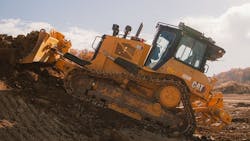
At CES 2026, Caterpillar presented its vision for the future of autonomy on various job sites through demonstrations of its current autonomous solutions as well as how they can be used in the future for additional productivity and efficiency gains. The company also announced it would now offer more intelligent machine product lines to bring autonomy to various applications. These include excavators with autonomous trenching, loading, grading and more; dozers with precision grading and earthmoving capabilities for increased efficiency and compactors with automated surface preparation to ensure quality and safety.
CEO Joe Creed will be a keynote speaker, taking part in a panel discussion to offer his insights on how Caterpillar is using advanced technologies to continually improve machine operation.
Additionally, the company announced an expanded partnership with NVIDIA to bring more AI capabilities to its machines to aid with autonomy and intelligent in-cab experiences for machine operators. In conjunction with this expanded partnership, Caterpillar announced the launch of Cat AI Assistant built using NVIDIA Riva open speech models. Operators in the machine cab can use voice activation to enable settings, guide troubleshooting and connect users to resources within Caterpillar apps and websites.
Caterpillar also intends to use NVIDIA’s AI Factory platform to help improve the safety and productivity of its manufacturing as well as supply chain operations.
Doosan Bobcat
Doosan Bobcat, part of the Doosan Group, is also making AI a focal point of its CES exhibit to demonstrate how it is using this technology to help ease equipment operation while enabling machine owners to be more productive.
Read our interviews with Joel Honeyman, Vice President of Global Innovation at Bobcat Co., to learn more about the company’s technology focus areas as well as the role it sees hydraulics continuing to play in its machinery.
Bobcat Aims to Make a Big Leap in Construction Equipment Design
Bobcat Focused on Developments in Connectivity, Electrification and Automation
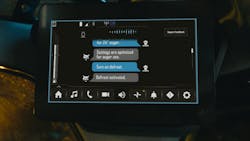
At CES 2026, Bobcat announced its new prototype technology Bobcat Jobsite Companion which is designed to provide real-time support and automation for everyday tasks in compact construction equipment. Per Bobcat, operators simply need to ask a question or state a command, and the system responds through voice and display interactions — adjusting attachment settings based on environment, offering operational recommendations and automating more than 50 functions without taking hands off the controls.
The technology is powered by Bobcat’s proprietary AI large language model and runs entirely onboard a machine to eliminate any potential delay that could occur if cloud connectivity were used. It also means the technology can be used even when in a remote location or where connectivity is limited, ensuring access at all times.
Bobcat also announced its Service.AI technology that allows dealers and technicians to instantly retrieve repair manuals and warranty details, receive real-time diagnostic guidance, and leverage Bobcat's archive of historical cases for faster troubleshooting. This will enable them to quickly provide service to machine owners so they can remain as productive as possible.
Other technologies Bobcat is showcasing include its prototype Collision Warning and Avoidance System designed to actively slow or stop a compact machine before a collision occurs as well as the RogueX3 fully electric and autonomous concept machine designed to be tailored to customer needs.
Kubota
Kubota is highlighting its latest developments in AI and autonomy for the agriculture industry at CES 2026. At the show, the company unveiled a commercialized smart, integrated autonomous solution for the specialty crop market which is built into its M5 Narrow tractor.
Advanced sensing and AI help ensure safe and accurate movement of the tractor through the narrow fields common to specialty crops such as vineyards. The tractor is undergoing field trials with wine supplier Treasury Wine Estates which joined Kubota at CES to talk about how it is using the autonomous tractor to help improve efficiency.
Kubota also introduced a concept ‘transformer’ robot known as KVPR that the company states can expand, contract, and move along every axis to provide customers with the adaptability of multiple machines in a single solution. With this robot, customers can use a single machine for multiple farming operations and seasons, minimizing the amount of machinery they need to have on hand for different crop planting and harvesting work.

Schaeffler Showcasing Range of Motion Technologies
At CES 2026, Schaeffler is showcasing its comprehensive motion technology portfolio as well as a few new additions to it. Technologies on display include those for humanoid robots along with solutions to enable automation, software-defined vehicles and reduced energy consumption.
Premiering at CES is a planetary gear actuator specifically designed for use in humanoid robots. Actuators play an important role in enabling accurate and efficient movement for these robots which may use as many as 25-30 actuators on average in their joints such as the knees and shoulders.
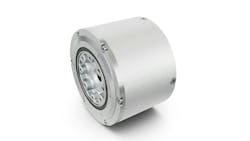
According to Schaeffler, its planetary gear actuator is able to provide smooth back-driving (the ability to move the drive in reverse) which is something conventional actuators have difficulty in achieving. The actuator is comprised of a two-stage planetary gearbox, an electric motor, as well as an encoder and controller in a space-optimized unit. Its high thermal stability, torque range of 60-250 Nm, and particularly low back-drivability enables the actuator to withstand external forces and prevent unintended reverse rotation of the drive component, helping to ensure efficient and accurate movements.
Also on display at Schaeffler’s CES booth is an autonomous forklift demonstrator. It contains several of the company’s technologies to show how they can be used together to enable autonomous material handling, including:
- linear actuation,
- steering and traction drives,
- intelligent sensors,
- precision bearings, and
- batteries.
Through its CES display and the many other technologies it will have on display, Schaeffler aims to show not only the trends shaping the various customer markets it serves but also how its motion technologies can help meet the needs of these trends.
Siemens Introduces Software for Building Industrial Metaverse Environments at Scale
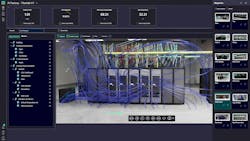
Siemens announced the launch of its Digital Twin Composer at CES 2026 which is a software solution designed to enable the building of Industrial Metaverse environments at scale. It enables users to bring together industrial AI, simulation and real-time physical data to help quickly make decisions in a virtual environment before any physical product is created.
Digital Twin Composer combines 2D and 3D digital twin data with physical real-time information built by NVIDIA Omniverse libraries. According to Siemens, the software allows users to rapidly build and maintain their global environments containing all aspects of their product or production data (both virtual and physical) in a secure, managed high-fidelity 3D experience, throughout the lifecycle of the product, process or facility.
The software aims to help design, engineering and production teams more easily work together in a single environment. They can visualize, interact with and iterate on any product, process or factory in its real-world context before physical design or construction takes place, and no matter the product — whether it's a new smartphone, a tanker in a shipyard, an autonomous electric vehicle, or a new AI factory on a greenfield or brownfield site.
ZF Debuts Active Noise Reduction Technology
During CES 2026, technology company ZF is introducing its new Active Noise Reduction software function. The company’s mechatronic actuators utilize software to reduce in-vehicle tire noise without the need for additional noise dampening hardware.
Mitigating the noise created by tires and other vehicle componentry is important in vehicles of all types, from passenger cars to construction equipment. Noise can cause discomfort for vehicle operators and when accompanied by vibrations lead to faster component wear and tear.
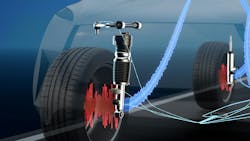
ZF explains in its press release announcing the technology’s debut that it is a software-based solution which uses the company’s Smart Chassis Sensor with an integrated acceleration sensor to precisely measure vibrations transmitted from the tires to the vehicle via the chassis. The vibration data is analyzed using an algorithm developed to recognize the characteristic noise patterns of tire cavity noise. The software then generates a countersignal provided by ZF’s cubiX software via the valves of semi-active dampers; micro-movements of the dampers reduce the noise interference without impairing the actual damper function.
Currently the software function can reduce noise levels by more than 3 dB which is an audible difference for vehicle passengers. In the future, ZF believes it can lower noise levels by as much as 10 dB. The company also foresees applying the capability to other actuators, such as those for brakes or its fully active damping system.
This technology fits in with the company’s broader product strategy incorporating intelligent and networkable actuators to enable new chassis functions via software. By combining intelligent actuators such as brakes, steering, and damping, with scalable electronic architectures (E/E) and innovative software solutions into highly integrated, flexible systems ZF says it is preparing for the future of software-defined vehicles — which will be key for enabling autonomous operation in many applications.
Learn more about software-defined vehicles and how they are shaping future technology designs in the following articles.
Software-Defined Vehicles Driving Future Growth Opportunities
How Connected and Software-Defined Vehicles are Reshaping System Architectures
About the Author
 Sara Jensen
Sara Jensen
Executive Editor, Power & Motion
Sara Jensen is executive editor of Power & Motion, directing expanded coverage into the modern fluid power space, as well as mechatronic and smart technologies. She has over 15 years of publishing experience. Prior to Power & Motion she spent 11 years with a trade publication for engineers of heavy-duty equipment, the last 3 of which were as the editor and brand lead. Over the course of her time in the B2B industry, Sara has gained an extensive knowledge of various heavy-duty equipment industries — including construction, agriculture, mining and on-road trucks —along with the systems and market trends which impact them such as fluid power and electronic motion control technologies.
You can follow Sara and Power & Motion via the following social media handles:
X (formerly Twitter): @TechnlgyEditor and @PowerMotionTech
LinkedIn: @SaraJensen and @Power&Motion
Facebook: @PowerMotionTech