Sensors in Fluid Power Systems are Improving Machine Performance
Key Highlights
- Kalid Ortiz from Festo and Leandro Zaza of HYDAC offer their insights on the growing use of sensors in fluid power systems and the many benefits this is bringing to machine owners.
- Pressure, temperature and position sensors are some of the most commonly used types in today’s hydraulic and pneumatic systems.
- Integration of sensors into fluid power components and systems is enabling the implementation of automated functions, more predictive maintenance capabilities and improved machine reliability.
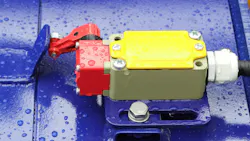
Sensors are now a common component within hydraulic and pneumatic systems. Their inclusion in these systems enables automated functions, data collection to improve maintenance and so much more.
Both Kalid Ortiz, Product Marketing Manager, Sensors, Festo NAM, and Leandro Zaza, Product Manager, Electronics Division, HYDAC, noted during a webinar with Power & Motion they have seen a significant increase in use of, and requests for, sensors.
“I think sensors are no longer considered an optional accessory,” said Ortiz. Industry 4.0 and smart manufacturing initiatives are among the factors driving increased use of sensors in Festo’s pneumatic products.
Predictive maintenance capabilities and the push toward higher levels of automation are among the reasons Zaza said demand for sensors continues to increase.
Ortiz and Zaza both estimate that 70-90% of the fluid power technologies their companies develop now include sensors, and they predict that will reach 100% in the not too distant future.
Register for the webinar, “Sensors for Fluid Power Systems: The Technologies and Trends Driving Industry Adoption” to watch the full discussion with Ortiz and Zaza. In addition to the sensor technologies used with hydraulics and pneumatics, we also dive into the trends driving sensor adoption, technological developments and what further progress they see for the use of sensors in fluid power systems in the years ahead.
In this excerpt from Power & Motion's webinar, I discuss with Ortiz and Zaza the types of sensors most commonly used with hydraulics and pneumatics today, the capabilities customers are looking for, and some of the biggest benefits sensor technology is bringing to the industry.
*Editor’s note: Questions and responses have been edited for clarity.
Power & Motion: What types of sensors are commonly being used with, or requested for use with, fluid power components and systems?
Leandro Zaza: Pressure sensors and pressure switches are required, as well as temperature [sensors]. With the increase of automation, position sensors are a must have.
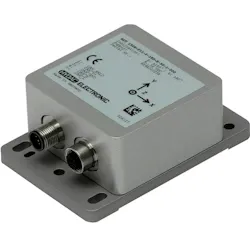
And we see three different flavors of position sensors [being used]. One is, for instance, the inclination sensor. Then there is an angle sensor as well as a linear position sensor. The combination of these three sensor modalities can give the operator a very good estimate of the position of the machine.
So, we see pressure, temperature, and position as the three main type of sensors [used]. Moving to full autonomy, but this is a different topic, we [will] need to have a vision system as well as other sensor topologies.
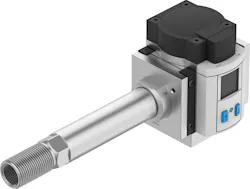
Kalid Ortiz: I totally agree. Pressure sensors for process control, diagnostics, and energy monitoring; flow sensors for air and to measure also consumption — it’s a pretty important variable. Position sensors [and] also vacuum sensors in many handling applications.
We need to know when we are grabbing the product and when we are manipulating it, so vacuum sensors are pretty important. Temperature sensors and leak detection; leak detection not only for the system that we are using, but also for different kinds of products. Leakage is a pretty important [factor to monitor].
Power & Motion: What are the capabilities customers are looking for from sensor technologies being employed in fluid power systems today?
Kalid Ortiz: This is a very important question. Many customers are looking today for real-time diagnostics and condition monitoring…to have predicted maintenance data. The capability of remote configuration and parameterization, such as with IO-Link technology, [and] easy integration into cloud systems [is also desired], because today the sensors are creating a lot of information, and we need somewhere to put that information to be processed.
Also, customers always want plug-and-play commissioning. They just want to connect it [a sensor] and have self-commissioning. They want to have quick [installation].
Health monitoring [is another thing customers want]. There are some sensors now available in the market that can give us the actual health state of the sensor. We have an opto-electronic family of sensors that can indicate its light beam is dirty. So, they are looking for these kind of features now on the sensors.
Leandro Zaza: Reliability is a key feature that customers are looking for now. They want to really be sure that the measured value is exactly…the value which needs to be measured. Also, an easy to install device makes a lot of difference, especially in a retrofit kind of application where there is already a machine and they want to install another system to automate it.
There is also cost-effective or competitiveness pressure. So, the expectation from the customer side is to get a higher [level of] technology with the least possible cost; that is a capability that we need to fulfill in the market, this requirement of having a cost-effective solution for the customer.
Power & Motion: What have been the biggest benefits you’ve seen sensors bring to the fluid power industry so far?
Leandro Zaza: The sensor technology, along with the advanced control unit or control system, brings a lot of value to a customer. If I think about an excavator, for instance, and the e-wall or auto-grading [features], these are features that are enabled thanks to sensor technology. Or e-fence, you want to protect [people outside of a designated] operating environment. All of these are benefits that good sensor technology, and reliable sensor technology, can bring to the end user.
Kalid Ortiz: Improving machine availability and reliability, as well as enhancing process quality and consistency. Faster troubleshooting, that's an important one.
With all the information the sensors are providing, it's easier to solve any problem that the process presents. In general, better machine performance is now [achievable] with the new generations of sensors.
About the Author
 Sara Jensen
Sara Jensen
Executive Editor, Power & Motion
Sara Jensen is executive editor of Power & Motion, directing expanded coverage into the modern fluid power space, as well as mechatronic and smart technologies. She has over 15 years of publishing experience. Prior to Power & Motion she spent 11 years with a trade publication for engineers of heavy-duty equipment, the last 3 of which were as the editor and brand lead. Over the course of her time in the B2B industry, Sara has gained an extensive knowledge of various heavy-duty equipment industries — including construction, agriculture, mining and on-road trucks —along with the systems and market trends which impact them such as fluid power and electronic motion control technologies.
You can follow Sara and Power & Motion via the following social media handles:
X (formerly Twitter): @TechnlgyEditor and @PowerMotionTech
LinkedIn: @SaraJensen and @Power&Motion
Facebook: @PowerMotionTech