A Lesson on the Importance of Circulating Hydraulic Fluid During Maintenance
Key Highlights
- Circulating oil in hydraulic reservoir when performing maintenance is critical to preventing contaminants from settling and causing damage to components once maintenance is complete.
- Devices such as vacuum dehydrators and filter carts, as well as kidney-loop filtration, should all be considered for circulating hydraulic fluid as they can significantly reduce harmful moisture and particle buildup.
- Care should also be taken when disassembling components during maintenance to prevent contaminants from being introduced into a system.

When Kirk LeBlanc learned that his client — a power plant in the Southwestern U.S. — had scheduled a shutdown of one of its GE D11 steam turbines for service, he fired off an email to the plant maintenance manager.
LeBlanc, a sales account manager at Controlled Fluids Inc. (CFI) with nearly 30 years of hydraulics experience, reminded the manager to protect the system’s fluid. Before taking the unit offline, he advised the plant and its contractor to rent a vacuum dehydrator or, at minimum, a filter cart to keep the fluid circulating in the turbine’s hydraulic oil reservoir.
According to LeBlanc, circulating hydraulic fluid during preventative maintenance stops suspended contaminants in the fluid from falling out and settling at the bottom of the system’s oil reservoir.
During shutdowns, he said hydraulic fluid often cools quickly; condensation can set in and cause moisture within the fluid. Moreover, when particles suspended in the fluid settle at the bottom of the reservoir and technicians restart the unit, the system’s pumps suck this back into the fluid lines which can damage components downstream like servo valves.
Using a dehydrator, which can cost approximately $15,000 (depending on size) to rent, or a filter cart to circulate hydraulic fluid can help prevent these issues.
As you may have already guessed, LeBlanc’s client did not follow this advice. The plant did not filter the fluid which led to problems costing it two additional weeks of unscheduled downtime, approximately $300,000 in lost revenue, and about $200,000 to flush the unit’s hydraulic system along with repairing several components.
While this incident occurred at a power plant, LeBlanc said the risks and preventative measures are applicable to any facility where a hydraulic reservoir’s fluid is exposed to the atmosphere or not circulated.
Circulating Fluid Prevents Accumulation of Damage-Causing Contaminants
Circulating a unit’s fluid while a maintenance team overhauls a turbine or other system is a known technique, even a best practice, that unfortunately some managers and contractors dismiss at their peril.
“Vacuum oil dehydration, or any type of circulatory fluid conditioning system, is like kidney dialysis,” explained LeBlanc, in that it essentially filters out water and contaminants that could harm hydraulic components.
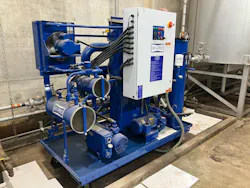
The fluid conditioning system is connected to the oil reservoir and circulates the hydraulic fluid within it. Keeping the fluid moving prevents contaminants from settling in the reservoir and entering components downstream once the system goes back online.
The GE D11 steam turbine used in the power plant has a main hydraulic oil reservoir which provides lubricating fluid to the bearings of both the generator and the turbine. Pumps, regulators, and other integrated lubricating oil system components attach to the reservoir. These same pumps, coolers, and filters deliver lubricating oil to the turbine and each generator. Once oil reaches the generator bearings, the fluid returns to the main oil tank.
Since the oil with the hydraulic reservoir serves so many components critical to the operation of the turbine, ensuring the cleanliness of that oil is vital.
Beyond employing a vacuum dehydrator as part of a preventative maintenance program, LeBlanc noted that, while a unit is offline, the owner should turn over the volume of fluid in the unit’s main oil reservoir at least four times per day with kidney-loop filtration.
LeBlanc said filtration of the turbine’s fluid while the system is offline “is the way to maintain cleanliness, reliability, and avoid hundreds of thousands of dollars in damage.”
“Kidney-loop filtration, whether it’s connected to the reservoir permanently or portable and used for outages, is low-cost,” said LeBlanc. “That might be overlooked by maintenance teams that have lost ‘tribal’ knowledge through retirements. Even some engineers aren’t familiar with what’s required to maintain hydraulic systems and ensure peak operating conditions.”
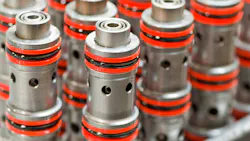
For whatever reason, LeBlanc’s power plant client did not take these steps and so contaminants in the reservoir made their way to into the servo valves used as part of the turbine’s actuator assembly.
Filters Installed in the System Have Their Limitations
Although filtration is used within the system to prevent contaminants from reaching sensitive components, LeBlanc noted that in many OEM designs, filtration and fluid conditioning systems are intentionally designed in a simple way to reduce costs. So, plant managers often spend the money to upgrade filtration or add an offline filtration system such as kidney-loop filtration, to boost reliability and fluid cleanliness.
The fluid system includes a filter in front of each servo valve, but the filter only catches particles measuring 25 microns (µm) in diameter or larger. By comparison, the diameter of human hair is about 40 µm.
Any particle smaller than 25 µm passes through to the servo valve. The servo valve can filter particles up to 3 µm in diameter. But if the system’s fluid has millions of particles less than 3 µm in diameter, they will accumulate within the servo valve and cause performance issues.
There are some filters that can be used in the system capable of trapping particles measuring as small as 3 µm. But when particles overload the filter, fluid will travel around via a bypass. Putting a filter in front of the servo valve that could trap particles less than 25 µm in diameter isn’t an option. LeBlanc said that would create too much back pressure and restrict a sufficient volume of oil to the servo valve.
“The last-chance filter catches the big stuff by design,” noted LeBlanc. “And Moog has developed a new servo valve that is more tolerant of contamination with good feedback and control as an alternative.”
But there is still only so much that the filters installed within the hydraulic system can capture.
That is why it is important to use a circulating fluid conditioning system during preventative maintenance procedures. It reduces the chances of contaminants building up in the system once it goes back online and potentially causing damage to components and in turn performance issues.

Proper Disassembly is Also Necessary to Prevent Contamination Issues
Compounding the power plant’s hydraulic system problems was the contractor’s approach to removing the actuator assemblies for the GE D11 turbine, said LeBlanc.
The actuator assembly on the GE D11 steam turbine is comprised of a main control valve, main stop valve, and intercept valve actuators. These large hydraulic cylinders link the steam admission and extraction valves, regulating steam flow into and out of the turbine. They are commonly serviced during planned outages.
The contractor removed each assembly’s Moog servo valve and capped the piping, and also removed the hydraulic manifold and plugged its lines. He felt this was done to prevent inadvertently swinging each 1,900 kg actuator assembly when lifting it with a crane and causing damage to the manifold and servo valve.
“The contractor on site was using rags to plug the lines to the removed servo valve and manifold, which introduced fibers and dirt into the system,” LeBlanc recalled. “The company owners certainly knew better. Maybe the techs on site lacked the knowledge to do this correctly or didn’t read the entire scope of work.”
Once CFI delivered the rebuilt actuator assemblies, which its technicians had carefully capped, the contractors, as part of the installation, took off additional components from the assemblies and introduced even more contaminants. That, and a lack of kidney-loop filtration, caused the power plant’s servo valves to run for about an hour and then they got “glued up,” said LeBlanc.

Contaminants entered the fluid lines and the valves, causing them to get clogged and no longer perform as required.
In response, CFI immediately sent field repair service technicians with spare parts. They also conducted fluid analysis, repaired the plant’s hydraulic system, and cleaned its components.
This enabled the plant manager to get the unit running. LeBlanc recalled the system still had so much contamination that the plant manager hired a company to flush all the oil, leading to additional costs. And replacing the eight servo valves cost the plant $8,000 per servo valve.
In the end, the power plant spent more time and money fixing its turbine’s hydraulic system than if it had followed proper maintenance procedures in the first place. This costly lesson stresses not only the importance of following best practices when performing preventative maintenance but also the critical role circulating hydraulic fluid can play in maintaining long-term hydraulic system performance.
About the Author
 Sara Jensen
Sara Jensen
Executive Editor, Power & Motion
Sara Jensen is executive editor of Power & Motion, directing expanded coverage into the modern fluid power space, as well as mechatronic and smart technologies. She has over 15 years of publishing experience. Prior to Power & Motion she spent 11 years with a trade publication for engineers of heavy-duty equipment, the last 3 of which were as the editor and brand lead. Over the course of her time in the B2B industry, Sara has gained an extensive knowledge of various heavy-duty equipment industries — including construction, agriculture, mining and on-road trucks —along with the systems and market trends which impact them such as fluid power and electronic motion control technologies.
You can follow Sara and Power & Motion via the following social media handles:
X (formerly Twitter): @TechnlgyEditor and @PowerMotionTech
LinkedIn: @SaraJensen and @Power&Motion
Facebook: @PowerMotionTech