Gates Large-Diameter Hoses Meet Increasing Data Center Cooling Needs
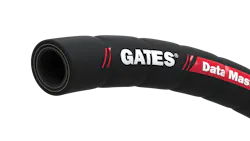
The cooling requirements of data centers continue to grow, prompting the need for components capable of delivering the liquid used to keep chips and servers from overheating.
Enter the latest Data Master MegaFlex hoses from Gates Corp. The company is now offering 3- and 4-in. inner diameter (ID) options purpose-built to meet the increased cooling capacity and higher flow rates now required in data centers.
Per Gates, server rack power densities are reaching 150-plus kW per rack which is increasing cooling needs and thus coolant flow requirements for the hoses and other components used in data center cooling systems.
Rebekah Headley, general manager of the Gates data center business unit, explained to Power & Motion that by increasing the inner diameter of the hoses, they are able to meet increased flow requirements.
“When you need to move more coolant through a system, hose diameter is one of the first design variables you have to address,” she said. “A wider bore, or internal diameter, provides less flow resistance, lower pump head requirements, and greater coolant throughput, all of which directly improve heat transfer efficiency and overall cooling loop performance.
“By introducing 3- and 4-in. options into the Data Master MegaFlex line, we’re enabling designers to support higher rack densities and next-generation AI (artificial intelligence) workloads while maintaining the same material performance and flexibility needed to scale liquid cooling infrastructure over time,” she said.
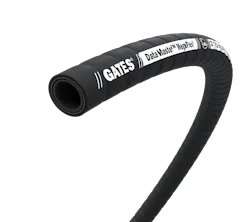
A Data Center Cooling Hose Designed to Meet Multiple Industry Requirements
Headley noted that Gates already has 1.25-2 in. size hoses, so it had materials technology proven to work in data center cooling systems it could use as a starting point when developing the new 3- and 4-in. ID hoses.
In addition to increasing flow capabilities, she said it was also necessary for the hoses to still meet cleanliness and routing requirements.
Learn more about other hose technologies in Gates' Data Master MegaFlex line.
Gates Data Master MegaFlex Cooling Hose for Data Centers
Gates Data Master Eco Liquid Cooling Hose Supports Hyperscale Data Centers
To achieve all of these design goals, she said the Data Master MegaFlex hose line is engineered around three key elements that work together to deliver high-flow and low-pressure-drop performance in liquid cooling systems.
1. The Bore Size
Increasing the bore size allows a higher flow rate while also reducing hydraulic resistance, lowering pump head requirements, and improving cooling loop efficiency.
“The larger internal diameter of the hose means the fluid moves slower for the same flow rate, which cuts friction losses significantly,” Headley explained. “Less friction means the pump doesn't have to work as hard. As rack densities and flow rate demands continue to rise, this relationship between bore size and system efficiency becomes increasingly important to overall data center energy performance.”
2. The Tube Material
The 3- and 4-in. ID hoses are comprised of a proprietary zinc‑free peroxide-cured EPDM tube material which helps to minimize system contamination.
“We use a proprietary peroxide-cured EPDM compound, and the reason that matters is coolant purity. Sulfur-cured rubber can introduce contaminants into the fluid over time. Once you've got that kind of degradation in your system, you're looking at corrosion, reduced heat capacity, and performance that erodes gradually rather than failing all at once,” she said.
“The Gates peroxide-cured EPDM gives you excellent compatibility across coolant types, including PG25, and it's designed to hold up in the closed-loop, high-stress conditions these systems run under.”
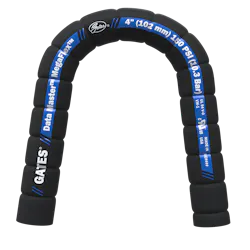
3. The Corrugated Cover Construction
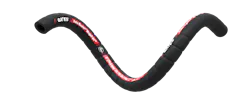
Use of a corrugated cover construction for the cooling system hoses helps provide fast, kink-free installation. Gates states the new hoses provide up to a 75% tighter minimum bend radius (MBR) versus competing hoses. This makes it easier to route the hoses through the often tight spaces cooling systems are placed in.
“Its routing flexibility can’t be matched by either rigid piping nor conventional hoses,” said Headley. “Rigid piping has no bend radius. What does this mean? Every single direction change requires a fitting, adding cost, installation time, and additional potential leak points to the system.
“While on the other hand, conventional hoses offer flexibility but are susceptible to kinking when routed through tight spaces. When a hose kinks, you lose flow, pressure spikes, and the pump has to compensate,” she continued. “Data Master MegaFlex’s corrugated cover construction maintains the internal geometry of the hose even through tight bends, delivering a minimum bend radius tighter than other flexible hoses on the market, eliminating kink risk, preserving flow performance, and simplifying installation in the constrained environments of modern high-density data center racks.”
AI and Chip Technology Increasing Cooling Demand, Bringing Opportunities for Fluid Power Industry
Increasing use of AI and evolving chip technology are among the factors driving the need for higher flow liquid cooling systems in data centers. The chips used in data centers are key for storing, processing and transmitting the data in these facilities.
The more powerful these chips get, the more heat they can generate and thus more cooling they require to prevent them from overheating and not performing as desired.
“The demand for higher-flow liquid cooling systems is being driven by a fundamental shift in the power and thermal requirements of modern AI and high-performance computing workloads,” said Headley.
“But the true underlying driver is chip architecture. Each new generation of chip operates at higher power densities than its predecessor, generating more heat per rack than traditional air cooling can effectively manage,” she explained.
“Higher power density means higher thermal loads, and higher thermal loads require more coolant moving through the system at greater flow rates to carry that heat away efficiently. It is this shift in system-level flow requirements that drove the design and expansion of the Data Master MegaFlex line.”
As cooling requirements in data centers increase further in the years ahead, it will likely bring opportunities for those serving this market, including many fluid power companies like Gates.
Read the article “Hydraulics and Pneumatics Play Important Role in Data Center Cooling” to learn more about how Gates and other fluid power companies are developing components for data center cooling systems.

“Liquid cooling is quickly becoming a baseline requirement in modern data centers. Fluid power companies are well positioned to play a meaningful role, and the opportunity extends well beyond hoses,” said Headley. “The full cooling loop depends on fluid power expertise: from the pumps that move coolant through the system, to the quick disconnect couplings that enable live maintenance without downtime, to the hose assemblies that connect every component in between. Companies that understand fluid dynamics, thermal management, material compatibility, and system-level performance have a real advantage in this space.
“That is why Gates has expanded its large-diameter hose offerings, developed advanced materials that protect coolant purity and system integrity under demanding operating conditions, and built out a full system portfolio spanning hoses, couplings, and pumps with a global footprint,” she continued. “With 115 years of innovation under our belt and deep expertise in materials science, fluid conveyance, and thermal management, we are able to anticipate customer needs in a rapidly changing market and bring the right products to market. The result is a single trusted source for the fluid transport layer of data center cooling infrastructure, engineered for the mission-critical environments where performance and reliability are non-negotiable.
“The companies that will win in data center cooling are those that bring both the product range and the application knowledge to help customers design and build systems that perform reliably at scale,” she concluded.
About the Author
 Sara Jensen
Sara Jensen
Executive Editor, Power & Motion
Sara Jensen is executive editor of Power & Motion, directing expanded coverage into the modern fluid power space, as well as mechatronic and smart technologies. She has over 15 years of publishing experience. Prior to Power & Motion she spent 11 years with a trade publication for engineers of heavy-duty equipment, the last 3 of which were as the editor and brand lead. Over the course of her time in the B2B industry, Sara has gained an extensive knowledge of various heavy-duty equipment industries — including construction, agriculture, mining and on-road trucks —along with the systems and market trends which impact them such as fluid power and electronic motion control technologies.
You can follow Sara and Power & Motion via the following social media handles:
X (formerly Twitter): @TechnlgyEditor and @PowerMotionTech
LinkedIn: @SaraJensen and @Power&Motion
Facebook: @PowerMotionTech