Danfoss Optimistic About Improving Market Conditions and New Growth Opportunities
Key Highlights
- Danfoss Power Solutions President Daniel Winter discusses the various market factors which helped drive growth for the company in 2026 and expectations for 2027 and beyond.
- Data centers have been a large growth driver for the company, and are expected to remain so over the long term.
- He sees opportunities to further grow the company’s industrial hydraulics and electrification businesses while also capitalizing on new markets such as security & defense.

Danfoss Power Solutions anticipates a return to more positive market conditions in 2027.
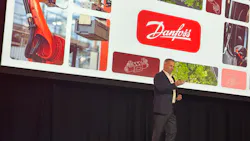
Daniel Winter, President of Danfoss Power Solutions, spoke during the company’s biannual distributor meeting held in September 2026 about why he expects market conditions to improve as well as growth opportunities he foresees for the company.
He said that it is likely we have hit the low point in the downward cycle and the first signs of improvement have started to show in various global markets. These improvements are expected to continue into 2027 and beyond.
Data centers have been a large opportunity area for the company as buildup of these facilities has boomed, particularly in the U.S., over the past year. Winter said this will remain an important market for the company going forward. In addition, he believes there are opportunities to be had in growing the industrial hydraulics business and capitalizing on other potential growth markets such as defense.
I had the chance to speak with Winter during the Danfoss Distributor Meeting (DDM) 2026 to learn more about the various market opportunities he sees for Danfoss Power Solutions in the year ahead.
*Editor’s note: Questions and responses have been edited for clarity.
Power & Motion: How have market conditions been for Danfoss in 2026?
Daniel Winter: If you look [at] our half-year results that we have posted, then you will see officially that we had 18% [organic] growth in Power Solutions. The majority of that comes out of our data center business that is vastly growing. Besides that, we see data centers having a very positive impact on construction equipment, in particular in North America, and that's where we see growth. So we are back to growth in construction, and data center construction is leading to growth in North America.
We're seeing growth in India, for example, where we have a stronghold in the ag (agriculture) market with our steering solutions, and we're seeing growth in Asia, particularly in China, and that is not so much because of the local economy being strong, but we see more and more that [our products] are on equipment that is being exported into the world. I think Europe is still lagging behind.
If I look over the course of the year, we are seeing that improvement. Whereas we started the year, it was not as good and not as many positive signals; our book-to-bill ratio was not as strong. [But] during the year we are seeing an improvement, and I expect that to continue.
Power & Motion: And is it mostly the markets you were mentioning that you’re seeing growth in or are there any other markets or regions where you’re seeing opportunities?
Daniel Winter: What I expect is we will also see Europe improve and recover. I think for us there's an opportunity now [in] Canada. I think [what] Canada is doing with investments into modernizing industry, in energy supply and in electrification will be very positive, and we want to have a stronger presence there.
I think there's actually a lot of opportunities in South America, and particularly in Brazil. So overall, I'm actually looking at a very strong foundation where we are. I see that there's improving trends, and I'm actually pretty enthusiastic.
Power & Motion: What are some factors that have presented challenges for Danfoss and the fluid power industry as a whole in 2026, and what has the company been doing to try to overcome them?
Daniel Winter: Well, I think the biggest challenge that I see is instability. We have a couple of [topics] that are impacting business, like tariffs, the uncertainty around what is the longer term trend on inflation and interest rates, and the influence from the [Iran] war driving inflation.
But we deal with those challenges, right? So, we are dealing with inflation in two ways. On the one side, we are working on being cost competitive with our products, our organization and our structure, and on the other side [we are doing so] with our pricing. We are getting better, I think, in managing shorter-term disruptions.
We have taken a big step forward in regionalizing, localizing our supply chain. That's why we can now serve China for China; we are investing in a big plant in India, so we are getting kind of independent there. We are already very independent in North America, and that just makes us more flexible and more adaptable to serve those markets.
Power & Motion: Do you expect these challenges to persist in 2027?
Daniel Winter: Yes. It seems to be a little bit the new normal. In the past you might have had these bigger disruptions every 10 years, now we’re getting them every 2-5 years. I think every company is adapting to that [by] getting more flexible, adjusting supply chains, [and] having leaner cost structures.
Also what we’re doing here [at the Danfoss Distributor Meeting 2026] — having stronger partnerships, that is a very important point. We learn from each other [with these partnerships] and are also able to react faster.
Power & Motion: After announcing the Alfagomma acquisition, you had mentioned that Danfoss sees a lot of opportunities across a range of sectors for fluid conveyance. Are you able to share what some of those opportunities are that you see?
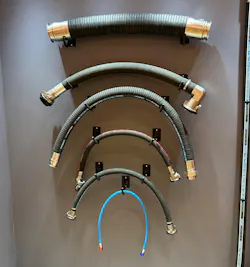
Daniel Winter: If you unfold our fluid conveyance business today, it is our fastest growing business at the moment. It is driven by big demand for data center products, where we have fittings and connectors. And then we have the hose business.
Now, with the acquisition of Alfagomma, I think we will be a global leading player in that market, both in hoses and fittings. And the good thing is that where we have been much stronger in the hydraulic oil hose business with our Aeroquip brand, now we are also adding a significant portion of industrial hose and that enables us to get into different applications like food and beverage and chemicals, areas where traditionally we did not have the product to serve those markets.
But on top of that, we are also strengthening our regional footprint; we had been very strong with fittings and hoses in North America. Now we have the largest hose plant in the world in Çerkezköy, Turkey. With the addition of Hydro Holding, we also got a connector portfolio.
But now we have probably one of the strongest presences also in Europe. In addition, we’re getting a footprint in Asia which Power Solutions did not have before. And then there's other nice additions where we're getting sizeable access to markets now in South Africa [and] Australia. If you look to Brazil, in the past we were producing hoses [there] and Alfagomma is producing fittings, so now we have hoses and fittings, and we can serve customers even better with hose assembly.
So, I would say addressing the market from a product portfolio and also a regional perspective, we see that as a very good match for us.
Power & Motion: You had noted during your presentation here at the Danfoss Distributor Meeting that you are noticing some upswings coming and wanting to be prepared for the growth projected over the next few years. What is Danfoss doing to prepare for that?
Daniel Winter: Looking back at the last DDM in 2024, we had just come out of a peak upswing in the market after COVID. And to be very honest, our delivery performance was not the best in that upswing; we had to put some customers on allocation because we were running out of capacity and ran into some delivery issues because we did not have the ability to serve all customers locally, we had to move parts around the world.
So, what we have been doing since is we have localized and regionalized the supply chain and we have invested in capacity. That ensures we are just better prepared for the upswing. We have more capacity, we have [more of our product portfolio available], and we are also more local; we are probably 85% localized. So, we have taken a lot of steps with investments in capacity and equipment so that we don't run into downtime [issues]. In particular, some of the legacy Eaton plants we have significantly upgraded, and that makes us just much more prepared now for the upswing that I expect to come.
Power & Motion: Coming back to the topic of data centers, do you anticipate that being a long-term growth opportunity?
Daniel Winter: I think this is a longer-term trend. We of course see geographies developing differently, where for sure the U.S. is in the lead right now, and then Asia. Europe is still lagging behind, but I think there might be a shift that we see actually stronger demand coming up out of Europe.
We will probably not see the growth rates that we have right now, which are like a factor of two or a factor of four, or doubling the business every year. But we will still see significant growth, and then the growth might only be 20% but it will be significant demand, and that is going to be a longer-term trend.
Power & Motion: Are there any other new market opportunities you guys are investigating or seeing potential in over the next year or two?
Daniel Winter: We talked about the geography presence that we're looking into, where there's for sure areas we want to strengthen our business, like Canada and Brazil. What China was in the past a growth driver India will be for sure. If you look at many of our customers, they are all setting up local manufacturing footprints in India.
I think on the technology [side], we see that our industry will for sure be disrupted with electrification. Probably not so much in North America right now, or not in the U.S., but we are seeing rising demand in Europe, and in particular, working with Chinese OEMs.
We have made adjustments in the company, and we have a very strong portfolio where we want to grow in the industrial space, industrial hydraulics.
And then we are also looking into new verticals or technologies. I think we are getting stronger and need to move away from being a component supplier to a system supplier. We will see also more system sales where you link components with software solutions. Also, we are looking into security and defense as one of the verticals where we want to serve that market in a more structured way.

Power & Motion: What opportunities do you see in security and defense?
Daniel Winter: If you look at defense, then you have the marine market. I think in marine there's a lot of electrification that is happening. And then for hydraulics, it's the land vehicles where traditionally you have a lot of hydraulic applications. It was just that in the past we were not serving that market directly, but we left that space open to partners or distribution partners.
And we believe that we need to take a different approach because that is one of the markets that is of course significantly growing [due to] geopolitical tensions. We need to get ourselves into a position where we are very clear on what markets we serve ourselves and also what markets we serve with distribution and other partners. But [there is] no doubt that is a growth market where we also want to participate.
Power & Motion: What are you most looking forward to or most excited about for Danfoss, or the fluid power industry as a whole, over the next year or couple of years?
Daniel Winter: I think it’s the growth potential we have in the industry. If you look over the last couple of years, it was pretty challenging. It had not yet happened that at the same time both the construction and the agricultural market was down that much.
Now we can see construction is really lifting. I think it's just a matter of time where we will also see some backwind coming into the ag market, and I think not only us but also competitors have learned a lesson and are well prepared. And so I think those investments that we have been doing will pay off.
When the markets swing back, we can increase our investments even more in advancing technology; it gives the opportunity to do more investments to develop and advance our technology. Not that we have abandoned that, but of course you need to scale back. And now I think we will be in a phase where we can do even more of that.
About the Author
 Sara Jensen
Sara Jensen
Executive Editor, Power & Motion
Sara Jensen is executive editor of Power & Motion, directing expanded coverage into the modern fluid power space, as well as mechatronic and smart technologies. She has over 15 years of publishing experience. Prior to Power & Motion she spent 11 years with a trade publication for engineers of heavy-duty equipment, the last 3 of which were as the editor and brand lead. Over the course of her time in the B2B industry, Sara has gained an extensive knowledge of various heavy-duty equipment industries — including construction, agriculture, mining and on-road trucks —along with the systems and market trends which impact them such as fluid power and electronic motion control technologies.
You can follow Sara and Power & Motion via the following social media handles:
X (formerly Twitter): @TechnlgyEditor and @PowerMotionTech
LinkedIn: @SaraJensen and @Power&Motion
Facebook: @PowerMotionTech