Mobile Hydraulics: Sensor Integration and Electronification are Key Design Priority Areas
Key Highlights
- Representatives from Faster, HydraForce and Poclain Hydraulics see sensor integration, electrification as well as the need for safe and intuitive operation among the key design priorities for hydraulics used in mobile applications.
- Integration of sensors and electronic control is increasing to bring performance improvements to hydraulic and machine designs in an effort to meet requirements for more intelligent systems, automation and electrification.
The hydraulics industry is undertaking a number of technological developments to help meet the evolving performance requirements of agricultural machinery, construction equipment and other mobile applications.
Chief among these is the increasing integration of sensors into hydraulic components and systems. This is enabling more intelligence to be built into systems, aiding the automation of machine functions and eventually fully autonomous operation.
Additionally, inclusion of onboard electronics and the general electronification of hydraulic systems is bringing a number of performance benefits to mobile applications, including enabling machine electrification which remains an important development area for many OEMs.
In this second part of my discussion with Emiliano Torresi, Product Management and Marketing Director at Faster; Dave Ruxton, Application Engineering Manager at HydraForce; and Denis Greder, Group Marketing Director at Poclain Hydraulics, they offer their insight on how these and other technological developments are influencing hydraulic designs for mobile applications.
*Editor’s note: Questions and responses have been edited for clarity.
Power & Motion: What are some of the key development areas in which your company is working on for mobile applications? And what factors are driving these developments?
Read the first part of my discussion with Torresi, Ruxton and Greder in the article “Mobile Hydraulics: Current and Future Trends Influencing System Designs” to learn more about the trends they see influencing hydraulic designs for mobile applications.
Emiliano Torresi: Our development approach is increasingly focused on the end user, while maintaining close collaboration with major OEMs. As a market leader, we believe we have the responsibility to redefine connection technologies starting from real-world usage conditions.
Key areas of development include:
- Fast, intuitive, and safe connections to support high-frequency attachment changes.
- Contamination management at the point of connection, where most contamination actually enters the system.
- Durability and maintainability, given increasing hydraulic power and harsher duty cycles.
- Integration of multiple media and technologies into unified interfaces.
A major driver behind these developments is the growing mismatch between how systems are validated in controlled environments and how they are actually used in the field.
Dave Ruxton: On the AI (artificial intelligence) side, there’s a couple of things that we’re working on specifically such as controllers that have better telematics in that they’re better able to sense what’s going on. For any of that control to work, you need to have some really good feedback on your system, so you need to know exactly what, for instance, your boom and bucket are doing. You need to know what angle they’re set at. You can have a vision system, but that’s beyond the processing power of your average skid steer.
Just having a thorough sensor suite onboard is important. Being able to report that sensor output to a home base, so data gathering, is important. For us at HydraForce, what that looks like is telematics; we’re working with a company to provide a good telematics solution.
On the mechanical side, when you start to have a computer driving a machine, very tight control on all of your valving is needed. You need to have next-to-no hysteresis and good linearity. Computers expect to be able to drive something that’s linear and predictable. If you have a valve that’s jumping all over the place, an expert operator can handle that, but it makes it a lot easier from the control side if you’ve got something that’s a little bit more linear.
For us what that looks like is putting onboard electronics on our valves; getting spool positions, pressure sensors everywhere, and maybe a flow meter here and there. It looks like getting the electronic feedback that we need.
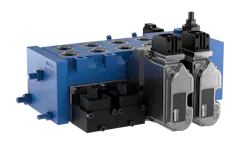
The other thing on valving, there’s a lot of solutions out there where if you’ve got a range of flow functions on a machine — you need 10 gpm for one function, 20 gpm on another and 30 gpm for yet another function — a 40 gpm valve is used for all of it. And it works pretty well.
We’ve got a pretty extensive line of valves so we can right size to every single function. We could put an 11 gpm valve on a function requiring 10 gpm, and that gives a lot better control and is a little bit better for packaging as well. The solution for us is to try to right size each function as much as possible to give the computer the best chance to be able to control accurately.
Denis Greder: Sizing transmissions not only on torque peaks but also on energy consumption and duty cycles. Traction force peaks may take place only during a small percentage of the working hours of a machine. These peaks must of course be addressed, but it is more important to optimize the transmission at conditions where most of the energy is consumed over the lifetime, for instance at high speeds, if you take a tool powered by hydraulics. And this, in turn, requires a good knowledge of the duty cycles of a machine.
Power & Motion: How have you seen the use and integration of sensors into fluid power components and systems for mobile applications progress in recent years? And is this a technology development area in which your company is working?
Emiliano Torresi: Sensor integration has progressed significantly in recent years and is becoming essential. We strongly believe that sensorization is one of the most effective ways to address reliability, maintenance, and environmental challenges.
Our work in this area has already been recognized — for example, with the innovation award at Agritechnica 2022 for our ABC (Always the Best Connection) system, which was among the first solutions to digitize the connection interface at the rear of the tractor.
We are continuing to invest heavily in fluid condition monitoring, connection status detection and predictive maintenance capabilities. Sensor-enabled connections allow operators to identify risks early, prevent failures, and optimize maintenance cycles.

Denis Greder: Yes, there is definitely more demand for all sorts of sensors in many markets — speed sensors, acceleration sensors, position sensors, angular sensors, obstacle detection sensors (radars, ultrasonic sensors), and temperature sensors.
This is driven by needs for more system integration and electronification for more precision and compliance with functional safety regulations.
Customers are requesting sensor options increasingly, whether it’s on motors or pumps, even valves, for a number of reasons like safety. It’s also linked to electronification of the machine; machines have more and more ECUs (electronic control units) to control the travel drive, for instance, and they need to feed those with sensors for performance accuracy and also safety and protection of the machine.
Temperature sensors, for instance, make sure the machine is not overheating or overpowered. Speed sensors increasingly include the detection of direction of travel as a safety requirement to provide redundancy information to the vehicle ECU.
We see a big increase in customer requests for sensors, and this is something we’re trying to integrate into our products. Request for higher speed sensor resolution are also becoming more common due to the need for more position accuracy.
Read the article "The Trends Shaping Fluid Power Designs for Mobile Applications" to learn more about the technologies and trends currently impacting fluid power systems used in mobile applications.
Power & Motion: How much, if at all, is electrification impacting your fluid power component and system designs? Do you see electrification continuing to be an important trend within the mobile equipment industry?
Emiliano Torresi: Electrification is definitely impacting our designs, but not in a simplistic way. The most realistic scenario we see is a hybrid architecture, where propulsion is increasingly electrified and work functions remain largely electro-hydraulic.
Hydraulics still provide the best power density and performance for many applications, especially for demanding attachments.
At the same time, electrification is expanding the need for thermal management solutions and new types of connections (e.g., cooling circuits, high-voltage interfaces).
For example, in agriculture, full electrification faces practical limitations due to duty cycles and charging constraints. This is leading to solutions such as battery swapping, which requires fast and reliable disconnection and reconnection of cooling lines.
Dave Ruxton: Pure electric solutions have waned a bit; hybridization, we do see it more. What effect does it have on our product line — coming from a valving and pump background, not a huge effect. A pump is still going to be a pump and a valve is still going to have a pressure drop across it. There’s always the attempt to make your pressure drop as low as possible, but we’re pretty much at the limit; you’re not going to get any less than 150 or 200 psi drop across a control valve and still maintain good control.
We see maybe some more circuits that allow a regeneration function [potentially coming into the market]. A forklift, for instance, when lifting and lowering it you waste some energy. Ideally, if you can come up with some sort of circuit that saves that energy, maybe stores it in an accumulator or spins a generator, that would be desirable but it doesn’t happen often.
Denis Greder: The use of electrohydraulic solutions with a traction battery, an electric pump and a hydrostatic transmission requires some clever ways of optimizing the efficiency to offset the losses linked with the energy transformation from chemical to electric to hydraulic to mechanical.
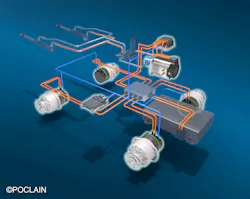
For instance, Poclain’s gear auto-shift allows the flow in the system to be minimized and to increase the working pressure, which boosts efficiency and keeps the machine running for more hours, without the need for a larger, more expensive battery; more generally the use of high efficiency components like radial piston cam lobe motors contributes to this objective.
Electrification also forces OEMs to use electronic control of pumps on machines that might be using manual or hydraulic controls in their conventional version, like small asphalt rollers, small articulated loaders or rough terrain fork lift trucks.
Electrification continuing to be a trend will depend on regulations and subsidies. For instance, we see more of it coming into on-highway equipment, and we have some solutions for this market (eFlow steering pumps, eAir compressors, eAddidrive). There is also an active market in Scandinavia for off-road battery operated vehicles.
It will also depend also on the use case. Mobile equipment that operates only on one site (like a harbor, an airport, a large warehouse or a landfill) can recharge more easily and are more prone to electrification (hence the market for large electric loaders in China).
Also, electric has benefits such as the ability to deploy max torque at start-up or to provide temporary very high torque peaks for a limited time [helping future uptake].
About the Author
 Sara Jensen
Sara Jensen
Executive Editor, Power & Motion
Sara Jensen is executive editor of Power & Motion, directing expanded coverage into the modern fluid power space, as well as mechatronic and smart technologies. She has over 15 years of publishing experience. Prior to Power & Motion she spent 11 years with a trade publication for engineers of heavy-duty equipment, the last 3 of which were as the editor and brand lead. Over the course of her time in the B2B industry, Sara has gained an extensive knowledge of various heavy-duty equipment industries — including construction, agriculture, mining and on-road trucks —along with the systems and market trends which impact them such as fluid power and electronic motion control technologies.
You can follow Sara and Power & Motion via the following social media handles:
X (formerly Twitter): @TechnlgyEditor and @PowerMotionTech
LinkedIn: @SaraJensen and @Power&Motion
Facebook: @PowerMotionTech