Job Satisfaction Remains High for Fluid Power Engineers
Key Highlights
- Most respondents to Power & Motion's 2025 Salary & Career Survey report high job satisfaction, with 62% indicating they are either very satisfied or satisfied in their current roles.
- Key industry challenges fluid power engineers continue to face include issues with component availability, keeping up with new technologies, and attracting new talent.
- Many respondents believe an engineering shortage persists, and noted difficulty in finding those with experience in hydraulics, pneumatics, and systems engineering.

Each year, Power & Motion surveys its audience to gauge the current state of engineering careers within the hydraulics and pneumatics industry. This annual Salary & Career Survey provides insight into hiring expectations, job satisfaction, challenges fluid power engineers are facing, and more that we then share with our readers to help them gain a better understanding of the industry in which they work.
Results from our 2025 Salary & Career Survey show that in general fluid power engineers continue to have a positive outlook on careers in the industry. However, as in years past, they face challenges related to component availability, keeping up with the pace of technology change, and attracting new talent.
Fluid Power Engineers Have High Level of Job Satisfaction
Results from our 2025 survey show that overall, engineers working in the fluid power industry are satisfied with their current jobs.
The majority of respondents to our survey, 98%, said they are in the same job as 2024, and most have worked at their present company for at least 5 years or longer, with several surpassing the 20-year mark — all indicators fluid power engineers are happy with their current employment.
When asked how satisfied respondents are in their current positions, 62% said they are either very satisfied or satisfied with 17% noting they are extremely satisfied. About 20% indicated some level of dissatisfaction with their current positions.
Read the article “Engineering Roles in Fluid Power Desirable but Difficult to Fill” for 2024’s survey results.
Read the article “Engineering Remains Viable and Important Career Path” for 2023’s survey results.
These figures are similar to the results from our 2024 and 2023 surveys (see sidebar), helping demonstrate the continued satisfaction many have with their careers in the hydraulics and pneumatics sector.
Just 7% of survey respondents said they are actively seeking new employment, and most at 40% said they cannot envision changing jobs in the foreseeable future, further demonstrating the satisfaction of many within the fluid power industry.
However, almost 60% did say that while not actively seeking new employment they would follow up if they heard about an interesting opportunity or were personally approached with an interesting opportunity.
Compensation and Other Factors Contribute to Career Satisfaction
There are a wide range of factors survey respondents said contribute to their job satisfaction. As to be expected, a large percentage of respondents indicated factors related to the job of engineering, such as researching potential design solutions and the challenges that accompany the design of new products, as either important or very important to their satisfaction.
Company culture and values, learning and advancement possibilities, and the opportunity to design products that can benefit society were also factors highly ranked by many as important to their job satisfaction.
Compensation was indicated as a top factor that contributes to job satisfaction as well. Just over half of respondents, 60%, said they feel their company adequately compensates them for the work they do.
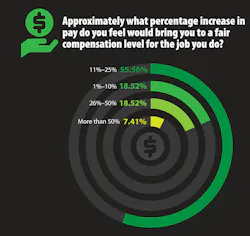
For those who feel a pay increase would bring them to a fair compensation level, most said that pay increase would need to be in the range of 11-25%.
Compared to other engineering employers, most respondents felt the compensation packages at their current employer is either equally competitive or somewhat less competitive.
Use our Salary & Career Tool to see how your job compares with others in the engineering field.
Component Availability and Keeping Up with New Technologies Remain Top Industry Challenges
Despite high levels of job satisfaction, our engineering audience still faces many challenges.
As the graphic below shows, there are a wide range of professional issues that respondents said keep them up at night. Staying current with new and emerging technologies as well as component availability were the top two issues indicated, followed closely by product reliability issues and concerns about general health of the economy.
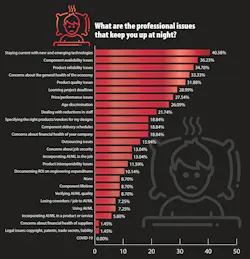
Component availability issues have been highly ranked in our survey over the last several years, which is not surprising given the many market challenges the fluid power sector has experienced. The COVID-19 pandemic in 2020 created a number of supply chain challenges. Although some easing of these supply chain pressures has occurred in recent years, tariffs and high interest rates have presented new challenges for the industry and its customer markets — contributing to both component availability and general economic health concerns.
And now, the U.S.’s war with Iran has the potential to upend the global economy and supply chains once again which will likely continue presenting challenges for the fluid power and broader engineering community.
Staying current with new and emerging technologies was highly ranked again this year which is not surprising given the vast number of technologies that can now be used with hydraulics and pneumatics.
The graphic below shows those technologies survey respondents said are having a major impact on their designs, demonstrating the breadth of topics engineers need to keep up on.
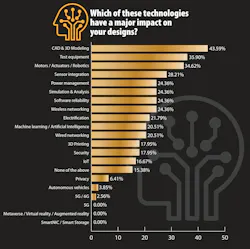
In conjunction with this, 50% of respondents said they are being given tasks outside their main expertise, further stressing the need to stay on top of technological developments in the market.
When asked about the challenges they face with trying to stay current with engineering information relevant to their work, not having enough time was the most common answer.
Other challenges noted include:
- there being too much information available and the difficulty in knowing what may be applicable,
- determining which topics are the most important to stay on top of,
- lack of company investment and reimbursement for training,
- finding good sources of information,
- colleagues being afraid of change and adopting new technology.
One respondent probably surmised best what many respondents indicated, “Staying current in engineering is a bit like trying to drink from a firehose — exciting, but overwhelming if you don’t have a strategy.”
Engineering Continues to be a Promising Career Choice
The majority of respondents, 63%, continue to see engineering as a promising career in the years ahead.
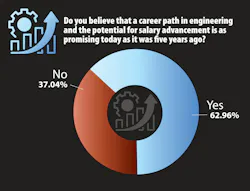
Many respondents who see continued promise in engineering careers noted it is because there remains a need to improve or invent technologies, and that it is a satisfying career with good earning potential. While some noted the increasing use of artificial intelligence (AI) for engineering work, many said humans will still be required for much of the work.
However, several respondents did indicate their concern about AI potentially displacing some engineering roles, particularly for entry-level jobs.
That said, the majority of survey respondents, 86%, said they would recommend engineering as a career path. A reason many gave for recommending it as a career is the fact engineering will always be needed and that it is interesting and creative work. Several also noted it is a rewarding and challenging career, with one respondent also adding there is “continual exposure to new things. At least once a year, there is a need/opportunity to do something you have never done before.”
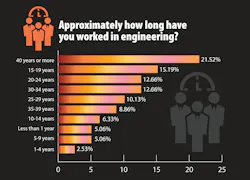
The belief that engineering is a good career path is evident from the length of time survey respondents indicated they’ve been in the industry. As the graphic below shows, most respondents have worked in engineering for over 10 years.
Sixty-two percent of respondents said they do not ever consider leaving the engineering profession, further signifying their enjoyment of this career path.
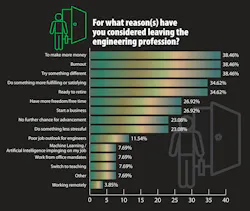
For those who have considered leaving the engineering profession, top reasons include making more money, burnout, and wanting to try something different.
Difficulty in Attracting Engineering Talent Persists
Ready to retire was another highly ranked reason survey respondents said they would consider leaving the industry, which is not surprising given the number of years many indicated they have been in the industry. This means there will be a need to attract more engineers to help fill the gap left by those leaving the fluid power sector.
However, once again this year most survey respondents, 63%, said they believe there is an engineering shortage, with 70% saying their organization is having difficulty finding qualified candidates for open engineering positions.
Mechanical design, systems engineering, and hydraulics and pneumatics were the engineering specialties for which most respondents noted difficulty in finding qualified candidates.
While attracting talent is not necessarily unique to just the fluid power industry, it has been noted by many over the years that it is not necessarily a sector young engineers consider when going to school. There are also only so many schools with fluid power-specific curriculums, further adding to the challenge of attracting engineers into the industry.
But organizations like the National Fluid Power Association (NFPA) and companies within the industry are working to address this through various programs that introduce fluid power to students at various ages and demonstrate all the interesting work being done in the industry.
View our below content to learn more about some of the initiatives the industry is undertaking to attract younger generations to a career in fluid power. You can also visit our Workers in Science and Engineering (WISE) page for all of our coverage of workplace issues affecting the engineering field, in addition to contributions from equity seeking groups and subject matter experts within various subdisciplines.



Hiring Outlook Mixed for Fluid Power Engineers
The outlook for engineering jobs in the hydraulics and pneumatics industry appears to be mixed at the moment. When asked about the status of hiring and budgeting at their companies, most respondents to our survey were evenly split between those who said hiring for new positions have been put on hold and those who said there is an increase in hiring.
For those that are hiring new employees, 46% of respondents said they are looking for engineers with an average of at least 5 years’ experience and 45% said they are looking for those with an average of 3 years’ experience, demonstrating the desire for those early on in their careers. Just a handful said they wanted candidates with 10 or more years of experience.
Although some respondents noted there are budget cuts to the engineering department and workforce reductions occurring at their companies, most survey respondents, 60%, expect their companies to maintain the current level of engineering jobs this year.
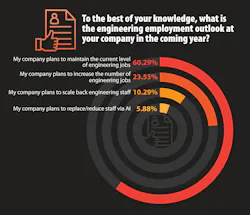
Given the many market challenges still facing the fluid power industry and its customer sectors, it is a good sign that respondents feel engineering jobs will be maintained.
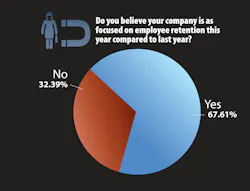
Related to this, over 65% believe their company is as focused on employee retention as they were last year, further signifying their belief that engineering jobs remain important at their companies.
In terms of compensation, while some survey respondents noted salary cuts, cancelled bonuses and freezes on raises, most respondents were evenly split between those who said there are no changes in their compensation (42%) and those whose salary increased (41%).
This again shows a fairly positive environment for engineers in the hydraulics and pneumatics industry., which most seemed to feel would remain though there will continue to be challenges to face in the years ahead, particularly as AI becomes more prevalent
Overall, results of our 2025 Salary & Career Survey indicate that a large portion of the fluid power engineering community remains satisfied with their careers and believe there will continue to be opportunities in this industry. However, the growing prevalence of AI and the need to attract more engineers into the industry as the number of people retiring from it increases are likely to be persistent challenges for the sector.
About the Author
 Sara Jensen
Sara Jensen
Executive Editor, Power & Motion
Sara Jensen is executive editor of Power & Motion, directing expanded coverage into the modern fluid power space, as well as mechatronic and smart technologies. She has over 15 years of publishing experience. Prior to Power & Motion she spent 11 years with a trade publication for engineers of heavy-duty equipment, the last 3 of which were as the editor and brand lead. Over the course of her time in the B2B industry, Sara has gained an extensive knowledge of various heavy-duty equipment industries — including construction, agriculture, mining and on-road trucks —along with the systems and market trends which impact them such as fluid power and electronic motion control technologies.
You can follow Sara and Power & Motion via the following social media handles:
X (formerly Twitter): @TechnlgyEditor and @PowerMotionTech
LinkedIn: @SaraJensen and @Power&Motion
Facebook: @PowerMotionTech