Why Electronic Control Units Need Higher Computing Power
Key Highlights
- Electronic control units are now controlling multiple functions in mobile machinery, providing greater flexibility to adjust controls as desired and enabling centralized control for numerous systems.
- There is a growing need for higher computing power in ECUs, driven by the desire to control more functions, process higher bandwidth sensor data, and support automation.
- Efforts to increase electronic control of machine systems, enable more automated functions, and aid detection of maintenance issues will continue to drive the need for ECUs with higher computing capabilities.

Electronic control units (ECU) are now a common part of agricultural machinery and other mobile equipment. A single ECU or multiple devices may be used to control various components and functions, including fluid power systems.
Use of ECUs, also referred to as controllers, continues to grow as original equipment manufacturers (OEMs) employ more electronic control and automated functions.
This is enabling them to improve productivity and ease of use for customers. But as OEMs continue to add capabilities to their machines, such as higher levels of automation, it is driving the need for ECUs with higher computing power.
Industry Drivers for Higher ECU Computing Power
The controllers on today’s machines are being tasked with processing data, making decisions based on that data, controlling machine functions and more. As machines continue to evolve, so too will the roles of their ECUs.
Increased electronic control, automation and the need to prevent downtime for machine owners are all factors contributing to the need for ECUs to do more in the future, and thus requiring them to have higher computing power to handle all of the information they will need to process.
Increased Electronic Control
Jonathan Meyer, Control Systems Engineer at Bosch Rexroth, said in an interview with Power & Motion that more components and systems on mobile machinery are going electric. “All the pumps, valves, everything has to be controlled with a controller,” he said.
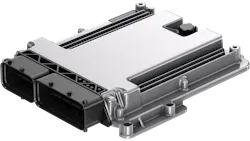
This is because of the flexibility electronic control provides. Pressure, flow and other controls for a hydraulic pump can all be handled within software when electronic control is utilized, eliminating the need for any manual adjustments.
Any changes to the controls can be made quickly and easily in the software, helping machine owners maintain productivity — a key criteria for OEMs and their customers. Machine operators are also able to more easily tune the performance of the hydraulics to their preferences with electronic control, helping make them more comfortable and productive.
The increased use of electronic controls on machines is prompting the need for faster processing times as well as the number of outputs on a controller, both of which are enabled with higher computing power.
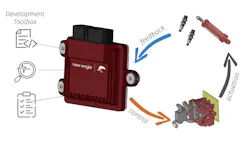
Kevin Alley, Chief Commercial Officer at New Eagle, agreed that customers are looking for ECUs with higher computing power. He said this is driven by the need to control more functions on a vehicle or machine.
Alley noted it is not about needing more compute for a single hydraulic implement but rather having a controller that can do multiple functions as well as interact with multiple systems.
He said customers today want a single controller that can run the hydraulic system as well as drive implements or other systems. “They care about precise control of the hydraulics, but they also care about the broader system context,” he said.
Centralizing functions on a single controller allows this broader system context to be better taken into account.
“That’s one major [factor] we see driving the need for increased compute,” he said.
System and Machine Automation
Autonomy and advanced driver assistance systems (ADAS) are another driving factor. Both require the ability to take in higher bandwidth sensor data — from cameras, radar, lidar, etc. — which in turn requires controllers capable of handling that data.
The company’s Raptor High-Performance Compute Platform introduced in 2025 aims to provide the processing power needed for these applications. Alley said it is a very high compute module that can do a variety of things.
It is a graphics processing unit (GPU)-enabled module capable of delivering up to 275 TOPS of processing power and supports up to 12 GMSL2 camera inputs with Power-over-Coax (PoC) technology which enables use for ADAS, mobile robotics, rapid prototyping, and rugged industrial automation environments.
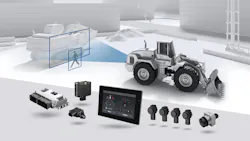
Bosch Rexroth has also introduced a controller for automation applications, the BODAS Off-Highway Robotics Controller (ORC). It features camera inputs, Ethernet inputs for high-speed sensors as well as integrated safety, all of which are necessary to enable the automation of systems and machines.
“It's a microprocessor, so it's actually processing information in real time that it's receiving from those sensors,” said Meyer.
Prevent Unplanned Downtime
A third factor Alley sees driving the need for more ECU compute power is the use of digital twins for the detection of performance anomalies. He explained that this would entail running a physics-based model of a system on its ECU and measuring it against real-world data to detect anomalies or if an issue is about to occur.
Doing so could help machine owners be more proactive about addressing maintenance issues before they become a larger problem that could lead to costly downtime.
Improved fault tolerance is a potential use case he sees. Because of the robust system model running inside the controller, should a sensor fault or other issue occur the controller can better determine what action should be taken — is an immediate machine shutdown required, or can it keep working until maintenance can be performed?
This could greatly minimize unplanned downtime by allowing a machine to keep working if it is able and thus ensure operational productivity. “You can extend the life of the machine,” he said. “Still give a warning they need to order a part, but it doesn’t have to be replaced immediately.”
While these are not the only factors driving the need for higher ECU computing power, they help demonstrate the industry trends shaping machine and component designs as well as the continued development opportunities for fluid power and other technology suppliers.
About the Author
 Sara Jensen
Sara Jensen
Executive Editor, Power & Motion
Sara Jensen is executive editor of Power & Motion, directing expanded coverage into the modern fluid power space, as well as mechatronic and smart technologies. She has over 15 years of publishing experience. Prior to Power & Motion she spent 11 years with a trade publication for engineers of heavy-duty equipment, the last 3 of which were as the editor and brand lead. Over the course of her time in the B2B industry, Sara has gained an extensive knowledge of various heavy-duty equipment industries — including construction, agriculture, mining and on-road trucks —along with the systems and market trends which impact them such as fluid power and electronic motion control technologies.
You can follow Sara and Power & Motion via the following social media handles:
X (formerly Twitter): @TechnlgyEditor and @PowerMotionTech
LinkedIn: @SaraJensen and @Power&Motion
Facebook: @PowerMotionTech