Electrohydraulics Aid Performance of New John Deere Excavators
Key Highlights
- John Deere redesigned the electrohydraulics on its new P-Tier Midsize Excavators to improve controllability and other performance aspects for machine operators.
- The electrohydraulic system uses sensors and software to electronically drive the hydraulics which enables faster response times.
- Use of electrohydraulics makes it easier to add automation and autonomy to machinery which is an increasingly important component of machine designs.
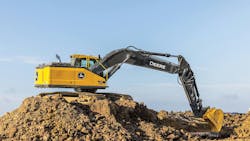
John Deere is introducing a new generation of its P-Tier Midsize Excavators. Redesigned from the ground up, the excavators feature several enhancements and integrated technologies aimed at improving productivity and the overall operator experience.
A critical component of these new machines is their completely redesigned electrohydraulic system. Doing so enabled the company to meet performance requirements as well as considerations for fuel efficiency, controllability, metering and machine tuning while still providing brute force when required noted Justin Steger, Product Marketing Manager at John Deere, during the company’s launch event for the P-Tier excavators.
Use of electrohydraulics in the excavators brings a number of benefits and capabilities to machine operators while also helping lay the foundation for integration of automation and other advanced technologies.
John Deere is debuting the new P-Tier Midsize Excavators at CONEXPO-CON/AGG 2026. Attendees can see the machines at the company’s booth #2415 in the Silver Lot of the Las Vegas Convention Center. Visit our CONEXPO 2026 page for more news and other content related to the year’s largest event for the construction equipment industry.
How the John Deere Electrohydraulic System Works
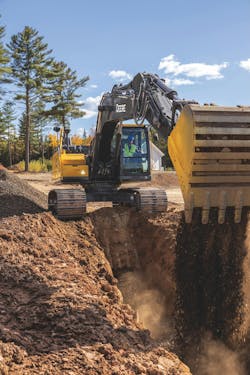
Robert Moore, Global Director Construction Engineering at John Deere, told Power & Motion that a lot of thought was put into what strategy to use for the hydraulics system on the P-Tier excavators.
He explained that traditional excavator hydraulics use an open center system with what is termed negative flow control. In these systems, the load on the machine is what told the pumps and the rest of the hydraulics to work. An electrohydraulic system, on the other hand, utilizes positive flow control in which “we're sensing what the operator is asking for with the joysticks in advance of what the machine feels for a load,” said Moore.
“The hydraulic pump and the rest of the hydraulics actually get a little bit of a jump start into what's going to happen next based on what the operator is asking the machine to do, instead of waiting for a load to be put on the machine and then have the machine react,” he continued.
To achieve this, the hydraulics went from a hydromechanical system to an almost entirely electronic one driven by sensors and software. Moore said there are pressure transducers in every circuit and decisions are being made by software when it comes to machine tuning and determining the flow a hydraulic pump will deliver. “All of those things are now driven by interrogating those sensors [on] the condition of the circuit and having software make a decision based on [those conditions],” he said.
Moore went on to explain that the previous hydromechanical system was pilot controlled, meaning joysticks in the operator cab sent a low-pressure hydraulic signal to the main hydraulic control valve to initiate various machine functions. The load on the tip of the bucket drove up the back pressure to the main control valve and the negative flow control system would then hydromechanically tell the system’s hydraulic pump to stroke.
John Deere’s electrohydraulic system on the P-Tier excavators differs by sending an electrical signal from the joysticks to proportional solenoids which then vary the pilot signal delivered to the main hydraulic control valve. Moore said this enables the positive flow approach used in the excavators by electronically controlling the system’s hydraulic pump.
The same electrical signal that's influencing the proportional solenoids is also telling the hydraulics that flow is needed in a few milliseconds. “Instead of waiting serially for a whole bunch of stuff to happen, now it's all happening in parallel,” he said. “[This is] really good from a manual operation standpoint and incredibly important from an automation perspective.”
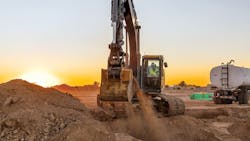
Electrohydraulics Help Ease Operation and Implementation of Automated Features
Moore said moving to an electrohydraulic system brings a lot of positives in terms of improving overall machine operation and efficiency as well as the ability to add automation and additional technologies as required.
From a performance perspective, he said electrohydraulics open up a universe of potential features and capabilities that can be employed. The use of electrohydraulics and software also makes it easier to change and optimize these features as needed.
“We no longer need to sit down and draw a new main spool for the core control valve. We can [instead] write new software requirements, code that software, do a little bit of tuning, verify it, and ultimately, make the change,” he said. “It has drastically improved how rapidly we can deliver solutions to the field and that’s a great thing.”
Operators themselves can be more in charge of how the hydraulics and machine perform as well. Because of the electrohydraulics, operators are able to adjust hydraulic response with speed and control modes, allowing them to match the performance of the machine to the response rates they choose to meet individual preferences or application requirements.
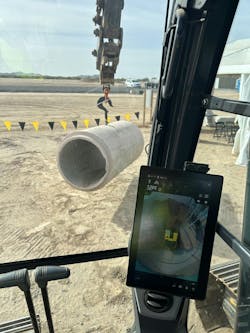
The electrohydraulics also enable integration of various technologies, such as the EZ Control feature on the P-Tier excavators which adjusts the hydraulics with the push of a button to create smoother boom and arm movements and an automatic coupler option that allows hydraulic tool changes to be made without leaving the operator cab.
Features like these are becoming increasingly important to help overcome the labor challenges the construction industry is facing as well as maintain the comfort and safety of machine operators.
Moore also noted that the ability to add automation and autonomy to a machine is a significant and necessary capability which is feasible with electrohydraulics. While technically feasible to hydromechanically automate something, he said from a practicality standpoint it makes no sense to do so. “You must invest in the infrastructure, the platform that you’re going to put automation on top of and electrohydraulics is that platform,” he said.
He said that when using excavators, it is common for operators to have to switch between manual and automated control. An operator may be using automated control for grading but if a rock or other object is suddenly in the way, quickly needs to switch to manual operation which is not always easy to do. “You want that to be seamless,” said Moore. “When you’ve got the right system to build on top of, [like electrohydraulics] it can seem really easy to the operator.
“We want it to be completely transparent to the operator. It should not be a mental load on them,” he continued. “They've got a job to do [and] it's our job to make it as easy as possible for them to stay focused on doing their job exactly the way they want to.”
In general, Moore anticipates use of electrohydraulic control to continue growing. It may not be used on all hydraulic circuits, he noted, but will likely make its way into most machine types in some capacity over the coming years.
The overall efficiency and automation potential of electrohydraulics will drive their continued uptake by John Deere, and other construction equipment manufacturers who want to take advantage of those benefits. “[Electrohydraulics are] a very capable tool…and the answer to a lot of the things our customers want,” he concluded.
Quick Stats on the John Deere New Generation P-Tier Midsize Excavators
Learn a little more about John Deere's newest generation of P-Tier Midsize excavators.
- 20-ton machines available in three models — the 210, 230 and 260 which range in power capacities from 157-202 hp
- rigorously tested in real-world applications with customers in various locations throughout the development process, accumulating over 165,000 operating hours
- integration of smart sensors around the machine provide critical information to operators to help improve safety and productivity
- incorporates several advanced technologies such as Attachment Manager, SmartWeigh and 2D Grade Control as standard, with 3D SmartGrade as an add-on option, to enhance job accuracy and overall productivity
About the Author
 Sara Jensen
Sara Jensen
Executive Editor, Power & Motion
Sara Jensen is executive editor of Power & Motion, directing expanded coverage into the modern fluid power space, as well as mechatronic and smart technologies. She has over 15 years of publishing experience. Prior to Power & Motion she spent 11 years with a trade publication for engineers of heavy-duty equipment, the last 3 of which were as the editor and brand lead. Over the course of her time in the B2B industry, Sara has gained an extensive knowledge of various heavy-duty equipment industries — including construction, agriculture, mining and on-road trucks —along with the systems and market trends which impact them such as fluid power and electronic motion control technologies.
You can follow Sara and Power & Motion via the following social media handles:
X (formerly Twitter): @TechnlgyEditor and @PowerMotionTech
LinkedIn: @SaraJensen and @Power&Motion
Facebook: @PowerMotionTech