HYDAC Introduces SUSTAINMICRON Filtration Technology
*Editor's note: This article was originally published March 2, 2026 and updated May 12, 2026 with additional information.
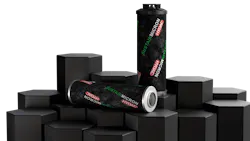
HYDAC has introduced SUSTAINMICRON, a filtration technology designed to provide improvements in performance, system reliability as well as sustainability.
The filter combines features of the company’s Optimicron, Optimicron Pulse, and Stat-Free technologies into a single, all-in-one solution. According to HYDAC, this helps to streamline inventory, replace the need to use multiple product lines and simplify system design for developers of industrial and mobile equipment.
HYDAC demonstrated the benefits of its SUSTAINMICRON filtration technology during CONEXPO-CON/AGG 2026. Read more news and content related to this large event for the construction industry on our dedicated CONEXPO 2026 page.
SUSTAINMICRON helps control electrostatic discharge, maintain stable contamination levels, and reduce system losses to ensure clean, stable fluid flow for more predictable hydraulic system performance.
Key features of HYDAC’s SUSTAINMICRON filtration technology include:
- up to 30% lower differential pressure than previous generations while maintaining dirt-holding capacity and filtration efficiency
- integrated electrostatic discharge protection as a standard feature
- universal compatibility with existing Optimicron elements for seamless upgrades
- robust construction for reliability in demanding environments
Typical applications for the SUSTAINMICRON technology include hydraulic filtration, oil conditioning, and fuel filtration in any system requiring high reliability and sustainability.
A Filter Element Designed to Meet All Desired Performance Criteria
When developing its SUSTAINMICRON technology, HYDAC’s goal was to figure out what was missing with today’s elements.
As A.K. Necioglu, Division Manager, Hydraulic & Lube Filtration at HYDAC, explained to me during an interview held at CONEXPO 2026, in any engineering discipline there is always some kind of compromise. “You either get very high quality but the price is too high or you can have great performance but it’s too slow.”
The same is true with filter elements. Design teams typically get to pick one or two of the three most desirable aspects, which are:
- how much can it actually hold before it’s clogged, referred to as dirt holding capacity,
- how efficient is it, and
- how much filtration does it actually do, known as the beta ratio.
But with SUSTAINMICRON, Necioglu said HYDAC was able to engineer the filter element so all three traits could be achieved. “It has the same dirt holding capacity, if not better [as well as] better efficiency in terms of what it can actually filter and also performance which we measure with the pressure differential.”
SUSTAINMICRON provides up to a 30% lower differential pressure which leads to less energy use, and thus improved efficiency.
“The lower the pressure differential, the more environmentally friendly it is because you’re using less energy,” he explained. “If you can give [customers] more efficiency, they have to buy fewer filters over the lifetime of their components and systems, and they’re using less energy.”
SUSTAINMICRON Combines the Best Aspects of Three Filter Technologies
Necioglu said there were three key things HYDAC wanted to achieve when developing the filter element for SUSTAINMICRON:
- better efficiency in terms of energy use,
- reduced electrostatic discharge, and
- pulsation control.
He said real-world testing has shown the filter can achieve up to 30% better efficiency because of its lower pressure differential. “That's a lot when you think about how much energy [customers] can save across their filtration system.”
Reducing electrostatic discharge was important to ensure the filter would continue to perform well with the higher quality hydraulic oils coming into the market. Necioglu said these new high-quality oils have very little zinc content “which means you can build up electrostatic discharge.”
He explained that if you have a lot of electrostatic discharge that cannot be carried away by the hydraulic oil moving through the filter, it builds up in the filter and can start a fire. To prevent this from occurring, HYDAC’s Stat-Free technology is built into the SUSTAINMICRON filter element to mitigate any kind of electrostatic discharge.
Necioglu foresees SUSTAINMICRON suiting about 80% of applications requiring use of this Stat-Free technology. For critical applications that may require a very high level of electrostatic discharge mitigation, he said HYDAC’s Stat-X filter elements will be the better fit.
Protections against pulsation were important to include in the filter element as well. “If our customers have an operating condition where the pressure is fluctuating, that creates this type of motion where the filter is kind of expanding and contracting several times based on that fluctuation,” explained Necioglu.
Including pulsation control in the filter element prevents these fluctuations from occurring which would otherwise negatively impact the performance of the filter.
To achieve all three of these design criteria, Necioglu said HYDAC took the aspects of the company’s other filter technologies that historically provided either good efficiency, good electrostatic discharge or good pulsation control — specifically its Optimicron, Optimicron Pulse, and Stat-Free technologies — and combined them into a single filter element to create SUSTAINMICRON.
“We have the ability now for our customers to buy one element that covers all of their needs,” he said.
Over time, HYDAC plans to displace the exiting product lines on which SUSTAINMICRON is built and have it become the company’s flagship filter element technology.
Why is the Filter Black?
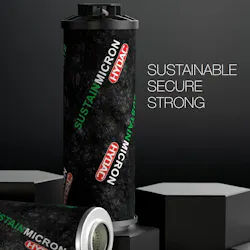
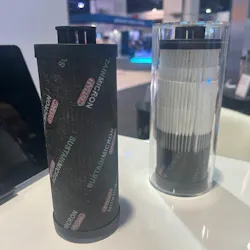
One of the first differences customers may notice about the SUSTAINMICRON filter element is its black outer fleece. This outer fleece helps ensure even distribution of hydraulic oil as it enters the filter.
The more evenly oil is distributed, the less air that gets into the system. “Air is the enemy of all hydraulics,” said Necioglu. If air gets into the hydraulic system, it can cause a number of performance issues for the system and the machine in which it is integrated.
So why is the outer fleece black? Necioglu told me the black color is a byproduct of the two materials used for the creation of fleece, and the color is actually necessary to achieve the performance desired from the filter, including the electrostatic discharge capabilities.
Since filters are usually white and turn a darker color once dirty and ready to be changed, it may seem counterintuitive to have a black filter from the start. While this visual queue can be a sign it’s time to change your filter, a reduction in system performance is typically a more realistic indicator it is time to change the filter or undertake other maintenance procedures.
He noted it may take some time for customers to get used to this change in filter coloration, but HYDAC plans to provide plenty of education about the filter element is black.
Over the course of 2026, HYDAC will be rolling SUSTAINMICRON out to the North American market in various sizes for use in a wide range of mobile and industrial applications.
About the Author

Sara Jensen
Executive Editor, Power & Motion
Sara Jensen is executive editor of Power & Motion, directing expanded coverage into the modern fluid power space, as well as mechatronic and smart technologies. She has over 15 years of publishing experience. Prior to Power & Motion she spent 11 years with a trade publication for engineers of heavy-duty equipment, the last 3 of which were as the editor and brand lead. Over the course of her time in the B2B industry, Sara has gained an extensive knowledge of various heavy-duty equipment industries — including construction, agriculture, mining and on-road trucks —along with the systems and market trends which impact them such as fluid power and electronic motion control technologies.
You can follow Sara and Power & Motion via the following social media handles:
X (formerly Twitter): @TechnlgyEditor and @PowerMotionTech
LinkedIn: @SaraJensen and @Power&Motion
Facebook: @PowerMotionTech