Hydraulic Hose vs. Industrial Hose: Understanding the Differences
Key Highlights
- Hoses are used to carry liquid, gases or dry materials from one point to another, and are typically categorized as hydraulic or industrial.
- Hydraulic hoses are used as part of a fluid power system to move fluid through the system while industrial hoses are a broad category type used for material transfer and utility applications.
- Knowing what the hose will carry, whether it must withstand pressure or vacuum, and the external conditions it will be exposed to can help determine whether an application requires a hydraulic or industrial hose.
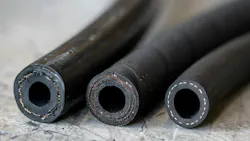
If you tell me you “just need a hose,” my first question would be, “What do you need the hose to do?” From there, three more questions help us understand whether the application requires hydraulic or industrial hose:
- What will the hose carry?
- What pressure or vacuum must it withstand?
- What external conditions will it be exposed to?
At the most basic level, hose is a flexible conduit used to carry liquids, gases, or dry materials from one point to another. Depending on the application, the product being conveyed may move under pressure, vacuum, or gravity flow.
For the purposes of this article, hose products can be divided into two broad categories: hydraulic and industrial.
Many hydraulic hoses are designed and tested to recognized SAE (Society of Automotive Engineers), ISO (International Organization for Standardization), and EN (European Norm) standards. Depending on the standard, requirements may include pressure and temperature ratings, minimum bend radius, construction, and impulse life.
Industrial hose covers a much broader range of applications, and no single set of requirements applies across the entire category. The standards and requirements for steam hose, for example, may be very different from those for food, chemical, petroleum, compressed gas, or dry-material-handling service.
On the surface, the hose types can appear very similar. Most hoses of either type have a tube, some type of reinforcement, and a protective outer cover. These similarities can cause confusion in the field, as size and appearance alone cannot identify the correct hose type.
A user in the field may know they need a 1/2-in. hose and assume that any hose of this size will work. However, a general-purpose, low-pressure hose would not be suitable for a hydraulic application. Likewise, a hose designed for hydraulic service would not be compatible with a chemical transfer application.
Hydraulic hose is a flexible, reinforced product used in a fluid power system. The system uses hydraulic fluid to transmit energy from a pump to a cylinder, motor, or other type of actuator, where that energy is converted into force and motion. In the simplest terms, this is how a hydraulic system performs work.
Hydraulic systems use various hose types, including pressure, return, and suction lines, so not every hydraulic hose operates under high pressure. A hydraulic hose must meet the requirements of the circuit, including pressure, flow, temperature, pressure impulses, connection type, and fluid compatibility.
Industrial hose is a broad category used for material transfer and utility applications. These hoses may convey water, air and other gases, steam, chemicals such as petroleum, and food products, slurries, or dry bulk materials. The range of products handled with industrial hose is nearly limitless. Unlike hydraulic hose, which is defined by its role in a fluid power system, industrial hose is generally defined by the material it conveys or the service it performs.
What Will the Hose Convey?
The construction of either type of hose begins with the tube. This innermost layer of the hose directly contacts the material being conveyed. The tube must be made from a material that is chemically compatible with both the product being conveyed and the application’s operating conditions.
Tube materials generally fall into two broad groups: elastomers and plastics.
Elastomers are widely used because of their flexibility and their ability to be compounded for different applications. Examples include nitrile rubber, ethylene propylene diene monomer (EPDM), styrene-butadiene rubber (SBR), bromobutyl rubber, and natural rubber.
Plastic tube materials have characteristics such as broad chemical resistance, low permeability, high purity, abrasion resistance, and wide temperature ranges. These materials include thermoplastics such as polyvinyl chloride (PVC), ultra-high-molecular-weight polyethylene (UHMWPE), and nylon; crosslinked polyethylene (XLPE); and fluoropolymers such as polytetrafluoroethylene (PTFE) and fluorinated ethylene propylene (FEP).
The range of material choices is significant because many thousands of chemicals are used in industrial applications. No tube material is suitable for every product or operating environment.
Choosing the wrong hose tube material can cause the tube to soften, swell, harden, or crack. Any of these conditions can lead to hose failure or contamination of the product being conveyed. Chemical compatibility also depends on concentration, temperature, and whether contact is continuous or intermittent.
What Pressure or Vacuum Must the Hose Withstand?
Once we have identified the proper tube material, the next part of hose construction is the reinforcement, which provides the strength required for the application. Reinforcement may consist of one or more layers that constrain the tube and limit volumetric expansion. A hose without sufficient reinforcement is a safety risk (Figure 1).

Excess expansion can affect performance, as some of the system’s energy is used to expand the hose instead of immediately moving the load or material. The reinforcement must be capable of handling the maximum working pressure and withstanding the required pressure-impulse cycles. The reinforcement must also ensure the hose meets its specified burst-pressure requirement.
Hydraulic circuits are dynamic, and pressure hoses experience repeated impulse cycles due to rapid pressure changes caused by cylinder movement, valve actuation, pump fluctuations, and load changes. These repeated pressure cycles demand strong reinforcement that must be matched to the application.
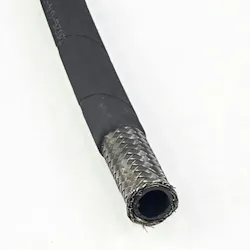
Hydraulic hoses commonly use steel-wire braid or spiral-wire reinforcement (Figure 2). Some lower-pressure hydraulic hoses may use a textile braid. All three types of reinforcement may be applied in multiple layers to provide the required pressure capability.
Industrial hose should not be viewed simply as a low-pressure hose, as the applications can be demanding. It may operate under gravity flow, pressure, or full vacuum. Because the applications and operating conditions are so diverse, the types of reinforcement are equally diverse.
Textile reinforcement is often used because it provides strength while remaining highly flexible. This reinforcement type may be braided, spirally wrapped, or applied in multiple plies to provide the required pressure capability.
Wire braid is used in industrial hose applications when greater pressure capability or mechanical strength is required. Suction and discharge hoses often contain a helical wire, also called a wire helix (Figure 3).
This helix supports the hose wall and helps prevent the hose from collapsing under vacuum. The helix may also be used when hose kinking or crushing is a concern. It may be made from steel, stainless steel, or thermoplastic. Large-diameter hoses may incorporate a combination of textile plies and one or more helical wires.
What External Conditions Will the Hose Face?
Now that we have selected a tube and reinforcement, the cover is the outermost layer in a typical hose construction. The cover protects the reinforcement and internal layers from external conditions. Cover criteria vary widely because a hose may require protection from abrasion, cuts, chemical exposure, weather, UV light, ozone, heat, cold, flame, and other environmental factors.
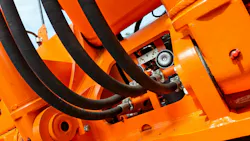
A hydraulic hose used on mobile equipment, such as an excavator, may require a cover with strong resistance to abrasion, oil, and weather. An industrial hose in a railcar loading area may be dragged across the floor, exposed to chemical spills, or operated near extreme heat. Its cover must withstand this combination of conditions.
Common cover materials are as varied as the applications and environments in which hoses operate. Rubber compounds such as EPDM, nitrile, chloroprene, and chlorinated polyethylene (CPE) are commonly used, along with materials such as PVC, polyurethane, and silicone. In general, EPDM may be selected for resistance to weather, ozone, heat, and certain chemicals; nitrile for oil resistance; polyurethane for abrasion resistance; and silicone for high-temperature environments. CPE may be used where a combination of oil, weather, heat, and chemical resistance is required.
No single cover material provides the best protection against every condition, so it must match the application and expected environmental factors. When extreme radiant heat or flame is present, a protective sleeve may also be required.
Hose covers provide protection but do not generally provide pressure strength; that is the job of the reinforcement. The cover may be smooth, wrapped, corrugated, fluted, fabric-finished, or ribbed, depending on the application. These terms describe the surface or profile of the cover rather than its material. A corrugated profile can improve flexibility, while ribs or flutes may affect handling and provide additional wear protection.
Why Aren’t Hydraulic and Industrial Hoses Interchangeable?
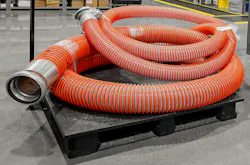
From the outside, hydraulic and industrial hoses may look alike (Figure 4), but they are engineered for very different jobs. Hydraulic hose is designed for the demands of a fluid power circuit, while industrial hose is designed around the material being conveyed and the service it performs.
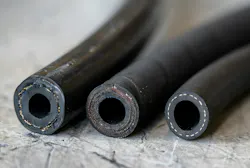
They may operate under pressure, vacuum, or gravity flow while carrying products such as chemicals, steam, gases, water, slurries, abrasive materials, and many others. The tube, reinforcement, and cover each serve a specific purpose in every application.
When choosing a hose, size and appearance alone are not enough; we first need to understand the job it must perform.
This article was written and contributed by Joe Mueller, Director of Hose Products at Motion.
About the Author
Joe Mueller
Director of Hose Products at Motion
Joe Mueller is the Director of Hose Products at Motion. With 29 years of fluid-power experience, he leads product strategy for the hydraulic and industrial hose markets and works with supplier partners to align product solutions with customer needs.