Global Off-Highway Hydraulic Hose Market to Grow 4.4%
Key Highlights
- Rising demand for off-highway machinery in the coming years will also help drive demand for the hydraulic hoses critical to their operation.
- The construction equipment industry is expected to account for the largest share of hydraulic hose demand due to increased construction activity and replacement needs in existing fleets.
- High-pressure hydraulic hoses will remain the most widely used type in the off-highway equipment market because of their ability to meet the performance requirements of these machines.

Off-highway machinery operates where margins are carved out of rock, soil, and steel –construction sites, mines, farm fields, infrastructure corridors, etc. In these environments, hydraulic systems power every core motion, and hoses serve as the high-pressure arteries sustaining machine performance.
Given the importance of hydraulic hoses to agricultural machinery, construction equipment and other off-highway machines, their market value is expected to grow in the coming years as demand for these machines increases as well.
Stratview Research is projecting the global off-highway hydraulic hose market will cross the U.S. $5 billion mark by 2031. In 2024 the market was already valued at ~4 billion and over the coming years is expected to achieve a compound annual growth rate (CAGR) of 4.4%.
Expanding construction activity across the globe, strong demand from Asia-Pacific, and evolving technical requirments are expected to help drive growth for the off-highway hydraulic hose market over the next 5 years.
Construction: The Demand Epicenter for Hydraulic Hoses
Every piece of equipment operating on a construction site — whether an excavator, wheel loader, dozer, or articulated dump truck — depends on hydraulic hoses to transmit power across boom, arm, steering, braking, and auxiliary systems under extreme duty cycles.
Global construction output is projected to expand from U.S. $11.5 trillion in 2024 to over U.S. $16 trillion by 2030, setting the stage for sustained equipment deployment across the world. The construction equipment market is also expected to surpass U.S. $232 billion by 2028, reflecting higher machine fleet utilization, longer operating hours, and harsher duty cycles.
This means there will be sustained demand for the hydraulic hoses used in construction equipment, including both new and existing machinery.
The existing equipment base will continue to generate consistent repair and MRO (maintenance, repair, and overhaul) demand. Industry guidelines indicate that, under typical operating conditions, a majority of hydraulic hoses are replaced after ~1,500–3,000 operating hours or within 1-2 years, whichever comes first.
The replacement cycle alone is likely to create a recurring revenue layer independent of new equipment sales, structurally insulating hose manufacturers from cyclical OEM volatility.
With expanding construction activity and a growing installed base of equipment, the outlook for the off-highway hydraulic hose market remains structurally strong.
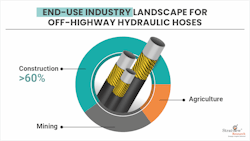
These factors make construction the largest demand-generating sector for off-highway hydraulic hoses globally. Per Stratview Research, the construction sector alone accounts for nearly 60% of global off-highway hydraulic hose demand, making it the single largest end-use segment.
APAC is Dominant Market Region for Off-Highway Hydraulic Hoses
Off-highway hydraulic hoses serve a broad range of end-use industries and regions, with Asia-Pacific (APAC) emerging as the dominant market. The region’s leadership is supported by the combined scale of construction and agricultural activity in APAC, as well as large infrastructure programs, rapid urbanization, and dense agricultural machinery fleets in the region.
Visit our Market Trends page for more economic outlook information as well as content related to both technological and economic trends impacting the fluid power and electromechanical technology space.
From an agricultural industry perspective, APAC is among the most equipment-intensive regions globally, supported by increasing uptake of mechanized farming and expanding agri-infrastructure. On the construction side, its dominance is even more pronounced, accounting for roughly 40% of the global construction market, reflecting the sheer volume of earthmoving, material handling, and infrastructure projects underway.
To meet market demand in the region, a few hydraulic hose manufacturers have expanded their portfolios for mobile off-highway equipment applications in APAC.
In December 2025, Continental’s group sector ContiTech launched its Reduced Dimension Spiral hydraulic hose series in APAC, strengthening its high-performance offering for construction, agricultural, and mining machinery. Parker Hannifin’s GlobalCore 187, along with Gates Corporation’s MXG 4K and ProV hoses, are among other series introduced as part of portfolio expansions in India and the broader APAC market which align with needs for these regional markets as well as next-generation hydraulic system requirements.
Industry assessments indicate that APAC contributed ~55% of global off-highway hydraulic hose demand in 2025, with its share expected to rise to nearly 60% by 2031, reinforcing the region’s role as the primary growth engine for the market.
High-Pressure, Rubber Hydraulic Hoses Account for Largest Share of Off-Highway Market
Hydraulic hoses for off-highway equipment are engineered flexible conduits designed to convey pressurized hydraulic fluid between system components such as pumps, actuators, motors, and valves. They must deliver consistent flow without spillage, resist degradation in extreme heat, abrasive environments, and provide longitudinal flexibility without fatigue failure, demands far beyond standard industrial hose applications.
To meet all these criteria, there are some key performance parameters that should be considered when developing hydraulic hoses for off-highway machinery including working and burst pressure ratings.
Hydraulic hoses for this machinery market are available in four pressure types:
- low-pressure hoses which operate below 300 psi,
- medium-pressure hoses ranging from 300-3,000 psi,
- high-pressure hoses that can bear pressure anywhere between 3,000-6,000psi, and
- extremely high-pressure hoses that are made to bear pressures >6,000 psi.
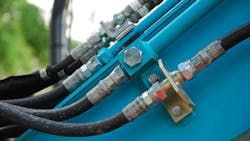
In off-highway equipment, >50% of hoses are high-pressure hoses, primarily due to the growing demand for hydraulic systems that can handle higher pressure requirements. End-use industries including mining and construction demand hydraulic hoses capable of withstanding pressures ranging between 3,000 and 6,000 psi to ensure consistent and safe performance.
Another key driver of high-pressure hose demand is the balance of strength and flexibility. These hoses withstand high fluid pressures while remaining flexible enough to fit into tight spaces and complex routing in modern off-highway equipment. This flexibility minimizes kinking and premature wear, even under motion and multi-directional operating conditions.
Additional design considerations for hydraulic hoses used in off-highway machinery applications include thermal stability, resistance to abrasion and cutting from debris and chassis contact, and high flex-fatigue endurance under cyclic loading.
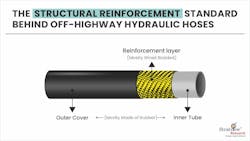
Meeting these requirements depends directly on appropriate material selection. Structurally, hydraulic hoses are multilayer assemblies consisting of an inner tube, reinforcement layer, and outer cover. The inner tube must be chemically compatible with the conveyed fluid to avoid degradation and corrosion.
While rubber has been the traditional material, fluoropolymers, PTFE (polytetrafluoroethylene), and silicone are used in select applications, and thermoplastics are preferred for very high-pressure requirements (up to ~10,000 psi).
Thermoplastics offer superior pressure ratings and weight advantages but rubber’s cost-performance equilibrium keeps it the dominant material of choice — accounting for over 80% of off-highway hydraulic hoses (in fleet-scale deployments), particularly in price-sensitive APAC markets.
The reinforcement layer, typically wrapped around the inner tube, provides pressure resistance and mechanical strength. In practice, most hydraulic hoses sold for off-highway systems today use wire-braided reinforcement, which captures nearly three-quarters of the market, well ahead of spiral and textile options.
Design Trends Impacting the Future Off-Highway Hydraulic Hose Market
Today’s off-highway hydraulic hoses are fast becoming a performance-critical, data-enabled asset as OEMs and fleet operators push for higher uptime, lower emissions, and tighter lifecycle control.
Digital traceability systems, such as hose labeling and cloud-based tracking platforms are already changing how fleets manage failures. In real-world deployments across construction and mining fleets, digital hose tracking has reduced unplanned hose failures significantly.
Predictive maintenance in such systems enables reductions in maintenance costs by 25-30% and can increase equipment availability by 10- 20% as these technologies can help eliminate installation errors, improve replacement timing, and standardize specifications across machines.
In addition, the shift toward embedded IoT (internet of things) sensors is further strengthening this trend. Field data from off-highway and industrial hydraulics shows that condition-based hose monitoring can cut hydraulic-related downtime by up to 40% compared to reactive maintenance models.
At the same time, electrification, downsizing, and sustainability targets are reshaping hose design requirements. Compact engine bays and electrified platforms generate higher localized temperatures with reduced airflow.
Although these trends could bring some changes to the hydraulic hose market in the coming years, ultimately, global growth for construction, agriculture, mining, and other off-highway equipment will lead to growth for the hydraulic hoses used in these machines as well.
Stratview Research anticipates the global off-highway hydraulic hose market will grow not just in volume, but in strategic importance. As machines become smarter, smaller, hotter, and more regulated, hoses sit at the intersection of reliability, compliance, and digital intelligence — all of which will help meet the needs of future off-highway equipment designs.
This article was written and contributed by Chandana Patnaik, Senior Content Specialist at Stratview Research.
About the Author
 Chandana Patnaik
Chandana Patnaik
Senior Content Specialist, Stratview Research
Chandana Patnaik is an experienced technical writer, presently serving as a Senior Content Specialist at Stratview Research. She has carved her niche in specific areas including disruptive technologies, information, and specialty chemicals. etc.
She is a regular contributor to various magazines and blogs and writes insightful content that keeps readers stay up-to-date with the latest trends and developments in her areas of expertise.