From the Editor’s Desk: 3 Trends of Note from CONEXPO 2026
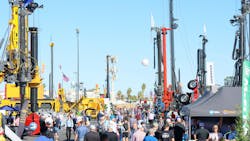
It’s hard to believe that another CONEXPO-CON/AGG has come and gone already. And like the other editions of the show I’ve attended, there was no shortage of new products on display and conversations about the trends and design priorities driving developments for the fluid power and wide range of other technologies utilized in construction equipment.
I’ll be spending the next several weeks digging through all of the information I collected while at the show, so be sure to stay tuned for more content from the year’s biggest show for the construction industry. And in case you missed any of the coverage we’ve published so far, you can visit our CONEXPO 2026 page for news, interviews and more.
When it comes to major themes at this year’s show, it felt less like a show dominated by electrification and automation as has been the case in years past and more about what solutions will provide immediate benefits for those working in the construction industry.
Electrification, and automation in particular, were still prevalent topics at CONEXPO but what I witnessed most was how fluid power and other technology suppliers are bringing performance improvements at a component, system and machine level.
I think one of the hydraulics engineers I spoke to put it best when he said it feels like the fluid power industry has hit the reset button. Broad industry trends like electrification, automation and digitalization are still important focus areas but the greater emphasis is on what can be done now to enable improvements in efficiency, productivity and ease of use, among other desirable traits for construction equipment and other mobile equipment applications.
Reflecting these efforts, there were three key trends that stood out to me at CONEXPO 2026 – advancements in sensors, improving ease of use and rising interest in hybrids - each of which helps meets current industry needs while also helping set the foundation for future developments.
Advancements in Sensors
Integration of sensors is not a new trend for the fluid power industry, but certainly an ever increasing one. Doing so brings a range of benefits in terms of performance and data collection — an increasingly important factor for equipment manufacturers to help provide performance metrics and maintenance information.
I saw several new senor technologies on display at CONEXPO this year, including more capable of measuring multiple parameters than I recall seeing at previous editions of the show. Sensors which can measure both pressure and temperature, for instance, are becoming increasingly more desirable to help reduce the number of components required and thus space taken up in a machine as well as design costs.
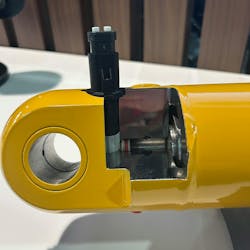
Another interesting sensor technology I saw at the show was Leggett & Platt Hydraulics’ new Integrated Radar Measurement (IRM) Sensor. Designed to provide direct stroke measurement of hydraulic cylinders, the sensor is compact in size for installation into the cylinder cap.
This is a change from other hydraulic cylinder sensors which are either mounted outside the cylinder or require drilling into it. The IRM sensor, on the other hand, simply requires on small hole to be drilled and the sensor can be dropped into place, making installation and replacement of the sensor much easier.
Improving Ease of Use
Speaking of making things easier, efforts to improve ease-of-use for both machine designers and owners/operators were evident throughout the show and discussions I had with companies as well.
These came in many forms such as components designed for easy installation like Leggett & Platt’s sensor mentioned above or the demo kit Sun Hydraulics is now offering for its eSense electrohydraulic cylinder.
The kit is comprised of an easy bolt-on controller from fellow Helios Technologies brand Enovation Controls with everything customers need to test and develop the eSense cylinder for use in their application. Once they determine how they want to use the technology, customers can have a conversation with Sun Hydraulics’ engineers to determine the final design parameters. A kit like this can help speed up the design process so products can be brought to market faster.
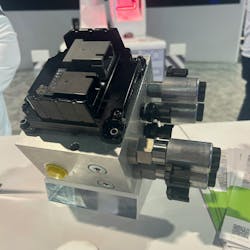
Faster, another Helios Technologies brand, showed its new MultiQTC multiconnection system for hydraulic attachment changes. Changing the attachments on excavators can be a time consuming and difficult process. But the multiconnection system aims to overcome that by consolidating multiple hydraulic connection steps into a single maneuver.
The company told me that with this device, attachment changes can go from as long as an hour to as short as 15 minutes, greatly reducing the downtime that would otherwise be required. And while automatic systems exist, they can be costly. The MultiQTC can be attached to a machine, and moved around to different machines in a fleet, offering greater flexibility for an operation.
Ease of use is becoming ever more critical, whether on the design side or from a machine user perspective, as industries face a skilled labor shortage. A large number of people with years of industry knowledge are retiring and fewer people are entering careers in fluid power and construction. Making things easier to use can help those who are entering these fields be productive while they gain the necessary skills. It can also benefit those who have been in an industry for years by enabling them to work faster and often more accurately.
Watch Faster's video below to see how the MultiQTC works.
Re-Emphasis on Hybridization
As electrification picked up steam over the last several years, a lot of emphasis has been placed on development of full-electric machines — those in which the internal combustion engine (ICE) is completely replaced by batteries, electric motors and other necessary components.
While many have said hybridization is the most feasible route to take for construction equipment and other off-highway machinery because of their size and power needs, it’s felt the conversation around hybrids has been more muted until recently.
Conversations I had at CONEXPO and prior indicate interest in hybrid machines that bring together ICE, batteries and other components may be on the rise. Hybrids make it possible to achieve some of the benefits of electrification, such as improved efficiency, without some of the drawbacks like range anxiety and charging infrastructure requirements.
Because hydraulics will remain critical to the operation of heavy machinery no matter the powertrain type, and understanding OEMs’ desire to get the benefits of electrification, Moog Construction developed a new axial piston pump capable of being paired with the electric motors commonly used in hybrid- and full-electric machines.
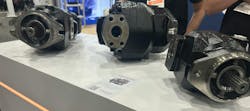
Unlike traditional axial piston pumps, Moog’s version features a floating piston design with no piston shoe. This enables a smoother running pump which generates less friction, enabling more efficient operation, beneficial for use in hybrid- and full-electric machines. In addition, the pump can spin faster which aids its ability to be paired with electric motors.
Did you attend CONEXPO this year? What technology developments and industry trends stuck out most to you? Let me know by sending me an email at [email protected] or taking the quick poll at the top of this article.
About the Author
 Sara Jensen
Sara Jensen
Executive Editor, Power & Motion
Sara Jensen is executive editor of Power & Motion, directing expanded coverage into the modern fluid power space, as well as mechatronic and smart technologies. She has over 15 years of publishing experience. Prior to Power & Motion she spent 11 years with a trade publication for engineers of heavy-duty equipment, the last 3 of which were as the editor and brand lead. Over the course of her time in the B2B industry, Sara has gained an extensive knowledge of various heavy-duty equipment industries — including construction, agriculture, mining and on-road trucks —along with the systems and market trends which impact them such as fluid power and electronic motion control technologies.
You can follow Sara and Power & Motion via the following social media handles:
X (formerly Twitter): @TechnlgyEditor and @PowerMotionTech
LinkedIn: @SaraJensen and @Power&Motion
Facebook: @PowerMotionTech