Electric Swing System Uses Energy Recovery to Optimize Fuel Use and Hydraulic Flow
Key Takeaways
- The Komatsu electric swing system demonstrates how energy recovery technology is being employed in a real machine application.
- Energy generated by the excavator’s engine can be captured and reused to power swing movements and keep the engine in an ultra-low idle state to achieve fuel savings.
- No longer needed for swing operations, hydraulic flow can be made more readily available for other machine functions like moving the boom, arm and bucket which can lead to productivity gains.

Fuel remains one of the largest costs for machine owners in the construction industry. Any opportunities to reduce fuel consumption can therefore greatly benefit a business’ overall operational costs.
Komatsu aims to do just this with the electric swing system included on its PC365LC-11 excavator introduced to the North American market in late 2025.
The electric swing system collects and stores energy generated during normal machine operation. Once enough energy is stored, the excavator’s engine can operate in an ultra-low idle state. This minimizes power draw and thus fuel consumption.
Hydraulic flow is optimized as well because the system provides energy for swing movements. Since hydraulic flow is no longer needed for swing operations, it is more readily available for work equipment, explained Daniel Prochaska, Product Specialist at Komatsu in an interview with Power & Motion.
“The optimization of hydraulic flow enhances digging cycle times, reduces work equipment lag and improves smoothness during multifunction operations to boost overall productivity,” he said.
Capturing and reusing energy generated by machine systems, including hydraulics systems, is a technique that has been discussed for years as a way to achieve fuel savings in mobile machinery applications such as construction equipment, although its use has remained somewhat limited.
However, discussions about the potential for these energy recovery technologies have picked up steam again in recent years within the fluid power and mobile equipment industries.
And Komatsu’s electric swing system offers an example of how this technology is coming to market to bring fuel savings as well as performance improvements for machine owners.
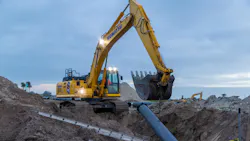
How the Komatsu Electric Swing System Captures and Reuses Energy
Komatsu first introduced its electric swing system in 2008 on its HB215LC-2 excavator. That machine featured a downsized engine compared to conventional Komatsu excavators in the same size class to meet fuel-saving requirements in the Japanese and European markets said Prochaska.
“After seeing the success of the HB215LC-2 overseas, Komatsu development teams recognized an opportunity to integrate a similar electric swing concept into the 36-ton size class to address the productivity requirements of North American contractors,” he said. “This opportunity prompted Komatsu to design the PC365LC-11, this time featuring the same size engine as conventional Komatsu 36-ton excavators with the addition of an electric swing system.”
Prochaska said the PC365LC-11's electric swing system is comprised of four major components:
- electric swing motor-generator,
- engine-mounted motor-generator,
- inverter and
- ultra-capacitor.
These components work together to collect and store energy generated by the excavator’s engine. If the PC365LC-11 has no electric power stored, when the operator first starts the engine, it automatically shifts into a high-idle state for approximately 60 seconds.
This is when the electric swing system goes into action and begins collecting energy.
“During this time, the engine-mounted motor-generator converts kinetic energy from the engine's flywheel into electrical energy, which is routed to the inverter/ultra-capacitor for storage,” explained Prochaska. “Once the ultra-capacitor is fully charged, the engine enters a unique ultra-low-idle state of 700 rpm, reducing fuel consumption.”
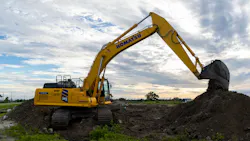
The stored energy can then be used in two ways.
“First, when the operator actuates the swing system, this energy is used to power the dedicated electric swing motor, providing quick and quiet cycle times,” he said. “As the operator comes to the end of the swing cycle, the swing motor-generator converts kinetic energy from the upper structure of the machine back into electrical energy, which is then routed to the ultra-capacitor and stored for later use.
“This system uses the concept of recycling energy through standard operation, so no external charging is required,” he added.
By eliminating the need for external charging, no additional equipment is required that could not only add costs for customers but also be difficult to have on job sites. The excavator’s energy recovery capabilities allow machine owners to achieve fuel savings but without the investment sometimes required with other technology options.
Stored Energy Provides Power Boost to Excavator Hydraulics
The second way the electric swing system’s stored energy can be used is through the “boom-up” power assist function.
When this function is actuated by a machine operator, Prochaska said the power stored in the ultra-capacitor is directed to the engine-mounted motor-generator, delivering an additional 70 electric horsepower to assist engine response from an ultra-low-idle state and promote efficient power delivery to the excavator’s work equipment — the hydraulically driven boom, arm and bucket (or other attachments) — while still achieving fuel savings.
“The electric swing system with boom-up power assist works in tandem with the conventional boom, arm and bucket hydraulic system,” he said. “The dedicated electric swing system provides quick, quiet and efficient swing cycles, while the power-assisted and optimized hydraulic system enhances work equipment performance to maximize productivity in multifunction applications.”
Currently, the PC365LC-11 is the only model in Komatsu's current excavator lineup that features an electric swing system with power assist. The company is estimating the electric swing system will provide up to a 15% increase in productivity and reduce fuel consumption by up to 20% compared to the Komatsu PC360LC(i)-11 excavator.
About the Author
 Sara Jensen
Sara Jensen
Executive Editor, Power & Motion
Sara Jensen is executive editor of Power & Motion, directing expanded coverage into the modern fluid power space, as well as mechatronic and smart technologies. She has over 15 years of publishing experience. Prior to Power & Motion she spent 11 years with a trade publication for engineers of heavy-duty equipment, the last 3 of which were as the editor and brand lead. Over the course of her time in the B2B industry, Sara has gained an extensive knowledge of various heavy-duty equipment industries — including construction, agriculture, mining and on-road trucks —along with the systems and market trends which impact them such as fluid power and electronic motion control technologies.
You can follow Sara and Power & Motion via the following social media handles:
X (formerly Twitter): @TechnlgyEditor and @PowerMotionTech
LinkedIn: @SaraJensen and @Power&Motion
Facebook: @PowerMotionTech