How Bioderived Greases are Rewriting the EAL Playbook
Key Highlights
- A new generation of bioderived overbased calcium sulphonate greases eliminate mineral oil from the thickener, enabling them to better meet biodegradability standards and reduce environmental impacts.
- These bioderived greases can significantly lower cradle-to-gate emissions by reducing reliance on energy-intensive lithium hydroxide and mineral oil extraction.
- Field trials across industries like mining, construction, marine, and rail confirm that this next-generation of bioderived greases can match or exceed the performance of conventional products.

Lithium-based thickeners account for close to 60% of global grease production. That dominance has gone largely unquestioned for decades — lithium complex greases perform well, and until recently, the environmental profile of a lubricant barely registered in procurement decisions.
The landscape looks different now. Lithium extraction is water-intensive and carbon-heavy. Even though lithium hydroxide rarely exceeds 1% of a finished grease by weight, it can drive up to 15% of the product’s cradle-to-gate emissions, depending on extraction method.
Meanwhile, regulatory frameworks like the U.S. Environmental Protection Agency’s (EPA) Vessel General Permit (VGP) and the European Union (EU) Ecolabel are pushing business operators toward use of Environmentally Acceptable Lubricants (EALs). This is especially the case in total-loss applications like mining, marine, construction and rail, where grease enters the environment during normal use and is never recovered.
Calcium sulphonate complex greases have always been strong contenders for these applications. Corrosion protection, water resistance, extreme pressure tolerance and thermal stability above 180 C (356 F) come built into the thickener chemistry rather than relying on additive packages.
But one problem has kept them out of the EAL category: commercially available overbased calcium sulphonates contain more than 50% mineral oil. That mineral oil content makes it impossible to clear the 80% biodegradability threshold required for EU Ecolabel certification, no matter what base oil the formulator uses downstream.
A new generation of bioderived overbased calcium sulphonate (OCaS) greases has solved this problem by producing the thickener entirely in an ester-based carrier oil, eliminating mineral oil from the formulation. The platform spans NLGI grades from below 000 to 2, with base oil viscosities from 32 to over 3,200 cSt, and meets EAL and EU Ecolabel criteria while delivering performance on par with conventional calcium sulphonate greases.
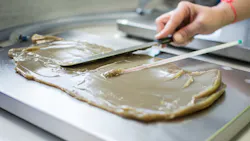
Producing Grease Thickener in Ester Overcomes Challenges with EAL Development
Every commercially available OcaS is manufactured in a mineral oil carrier. Grease producers purchase these precursors as finished raw materials and build their products from them. Even switching the remaining base oil to a biodegradable ester leaves the mineral oil from the thickener precursor embedded in the final product — and with it, goes any chance of meeting biodegradability certification requirements.
The alternative is manufacturing the OcaS from scratch in an ester medium. This is harder than it sounds. Ester base oils break down under the alkaline conditions the overbasing chemistry demands.
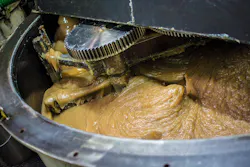
If temperature, timing or raw material ratios drift even modestly, the ester undergoes calcium saponification, destroying both the carrier oil and the thickener structure in a single failure mode.
The process used for the new generation of bioderived OCaS greases adds a pre-stage reactor upstream of conventional grease manufacturing. Alkylbenzene sulphonic acids dissolve in a bio-based ester and react with excess calcium hydroxide:
2R-SO3H + Ca(OH)2 → (R-SO3)2Ca + 2H2O
Carbon dioxide (CO2) then enters the gas-tight reactor under controlled conditions, converting excess calcium hydroxide into ultrafine calcium carbonate. This is the micelle-building step that gives calcium sulphonate greases their characteristic properties:
Ca(OH)2 + CO2 → CaCO3 + H2O
Standard grease kettles cannot handle this chemistry. The CO2 must recirculate through the mixture multiple times with near-zero loss, using purpose-built gasification equipment (see sidebar below). Two things can go wrong.
- If micelle building fails, the calcium carbonate falls out of the ester medium.
- If excess calcium hydroxide remains unconsumed, ester cleavage and calcium soap formation ruin the batch. IR spectroscopy tracks the process in real time to catch both failure modes.
Once the ester-based OcaS is produced, it transfers to a conventional grease reactor. From that point on, the process is standard batch grease production.
Inside the Reactor — How Ester-Based OCaS Production Works
Manufacturing a mineral oil-free overbased calcium sulphonate (OcaS) requires a dedicated pre-stage reactor upstream of conventional grease production equipment. The process unfolds in three phases.
Phase 1 — Neutralization. Alkylbenzene sulphonic acid dissolves in a bio-based ester and reacts with excess calcium hydroxide to form neutral calcium sulphonate and water. The resulting product has limited thickening performance on its own and must be further processed.
Phase 2 — Micelle building. Carbon dioxide (CO2) enters the gas-tight reactor under controlled pressure, converting excess calcium hydroxide into ultrafine, microcrystalline calcium carbonate. These particles — encapsulated by a stabilizing layer of calcium sulphonate — form the colloidal micellar structure that gives calcium sulphonate greases their corrosion resistance, pressure tolerance and thermal stability. The CO2 recirculates through the mixture multiple times with near-zero loss.
A visible color change — the disappearance of the initial pale appearance — indicates successful encapsulation. Separately, IR (infrared) spectroscopy tracks the consumption of excess calcium hydroxide to guard against ester cleavage. The goal is a homogeneous dispersion of calcium sulphonate, microcrystalline calcium carbonate and base oil.
Phase 3 — Thickening and finishing. The overbased calcium sulphonate transfers directly to a grease reactor, where it mixes with additional base oil (which may differ from the carrier ester used in Phases 1 and 2) and additives such as corrosion inhibitors, EP (extreme pressure) agents and antioxidants. Controlled heating, mixing and milling produce the finished grease at the target NLGI consistency.
The critical risk throughout Phases 1 and 2 is ester cleavage. The alkaline environment required for overbasing can break down the ester carrier through calcium saponification if raw material quantities, addition timing or process temperatures deviate from tight tolerances. No chemical additives can prevent this, only precise process control. A failed batch destroys both the carrier oil and the thickener structure.
Testing Shows Performance of Bioderived Grease Holds Up
Lab data from a multi-use NLGI 2 formulation (synthetic ester, 370 cSt base oil viscosity at 40C) shows the bio variant performing on par with its mineral oil-based counterpart:
Corrosion protection, thermal stability and extreme pressure capacity match or exceed the conventional product. Water washout and spray-off numbers are higher in the bio version but remain well within ranges validated by field testing.
Tested against the NLGI High-Performance Multiuse (HPM) CORE specification, the bioderived grease meets every criterion, including several by wide margins. Worked penetration change came in at 19 delta dmm against a 30 limit. Oil separation during storage measured 0.38 wt% against a 5% maximum. Four-ball weld point reached 400 kgf, well above the 250 kgf minimum.
Bioderived Grease Improves Carbon Footprint at Three Points
Product carbon footprint (PCF) analysis under ISO 14040/14044 and ISO 14067 identifies three areas where the bioderived calcium sulphonate approach produces lower emissions than mineral oil and lithium-based alternatives.
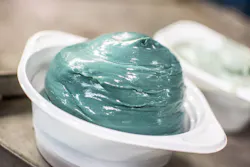
Base oils matter most. They make up more than 70% of the finished grease by mass. Mineral Group I base oils carry cradle-to-gate values of 1.0-1.7 kgCO2eq per kilogram. A bio-based RSPO-certified ester with over 95% bioderived content comes in around 0.6 kgCO2eq — 40-65% lower. As agricultural and energy practices behind bio-feedstock production continue to improve, these values have room to drop further.
CO2 becomes a raw material. The micelle-building process consumes carbon dioxide — 4-7% of the finished grease by weight. That CO2 moves from an unbound state into a chemically bound calcium carbonate structure. For PCF purposes, the raw material CO2 carries a value of 0 kgCO2eq.
Calcium beats lithium on thickener emissions. Lithium hydroxide production generates 7-15 kgCO2eq per kilogram. Calcium hydroxide, produced from widely available limestone, generates 0.9-1.2 kgCO2eq — roughly one-tenth the footprint. The calcium sulphonate production process also uses less energy overall. The overbasing reaction starts exothermically, and unlike lithium complex manufacturing, it does not require reheating above 200 C (392 F) to melt the thickener.
Field Data Shows How Bio-Based Grease Performs in Real-World Applications
Lab results prove capability, while field trials prove reliability. Bioderived calcium sulphonate greases have accumulated operating data across six application areas.
Mining
An NLGI 2 formulation ran for over 1 year in a fleet of excavators (3.5-45 tons) at an Australian open-cast mine. The machines, fitted with tiltrotors, demanded reliable lubrication under extreme desert heat.
The grease showed zero oil bleed or dripping, adhered cleanly around grease points and confirmed all HPM CORE criteria after 12 months of field service.
Marine Wire Ropes
The VGP requires EAL use at oil-to-sea interfaces in North American waters; OSPAR applies similar rules in the North-East Atlantic. An NLGI 2 grease tested on harbor crane wire rope showed no UV (ultraviolet) deterioration after 2 months.
This is notable because ester-based greases commonly harden and flake under UV exposure. The formulation has since received official approval for the lubrication system.
Construction Equipment Slewing Gears
An NLGI 0 formulation (380 cSt) ran approximately 2,500 hours on the slewing gear of a 40-ton excavator handling scrap metal. The machine routinely exceeded its rated load capacity.
After a year of operation at temperatures from -10 C to 30 C (14 to 86 F), tooth flank inspections showed no pitting or surface changes. Grease consumption ran lower than the first-fill product.
Rail Switches
Railway switch lubrication is a labor-intensive, manual process. An NLGI grade below 000 formulation (32 cSt) was field-tested over 8 months through summer and winter. Under dry conditions, the grease lasted 4 weeks on slide plates — double the 2-week interval of the comparison product.
Under heavy rain, it lasted 3-4 weeks versus 1. The labor savings from extended intervals are the primary economic benefit here.
Cement Facility Open Gears
Open gears in ball mills and rotary kilns face temperatures up to 400 C (752 F) and must not ignite on contact. An NLGI 00 formulation ran for 4 months via spray nozzle application. Tooth flanks showed no changes.
The grease appeared to over-lubricate at the same feed quantity used with the previous product, suggesting reduced dosage — and material cost savings — may be feasible.
Hydraulic Hammers Still in Development
Field tests on hammer wear bushes have not yet matched the performance of established lithium-saponified bio-greases. Initial testing showed seizures and cold welds after 50 hours.
Pumpability of the calcium sulphonate thickener in cold conditions appears to be the main obstacle. Testing continues with lower NLGI grades and reduced base oil viscosity.
Bioderived Greases Provide a Viable Path Forward for EAL
For operations subject to VGP, OSPAR or EU Ecolabel requirements, bioderived calcium sulphonate greases eliminate the performance trade-off that earlier EAL products imposed. All formulation variants are EU Ecolabel-certified or in the certification process, with ingredients listed on the Lubricant Substance Classification List (LuSC-list) and compliant with OECD biodegradability, toxicity and bio-accumulation standards.
The practical case goes beyond compliance. Doubled relubrication intervals in rail applications, lower grease consumption in slewing gear and open gear trials, and HPM-grade performance across the board point to reduced total cost of ownership.
The platform is still maturing. Hydraulic hammer formulations need more work, cold-temperature thickener behavior requires optimization for certain use cases, and supply chain PCF data is still being refined.
But across mining, marine, construction, rail and cement applications, the technology is accumulating real operating hours and confirming what the lab data predicted. If you’re evaluating a path away from mineral oil and lithium, that field record makes the conversation a practical one rather than a theoretical one.
This article was written and contributed by Ulf Gardenier, Senior Technical Director, KAJO North America.
About the Author
 Ulf Gardenier
Ulf Gardenier
Senior Technical Director, KAJO North America
Ulf Gardenier is Senior Technical Director for KAJO North America. He studied physics and business administration at the University of Aachen. Following a long stint at Siemens, he joined KAJO, a German manufacturer of lubricating greases and oils, in 2022, and now heads KAJO North America Inc. located in North Carolina.