Servo-Driven vs. Hydraulic Press Brakes: Comparing Their Capabilities and Use Cases
Key Highlights
- Hydraulic press brakes are capable of delivering high-force across long strokes, making them suitable for heavy forming applications.
- Servo-driven press brakes use a closed-loop system that monitors position and speed in real time, aiding position accuracy, repeatability, and energy efficiency.
- Force requirements, energy use, cycle speeds, maintenance and overall production needs are among the factors to consider when determining whether to use servo-driven or hydraulic press brakes.
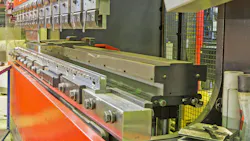
In metal fabrication, press brakes are a critical tool for bending and shaping materials. They require a high level of precision to ensure metal is formed exactly as desired.
Advancements in motion control technology over the years have helped to make press brakes more precise and easier to program.
Due to these advancements, press brakes in operation today are usually either hydraulic or servo-driven. Hydraulic press brakes use pressurized oil to drive cylinders that move the ram while servo-driven versions rely on electric motors to drive the ram through mechanical systems such as ball screws or belts.
Each technology has its pros and cons which can affect how parts are formed, repeatability, and how efficiently machines run over long production cycles.
Therefore, it is important to understand the differences between the two press brake types and how to determine which to use.
Factors to Consider When Comparing Servo-Driven and Hydraulic Press Brakes
The comparison between servo-driven and hydraulic press brakes often comes down to how each system generates force and controls movement under load. But there are several other factors to consider as well.
Motion Control and Force Requirements
Hydraulic press brakes have been the standard for decades because of their ability to deliver high force across long strokes. For thick materials or large components, hydraulic systems remain the practical choice.
The ability to apply consistent tonnage makes them suitable for heavy forming applications where force requirements vary throughout the bend.
Servo-driven press brakes control motion through a closed-loop system that monitors position and speed in real time. Instead of relying on fluid pressure, the machine follows programmed motion paths defined by the operator.
This difference affects how each system behaves during a bend as hydraulic machines depend on pressure stability, while servo systems follow a defined position curve with direct feedback.
Servo-driven press brakes are generally used for lighter to mid-range applications. They perform well with thinner materials and parts that require precise bends. While motor capacity continues to improve, hydraulic machines still handle the highest force requirements.
This distinction guides equipment selection. Shops working with a wide range of material thickness often operate both systems, assigning jobs based on force and accuracy needs.
Position Accuracy and Repeatability
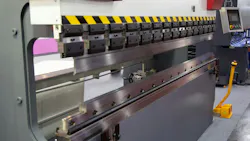
In applications where tolerances are tight, servo-driven systems offer a measurable advantage. The motor-driven architecture allows precise control over ram position at every stage of the bend cycle. Approach speed, bending speed, dwell time and return can all be programmed with exact values.
This level of control reduces variation between parts. Once a program is set, the machine repeats the same motion without relying on pressure adjustments or compensation for oil temperature. For shops running high-mix production, this helps to reduce setup time and lower scrap rates.
Hydraulic press brakes can achieve good accuracy, especially with modern CNC controls. However, fluid-based systems are affected by factors such as oil temperature, seal wear and pressure. These variables require periodic adjustment, particularly in long production runs.
Energy Use and Operating Conditions
Hydraulic systems typically run pumps continuously to maintain pressure. Even when the machine is idle, energy is being used to keep the system ready for operation. This leads to higher overall power consumption and heat buildup. Cooling systems are often required to keep oil temperatures within range.
Servo-driven press brakes use power only when the motor is moving. When the ram is not in motion, energy use drops significantly. This reduces electricity consumption and limits heat generation. Shops also benefit from lower noise levels since there are no constantly running pumps.
These differences directly affect operating cost. Facilities running multiple machines or long shifts may see a larger impact from energy efficiency. In addition, reduced heat output can improve working conditions on the shop floor, while lower power demand may ease strain on facility electrical systems and support more predictable operating budgets.
Maintenance and System Complexity
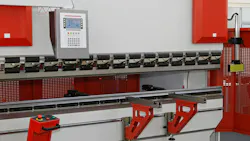
Hydraulic machines require ongoing maintenance related to fluid systems. Oil levels, seals, valves and hoses must be checked regularly. Leaks and contamination can affect performance and lead to downtime if not addressed.
Servo-driven machines remove the hydraulic circuit entirely as there is no oil to replace as well as fewer wear components related to fluid movement. Maintenance shifts toward electrical components, drive systems and control software.
While this reduces routine servicing, it introduces a different type of technical requirement. Diagnosing electrical or control issues may require specialized knowledge. For many shops, this means relying on trained technicians or manufacturer support.
Cycle Speed and Production Flow
Servo-driven machines respond quickly because electric motors can accelerate and stop without delay from fluid movement. This improves cycle time, particularly in jobs with frequent repositioning or short stroke lengths.
Hydraulic systems depend on fluid flow and pressure changes, which can limit response speed. For longer bends or high-force applications, this difference may not affect throughput significantly. In shorter, repetitive cycles, servo systems can complete more bends in the same time period.
Faster response also supports automated workflows. Servo-driven press brakes integrate more easily with digital controls and production tracking systems, allowing better coordination with upstream and downstream processes.
Understanding Production Requirements Key to Choosing the Right Press Brake Technology
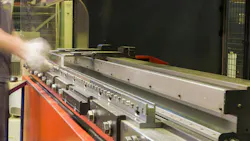
The choice between servo-driven and hydraulic press brakes truly depends on the type of work being performed. Shops focused on precision sheet metal components, short runs or frequent job changes benefit from the control and efficiency of servo systems.
Operations handling heavy materials or large structural parts continue to rely on hydraulic machines.
In many cases, both technologies are used within the same facility. This allows fabrication teams to assign work based on material thickness, tolerance requirements and production volume. Matching the machine to the job improves overall efficiency without compromising part quality.
Production planning also plays a role in this decision. Shops that manage a mix of prototypes and high-volume orders often gain flexibility by distributing workloads across both systems. This approach helps maintain throughput, reduce bottlenecks and keep equipment utilization balanced across the operation.
Press brake performance is increasingly tied to how motion is controlled rather than how force is generated. Servo-driven systems provide direct control over position and speed, reducing variation and simplifying setup while hydraulic systems continue to deliver the force required for demanding applications.
As motion control technology advances, fabrication teams are placing more emphasis on repeatability, energy use and integration with digital systems. These factors influence not only equipment selection but also long-term production strategy.
In today’s metal fabrication environments, the ability to control motion precisely has become as important as the ability to generate force, necessitating an understanding of when to use a servo-driven or hydraulic press brake.
This article was written and contributed by Brent Anderson, Vice President of Sales at Capital Machine Technologies.
About the Author
Brent Anderson
Vice President of Sales at Capital Machine Technologies
Brent Anderson is the Vice President of Sales at Capital Machine Technologies, a company that provides advanced fabrication equipment, robotic welding systems, and automation solutions for manufacturers. With decades of experience in manufacturing technology, Anderson helps customers identify high-impact automation opportunities and evaluate return on investment before implementation. He is a trusted advisor to fabrication leaders seeking to improve productivity, efficiency, and long-term competitiveness through robotic welding and automation.