Pneumatic Actuators for Industrial Conveyor Systems
What You'll Learn
- The ways pneumatic actuators are commonly used in industrial conveyor systems.
- Types of pneumatic actuators and the conveyor system applications for which they are best suited.
- How retrofitting a pneumatic rotary actuator into a conveyor system helped achieve performance and cost benefits.

At a time when artificial intelligence (AI) and other advancements in technology are leading to the consistent development of new manufacturing systems and processes, various research studies indicate that one of the categories of equipment experiencing notable growth in the industrial manufacturing category dates back more than 125 years: conveyor systems.
Factory automation, continued growth in e-commerce and other factors are contributing to the rising use of conveyor systems because they ensure the safe, efficient, accurate, and timely movement of parts, products, and goods throughout a facility.
And an essential component within these conveyor systems are the pneumatic actuators enabling them to automate various tasks — such as sorting, diverting, inspection and testing, packaging and more.
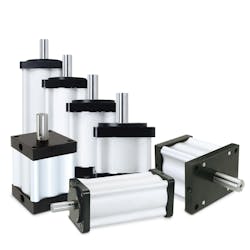
Linear and rotary pneumatic actuators facilitate the precise control and movement of objects as they move through a conveyor system. The task an actuator performs is typically dictated by vision systems, proximity sensors, scales, and other devices on conveyor systems used to help make decisions about actions to take.
Typical uses and applications for actuators within a conveyor system include diverter gates, conveyor stops, product stops, roll conveyors, modular deck conveyors, product gapping and spacing, overhead pushers, indexing/rotate stations, tensioners, and pick and place.
Types of Pneumatic Actuators Used in Conveyor Systems
Just like there are different types of conveyors for specific application purposes, there are different types of pneumatic actuators utilized in conveyor systems. These can include air cylinders, grippers, slides, stopper cylinders, and rotary actuators.
Pneumatic actuators use compressed air to convert energy into linear or rotary motion. With a simplistic structure comprised of a cylindrical housing, piston, and piston rod, air cylinders are simple to install, use, and maintain.
The compressed air is directed into the cylinder, causing the piston to move, thus creating linear motion. This motion is utilized in various tasks, including clamping, lifting, sorting, spacing, and pushing of objects. Their robust construction enables pneumatic actuators to withstand harsh operating conditions, ensure long-lasting performance, and reduce the need for maintenance.
Air springs are a type of pneumatic actuator which can provide linear or angular motion. With a favorable stroke-to-compressed-height ratio, air springs can operate within small spaces and reduce vibration at low input frequencies.
Rotary vane actuators are another pneumatic actuator type often used in conveyor systems. These mechanical devices produce rotary motion when pressure is applied to the vane. Commonly used in applications that require diverting, tucking, swing stops, valves, or other components to be rotated, rotary actuators are known for their high torque output, precise repeatability, small powerful design, and ability to handle heavy loads.
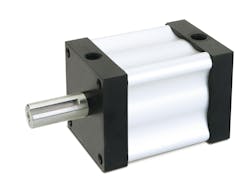
The basic structure of a vane actuator includes a secure housing that encapsulates the rotor with internal stop vanes and an output shaft. The rotor is strategically placed within the housing and connected to the output shaft, which then imparts the rotary motion to the desired mechanism.
When the vane and rotor assembly is comprised of a single moving part, a rotary vane actuator provides 100% repeatability, delivers a long cycle life of 25 million+, and delivers greater reliability by preventing lost motion. A single moving rotor allows for shaft attachment material options, along with a wide assortment of shaft connection configurations.
Application Example: Pneumatic Rotary Actuator Improves Conveyor System Performance
When a manufacturer of conveyor systems needed a pneumatic rotary device that could open and close its metal detection gates quickly for scrap product removal while also withstanding high-pressure wash down conditions, it turned to Compact Automation Products (Compact), a developer of pneumatic and hydraulic actuation technologies.
Compact provided its Turn-Act rotary actuators with an extended shaft and a special food service coating. The unit effectively replaced four clevis style cylinders, valves, fittings, and tubing that were being used in the previous system.
The Turn-Act rotary actuators were able to increase the gate speed on the conveyor system, providing the customer with faster throughput. In addition, the rotary actuators improved service life by millions of cycles versus the thousands provided by linear cylinders that were previously utilized — leading to reduced maintenance and thus cost savings for the manufacturer.
This article was written and contributed by Joe Amshoff, Strategic Account Manager, Compact Automation Products.
About the Author
Joe Amshoff
Strategic Account Manager, Compact Automation Products
Joe Amshoff is a Strategic Account Manager at Compact Automation Products, a developer of linear actuator solutions including industry standard and custom pneumatic cylinders, hydraulic cylinders and accessories.