Hydrostatic Bearings and Precision Machining Aid Performance of World’s Largest Telescope
Key Highlights
- Building the Giant Magellan Telescope requires use of components and manufacturing techniques offering a high level of reliability and precision to ensure the telescope will perform as desired.
- Hydrostatic bearings provide ultra-low friction to minimize heat buildup and wear as well as the stiffness necessary to accurately point the telescope at celestial targets.
- Tight machining tolerances used during the manufacture and assembly of the telescope mount will aid its ability to provide smooth and controlled movements.
An international consortium of 16 universities and research institutions is in the process of building the Giant Magellan Telescope, considered to be the largest Gregorian optical infrared telescope ever engineered. Up to 200 times more powerful than existing telescopes, it will enable scientists around the world to see farther into space than ever before.
Production for many parts of the telescope is underway, including its mount which utilizes hydrostatic bearings for accurate and frictionless movement. Precision machining of the mount and its components will help ensure the Giant Magellan Telescope is able to move with the smoothness and accuracy of a laboratory instrument.
Why Hydrostatic Bearings Were Chosen for the Giant Magellan Telescope
Two hydrostatic bearings are incorporated into the telescope structure to support the azimuth (vertical) and elevation (horizontal) axes explained Keath Beifus, Senior Mechanical Engineer, Telescope Structures, Giant Magellan Telescope, during a virtual event discussing progress of the telescope project.
Hydrostatic vs. Hydrodynamic Bearing
Bearings are commonly categorized as hydrostatic or hydrodynamic.
Hydrostatic bearings generate lubricant film pressure between moving surfaces through an external source whereas hydrodynamic bearings which create the film pressure via relative motion of the moving surfaces and their geometry.
He said the bearings operate by pumping hydraulic oil between an array of hydrostatic pads and a high precision bearing raceway.
These hydrostatic bearings allow the massive telescope mount to float on a 50-micron thick film of oil, about the thickness of human hair. “That thin film removes friction and reduces vibration, which is critical when you're observing objects billions of light years away,” said Jeff Kimberly, President and CEO of Ingersoll Machine Tools — which is manufacturing the telescope mount — during the event.
Beifus said the hydrostatic bearings’ ability to provide ultra-low friction was among the reasons this technology was chosen for the Giant Magellan Telescope. “A constant, precisely controlled oil film separates the bearing pads from the raceway, resulting in ultra-low static and dynamic friction.”

The less friction created, the better because it can lead to heat buildup and wear, both of which could negatively impact performance of the telescope and lead to maintenance issues. Given the large size of the telescope and its components, there are not likely to be off-the-shelf replacement parts at the ready should an issue occur. Therefore, it is critical to utilize technologies designed for reliability so potential downtime can be minimized as much as possible.
High stiffness — a bearing’s ability to maintain its shape while supporting a load — was another reason Beifus said hydrostatic bearings were chosen for the telescope. “The hydrostatic bearings provide excellent stiffness, both statically and dynamically, which enables extremely accurate pointing and stable tracking of celestial targets under normal operating conditions.”
The final reason he noted for choosing hydrostatic bearings was the fact they could be integrated with an earthquake damping system. “The same hydraulic system that provides oil to the bearings is also used to mitigate seismic damage to the telescope,” said Beifus. “This system provides vertical isolation and damping to the rotating telescope structure.”
The complete telescope mount, including its use of the hydrostatic bearings, was designed by OHB Digital Connect GmbH.
Scroll through the media gallery above to see more images of the telescope, hydraulic components used in the telescope mount and manufacturing of the mount.
High Level of Precision Required to Manufacture the World’s Largest Telescope
Ingersoll Machine Tools, part of Camozzi Group, is producing the mount that will support and move the Giant Magellan Telescope’s seven primary mirrors, instruments and control systems at its facility in Rockford, IL. The company was chosen for the project due in part to its years of experience in building large structures and machines including submarines, spacecraft and satellite structures.
Kimberly said the Giant Magellan Telescope project “has grown into one of the most ambitious engineering and machining projects we've ever undertaken.” He said the mount stands 39 m tall and weighs 2,600 tons.
“The telescope is so large that we had to build a new 40,000 sq. ft. manufacturing and assembly bay, including a giant pit just to machine and assemble it,” said Kimberly.

The Ingersoll Machine Tools facility also has the largest five axis master mill gantry machine in North America. It is currently being used to set up the first three semi-finished azimuth tracks that will be finish machined with key features including the hydrostatic guideways. The azimuth track enables a full 360-degree rotation on the x-axis and 25 to 165 degrees on the y-axis.
“Each of these enormous tracks weigh over 50,000 lbs. and presents a challenge at every step of the manufacturing process,” said Kimberly. “The fabrications themselves had to be flat within 13 mm from end to end; that's just over a half inch.
“When machining the azimuth tracks, we’ll be holding a flatness to within two thousandths of an inch in the zone where the hydrostatic pads ride, and within 12 thousandths of an inch over the entire 70 ft. diameter when the tracks are assembled.”
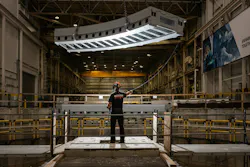
A large bearing assembly machine from In-Place Machining will then be used to finish the radial and hydrostatic guideway surface. It is an arm assembly with a turning head and a grinding head that make it possible to complete this work on the assembly floor, something Kimberly said he has never seen done before.
Ingersoll Machine Tools will also install the large earthquake damping system, which will act like a giant shock absorber to protect the telescope from damage should an earthquake occur, and the large hydrostatic bearings.
“Before this project is over, we will have assembled and tested the entire mount here in Rockford, IL, before it is disassembled and shipped to Chile,” said Kimberly.
He said the company will soon be focusing on the final phase of the project which includes building:
- the large C-ring elevation axis structure that allows the telescope to tilt up and down,
- the huge Gregorian instrument rotator where all the scientific instrumentation will be located,
- the massive primary mirror cell structures, and
- the tall secondary mirror structures.
“This undertaking requires an incredibly skilled team…and key contributors across the U.S. supply chain, along with other partners across the country whose craftsmanship and discipline make this possible,” he concluded. “This is the one of the most extraordinary engineering projects in the world, and we are so honored to be a part of it.”
Watch the video below to see illustrations of the Giant Magellan Telescope and some of the manufacturing underway for it.
Visit the Giant Magellan Telescope website for more information on the telescope.
About the Author
 Sara Jensen
Sara Jensen
Executive Editor, Power & Motion
Sara Jensen is executive editor of Power & Motion, directing expanded coverage into the modern fluid power space, as well as mechatronic and smart technologies. She has over 15 years of publishing experience. Prior to Power & Motion she spent 11 years with a trade publication for engineers of heavy-duty equipment, the last 3 of which were as the editor and brand lead. Over the course of her time in the B2B industry, Sara has gained an extensive knowledge of various heavy-duty equipment industries — including construction, agriculture, mining and on-road trucks —along with the systems and market trends which impact them such as fluid power and electronic motion control technologies.
You can follow Sara and Power & Motion via the following social media handles:
X (formerly Twitter): @TechnlgyEditor and @PowerMotionTech
LinkedIn: @SaraJensen and @Power&Motion
Facebook: @PowerMotionTech