Compact, Efficient and Intelligent Hydraulics Desired for Construction Equipment
Key Highlights
- Hydraulics used in construction equipment are evolving to become more efficient and intelligent.
- Further advancements in areas such as efficiency, integration of sensors and software, and power density are desired from the hydraulics industry to enhance machine capabilities.
- OEMs see continued advancements in hydraulics enabling more predictive maintenance, improved machine control as well as improved packaging and system integration.
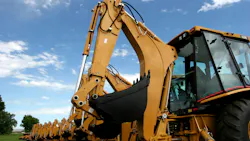
Excavators, telehandlers, wheel loaders and a range of other construction equipment rely on hydraulics to perform a number of machine functions. The hydraulic components and systems in these machines continue to evolve to meet requirements for increased productivity, ease of maintenance and more.
At the same time, there are still many areas in which equipment manufacturers would like to see further developments such as sensor integration, efficiency improvements, and power density.
Power & Motion spoke with representatives from three original equipment manufacturers (OEM) which develop various types of construction machinery to learn what they are looking for in hydraulic components and systems:
- Matt Kaldor, PE, Director of Engineering – Global Hydraulic Systems, Bobcat
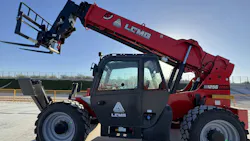
- Zhaoliang Zhang, Vice Director of Technology Research and Development Department, Lingong Heavy Machinery Col, Ltd. (LGMG)
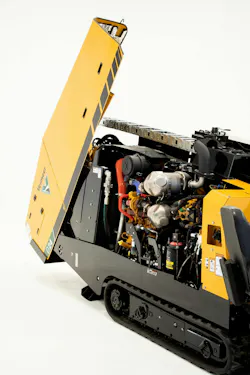
- Clint Recker, Product Manager for Horizontal Directional Drilling, Vermeer
Each provided their perspectives on the capabilities they look for, the challenges they face when integrating hydraulics into their machine designs as well as how they see hydraulics for construction equipment continuing to evolve in the years ahead.
*Editor’s Note: Questions and responses have been edited for clarity.
Power & Motion: How have you seen hydraulic systems utilized in construction equipment evolve in the past 3-5 years?
Matt Kaldor: The transition from mechanical or pilot-controlled hydraulics systems to electro-hydraulic has been happening for quite some time and it has expanded into smaller class machines and become a significant share of the market in larger machines. As customers see the benefits of the electro-hydraulic control responsiveness, combined with reduced lever efforts and ease of operation, the widespread acceptance of electro-hydraulics systems is not surprising.
Electro-hydraulic systems also demand a high level of integration between the hydraulic hardware and software. Electro-hydraulic controls also provide the potential to offer operators software customized control solutions that meet their specific preferences, which is not possible with traditional mechanical or pilot-controlled systems.
As the market moves toward more electro-hydraulic systems, we've also seen these systems become more cost competitive with traditional mechanical or pilot-controlled systems.
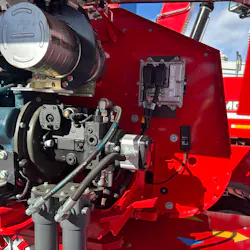
Zhaoliang Zhang: Over the past few years, hydraulic systems have evolved from simple power execution units into highly integrated electro-hydraulic, energy-efficient, intelligent, and digital systems. Control has shifted from traditional gear pumps and on-off valves to load-sensing, electro-proportional, and digital control, delivering smoother motion and higher precision. Energy-saving technologies are now widely adopted. In many applications, overall machine energy consumption can be reduced by approximately 15–20%.
Electrically driven hydraulic pumps are increasingly replacing engine-driven systems, especially in electric equipment. At the same time, reliability and real-time monitoring have significantly improved, transforming hydraulics from a “black box” into a diagnosable system.
Power & Motion: What features or capabilities are you looking for from a hydraulics component or system that will be integrated into a machine?
Matt Kaldor: As machines move to more semi-autonomous and autonomous operations, consistent, repeatable component and system performance becomes key to developing robust autonomy solutions. There is also the ongoing challenge of extracting every bit of power available to perform work.
With the maturity of hydraulic components, much of this comes down to developing system architectures optimized for efficiency in specific high power consumption duty cycles, as well as leveraging electro-hydraulic controls and software to tailor hydraulic response based on operator preference and application. This flexibility helps improve overall operating efficiency and enables operators, particularly those with less experience, to become productive more quickly.
Zhaoliang Zhang: We prioritize high efficiency, precise control, long service life, and strong reliability. In addition, compact structure, low noise, zero leakage, strong contamination resistance, and intelligent adaptability are critical factors. In the North American market, stability at height and controllability under varying load conditions are especially critical for boom applications.
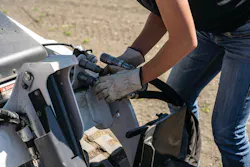
Power & Motion: Are there any features or capabilities you want hydraulics to provide but are not yet available?
Matt Kaldor: The substantial leap forward here would be a significant step-change improvement in component efficiency. Component maturity has led to little headway around significant component efficiency improvements. Higher efficiency has benefits to machine cooling, engine power needs, and fuel consumption.
Zhaoliang Zhang: We aim to achieve lifetime zero leakage, self-diagnosis and self-compensation capabilities, and more widely adopted highly integrated electro-hydraulic modules. We see continued opportunity for improvement in response and stability under heavy shock loads and sudden high-flow demands.
Power & Motion: What, if any, features or capabilities do you hope to see the hydraulics industry bring to the market in the coming years?
Matt Kaldor: Robust component condition monitoring and prognostics. Being able to predict component failures before they occur so customers can address potential downtime in a scheduled manner before they become machine-down issues interrupting the customer’s ability to work.
Zhaoliang Zhang: We expect plug-and-play integrated electro-hydraulic drive units and full lifecycle digital management. Higher power density and stronger self-optimization capabilities will reduce commissioning efforts and enhance overall machine performance. In addition, plug-and-play modularity will also help accelerate product development cycles.
Clint Recker: Having sensor components built into pumps and motors, that would be an area where we could see some integration [work undertaken by the hydraulics industry] so that we don’t have to put in a valve block or additional fittings or sensors.
We’ve done some of this integration work. Some of our sensors we’ve started to integrate into hydraulic components, such as thrust encoders in radial piston motors. We worked with the component manufacturers to integrate those sensors and find that it just creates a more durable component and better experience for the customer.
Power & Motion: Are there instances in which you are replacing, or considering replacing, hydraulics with an electric or other alternative technology option? If so, when and why might it make sense to replace hydraulics?
Matt Kaldor: We are always evaluating a range of technology options, including electric solutions, and how they can complement hydraulics where it makes sense. Our focus is on maximizing operator efficiency and helping customers save time and money, so decisions around integrating additional technologies are driven by application requirements, system performance, and overall productivity. Hydraulics continue to play a critical role, particularly where power density and robustness are required, while alternative technologies can add value in specific use cases.
Zhaoliang Zhang: The future is coexistence, not replacement. Pure electric actuators are ideal for high-precision and clean environments. However, in heavy-load and high-impact applications, hydraulics remain highly advantageous and often the most practical solution. The slight compressibility of hydraulic oil provides superior shock absorption, which electric systems cannot easily match. We think the most promising direction is electro-hydraulic integration, where digital intelligence enhances hydraulic power density.
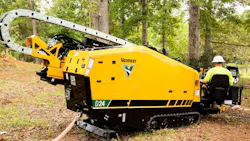
Clint Recker: We have done work around this; Vermeer has a machine built at the Netherlands facility that has electric motors for the thrust and the rotation that replace [some hydraulic] components, and we are selling that in Europe. But it's not replacing the demand from a hydraulic aspect. [Electric options are] something we’re interested in, but the availability and price of components need to evolve and become more competitive to hydraulics for us to seriously consider.
Today, electric components cost more. The majority of our customers are not going to get paid more if it's a hybrid or electric [machine]. So, trying to sell a machine that costs more [is] not a good value proposition for our customers.
We have seen [in the market] more development on the electric motor side, and some electric actuators replacing hydraulic cylinders. Speed is really important for our machines. Even our electric drill built in the Netherlands, it's still hydraulic cylinders that are doing the raising, moving and clamping because that's not an area that we see a similar amount of capability [from electric actuators].
Power & Motion: What challenges do you face when working with or specifying hydraulics, and what could be done to address these challenges?
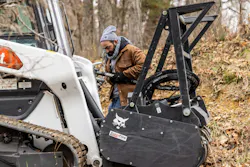
Matt Kaldor: In compact construction equipment, space on the machine is at a premium so developing a hydraulic cooling system that meets temperature and viscosity requirements of the various hydraulic components can be a challenge. Construction equipment operates at both ends of the temperature spectrum and components that have been validated for use in broader temperature ranges provide flexibility in application.
Zhaoliang Zhang: Key challenges include system matching complexity, energy efficiency optimization under fluctuating loads, and reliability in extreme environments. Solutions involve joint development with suppliers, standardized modular design, and online monitoring for predictive maintenance. Close collaboration between our North American R&D team and global suppliers is essential to address these challenges.
Clint Recker: Packaging and port locations [is one challenge]. We're trying to orient components exactly, so sometimes having multiple choices for case ports is beneficial to us, depending on how we want to orient it. Also, the size of the case ports. Usually, we're putting in a bigger fitting and hose than the size of the case port. Case pressure is always something that we're paying a lot of attention to and trying to mitigate that to make sure we respect the manufacturer's recommendations for it.
Heat is another. If there are things that can be done to make the hydraulic components more efficient, that's heat that we don't have to reject and horsepower that goes into work instead.
Power & Motion: How do you see the use of hydraulics in construction equipment evolving in the next 5 years?
Matt Kaldor: The power density of hydraulics makes it a difficult technology to replace in the near term. I see electro-hydraulic controls continuing to increase in utilization over mechanical and pilot-controlled systems for the reasons noted previously. Software development will go hand in hand with hydraulic system and component development as some of the biggest improvements in the hydraulic systems may come in how the systems and components are controlled via software.
Zhaoliang Zhang: In the next 5 years, electro-hydraulic integration will become mainstream. Intelligent adaptive control and low-carbon efficiency will be standard requirements. Systems will become more integrated and modular, enabling predictive maintenance. Through deep integration with electrification and digitalization, hydraulics will become smarter and more reliable, continuing to serve as the core power of construction equipment.
Clint Recker: As you look at the progression of hydraulics, the power density has increased. And that's certainly something that we would be interested in [seeing more development]. Today, our hydraulic circuits are 6,000 PSI. Are we going to see higher pressures beyond that? Because if we could see higher pressures that could operate reliably, then the components don't need to be quite as big.
[Many Vermeer machines are] compact, so we’re putting a lot of work into the packaging of the machine. The size of the hydraulic components, for instance the hydraulic motors, dictate how wide the carriage is; the size of the hydraulic pumps dictate how much space claim we need in the engine bay. Trying to fit all the valves, hoses and integrate all those pieces together [can be challenging].
About the Author
 Sara Jensen
Sara Jensen
Executive Editor, Power & Motion
Sara Jensen is executive editor of Power & Motion, directing expanded coverage into the modern fluid power space, as well as mechatronic and smart technologies. She has over 15 years of publishing experience. Prior to Power & Motion she spent 11 years with a trade publication for engineers of heavy-duty equipment, the last 3 of which were as the editor and brand lead. Over the course of her time in the B2B industry, Sara has gained an extensive knowledge of various heavy-duty equipment industries — including construction, agriculture, mining and on-road trucks —along with the systems and market trends which impact them such as fluid power and electronic motion control technologies.
You can follow Sara and Power & Motion via the following social media handles:
X (formerly Twitter): @TechnlgyEditor and @PowerMotionTech
LinkedIn: @SaraJensen and @Power&Motion
Facebook: @PowerMotionTech