The Trends Shaping Fluid Power Designs for Mobile Applications
Key Highlights
- Vehicles and machines are becoming more automated, necessitating use of fluid power systems with onboard electronics and improved control capabilities.
- Integration of sensors into hydraulics and pneumatics continues to grow to meet requirements for safety, automation, precision and more.
- Electrification remains an important design trend that is more commonly coming to fruition through hybrid systems pairing electric and fluid power technologies to achieve efficiency gains and other benefits.
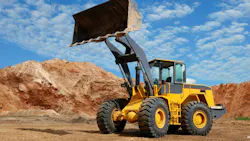
Mobile applications such as construction equipment, agricultural machinery, forklifts and other material handling vehicles rely on fluid power technologies for a range of functions. As these machines continue to evolve, new design needs are being placed on the hydraulics and pneumatics used in them to meet OEM and customer requirements.
To help get a sense of the technology and development trends currently having the most impact on fluid power designs for mobile applications, Power & Motion spoke with members of the fluid power industry and surveyed its audience for their insights.
Automation and Precision Key Development Areas of Focus for Fluid Power Industry
The majority of respondents to Power & Motion’s survey noted automation as the broad industry trend they see having the largest influence on hydraulics and pneumatics used in mobile applications.
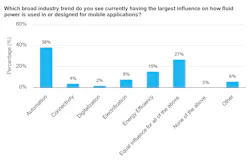
Original equipment manufacturers (OEM) continue to add more automated functions to their machines. This helps improve ease of use for operators, an increasingly important factor as construction and other industries face a skilled labor shortage. Automation can also ensure tasks are performed accurately, reducing rework to help maintain productivity and efficiency for an operation.
For many, the ultimate goal is to reach fully autonomous operation. While some concepts and use cases exist — such as in the mining industry — the number of fully automated machines in the market remain limited.
In the meantime, the subfunctions of machines are becoming increasingly more automated, said Denis Greder, Group Marketing Director at Poclain Hydraulics. He noted steering, braking and tractor implement management as examples. Automating these subfunctions requires integration of electronics, including sensors, within machines and their fluid power systems.
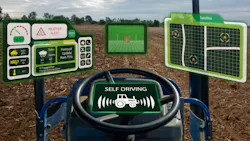
Dave Ruxton, Application Engineering Manager at HydraForce, told Power & Motion he sees automation of machine functions as a good use case for artificial intelligence (AI). When using a skid steer, excavator or other type of machine “there’s a lot of [tasks] you do repeatedly,” he said. “That’s something where I think AI [can be used by] having it manage some of those skilled tasks that are done over and over, start to automate functions and correct operator deficiencies.”
This is prompting HydraForce to add better telematics to some of its controllers so they can sense what is going on. “For any of that control work, you need to have really good feedback on your system,” said Ruxton. “You need to know exactly what your boom and bucket are doing, for instance; you need to know what angle they’re set at.”
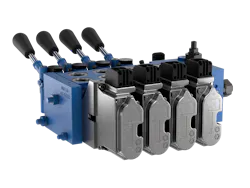
To do so, it is important to have a full sensor suite onboard and the ability to gather data through telematics or other means. On the hydraulics and pneumatics side of things, he said it is necessary to have very tight control on all of the valving.
“You need to have next to no hysteresis [and] good linearity,” said Ruxton. “Computers expect to be able to drive something that’s linear and predictable.”
This can be achieved through use of hydraulic valves with onboard electronics as well as integration of pressure sensors and flow meters. He noted right sizing components for a given function can also help improve control and overall system packaging.
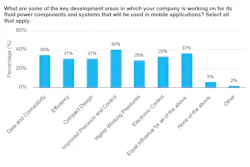
Respondents to Power & Motion’s survey indicated improved precision and control is a top technology development area for them as well. This was closely followed by data and connectivity, and electronic control, all of which is necessary to aid further automation.
Sensor Integration Continues to Grow Within Hydraulics and Pneumatics
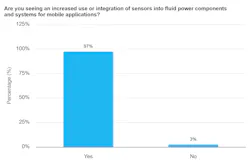
With automation, precision, and data noted as such important development areas for mobile applications by survey respondents, it is not surprising the overwhelming majority, 97%, also indicated that use of sensors is increasing.
Sensors are critical for enabling all of these capabilities, among many others, because of the varied types of data they can collect and transmit. As such, they can increasingly be found in components, systems and machines — including hydraulics and pneumatics.
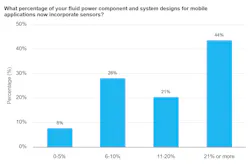
This growth is evident from our survey results with 44% of respondents saying that 21% or more of their fluid power component and system designs for mobile applications now incorporate sensors.
Greder agreed that demand for all types of sensors is increasing in many mobile markets, including:
- speed,
- acceleration,
- position,
- angular,
- temperature, and obstacle detection such as radar and ultrasonic sensors.
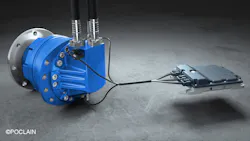
He said Poclain is receiving more request from customers for sensors to be included on motors, pumps and valves for various reasons such as safety. “It’s all linked to the electronification of the machine. Machines have more ECUs (electronic control units) to control the travel drive, for instance, and they need to be fed [information] with sensors for performance accuracy.”
Sensors are also necessary to ensure safety and protection of the machine, he continued. Inclusion of temperature sensors can help with this by making sure the machine is not overheating or overpowered.
“Speed sensors are increasingly included in [Poclain’s motors for] the detection of direction of travel, as a safety requirement to provide redundancy information to the vehicle ECU,” said Greder. “Requests for higher speed sensor resolution are also becoming more common due to the need for more position accuracy.”
Emiliano Torresi, Product Management and Marketing Director at Faster, told Power & Motion that sensor integration has progressed significantly in recent years and is becoming essential. “We strongly believe that sensorization is one of the most effective ways to address reliability, maintenance, and environmental challenges,” said Torresi.
Because of this, he said the company continues to invest heavily in sensor technologies for fluid condition monitoring, connection status detection and predictive maintenance capabilities.
Electrification Remains an Important Design Consideration
Power & Motion’s survey shows electrification remains an influential design trend for many mobile applications as well, with most respondents indicating it is having at least some level of impact on their design or use of fluid power technologies.
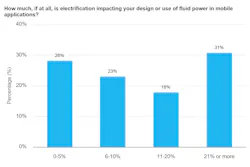
While many companies we have spoken to in recent months — including at this year’s major construction industry event CONEXPO-CON/AGG — have noted a slowdown in the electrification space, especially for full-electric options, they are still seeing requests for electrification solutions.
In many cases, fluid power and electric technologies are coming together to create hybrid systems that enable the benefits of electrification such as efficiency gains to be achieved.
As Torresi noted, the most realistic scenario the company sees in the mobile market is hybrid architectures where propulsion is increasingly electrified and work functions remain largely electro-hydraulic.
“Hydraulics still provide the best power density and performance for many applications, especially for demanding attachments,” he said.
From Greder’s perspective, electrification in its various forms is prompting many OEMs to use electronic control for pumps that otherwise used manual or hydraulic controls. There is also increased use of high-efficiency components like radial piston cam lobe motors to ensure efficient operation which is key to prolonging battery run times between charges as well as enabling use of smaller batteries in many cases.
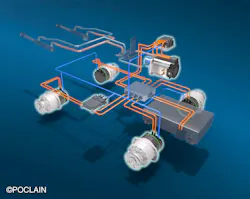
He offered Poclain’s gear auto-shift as an example of a technology that can provide the efficiency desired in electric machines. It allows the flow in a system to be minimized and working pressures to be increased which he said boosts efficiency and keeps machines running for longer hours without the need to use a larger, more expensive battery.
HydraForce’s Ruxton noted that with electrification there is the potential for some hydraulic circuits to be used for energy recovery. For example, in a forklift there is a lot of energy wasted during lifting and lowering operations. But if you can create a circuit that saves that energy and stores it in an accumulator for use at a later time or uses it to spin a generator, that could be desirable for ensuring efficient energy use.
In general, Greder and many others in the fluid power industry still see electrification as an important design trend that, along with other trends and industry requirements, will continue to bring opportunities for the fluid power industry.
The overwhelming majority of respondents to Power & Motion’s survey, 92%, said they still see opportunities to further advance the capabilities of hydraulics and pneumatics for mobile applications.
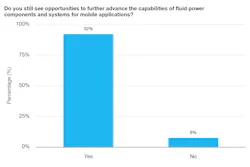
Those Greder foresees include more integration of electronics and automation of functions, while Torresi anticipates use of sensors to become a standard requirement to enable real-time monitoring, predictive maintenance and improved safety and sustainability.
For Ruxton, he expects a continued focus on rightsizing components to aid with efforts to improve control and system packaging. The latter is particularly important as machines become more space constrained due to all of the technology being put onto them.
This may include the addition of new cartridge valve sizes in the future or moving low-flow functions to a separate pump. Using a small gear pump to handle these low-flow functions and a larger pump for the higher flow machine functions can help minimize energy use.
While the technological opportunities for fluid power vary widely, the goal for all of them is the same — providing OEMs and their customers with the features and capabilities they require to get their work done in as safe, productive and efficient a manner as possible.
About the Author
 Sara Jensen
Sara Jensen
Executive Editor, Power & Motion
Sara Jensen is executive editor of Power & Motion, directing expanded coverage into the modern fluid power space, as well as mechatronic and smart technologies. She has over 15 years of publishing experience. Prior to Power & Motion she spent 11 years with a trade publication for engineers of heavy-duty equipment, the last 3 of which were as the editor and brand lead. Over the course of her time in the B2B industry, Sara has gained an extensive knowledge of various heavy-duty equipment industries — including construction, agriculture, mining and on-road trucks —along with the systems and market trends which impact them such as fluid power and electronic motion control technologies.
You can follow Sara and Power & Motion via the following social media handles:
X (formerly Twitter): @TechnlgyEditor and @PowerMotionTech
LinkedIn: @SaraJensen and @Power&Motion
Facebook: @PowerMotionTech